Restaurant · Best of · ranked Updated September 2026
Best Hourly Hiring Software for Multi-Location Restaurants (2026)
If you run two or more restaurants, Workstream is the hiring tool I point owners to first. Text-to-apply, AI phone screening, onboarding paperwork and payroll sit in one system. Workstream says 46 of the top 50 QSR brands and 35,000+ locations run on it. HigherMe and StaffedUp are the picks when hiring is your only gap. Homebase is the free starting point for one shop.

Hiring for one restaurant is a job. Hiring for three is a leak you never finish plugging. The day you staff up one store, another one springs a gap.
I lived this taking 720 Sweets from one shop to seven. Hiring stopped being an interview and became a pipeline. Resumes piled up in an inbox. Applicants never picked up the phone. My GM was off the floor chasing candidates instead of running service. The Bureau of Labor Statistics counted 8.2 million quits in accommodation and food service in 2019 alone, and the sector has not calmed down since. Every one of those quits is a shift to cover and a hire to make. And a bad hire costs you $3,500 to $6,000 before they even get up to speed.
So I ranked these ten tools on one question. How fast does it put a real applicant in front of your manager, and how much of the paperwork after that does it take off their plate? Restaurant-built tools rank ahead of general HR tools. Most of the numbers below come from the vendors themselves, and I say so each time.
| # | Platform | Best for |
|---|---|---|
| 1 | Workstream | Groups wanting hire-to-payroll in one |
| 2 | HigherMe | Franchise hiring, payroll stays put |
| 3 | 7shifts | Teams already scheduling on it |
| 4 | Harri | Big hospitality groups, AI scheduling |
| 5 | Restaurant365 | Operators who manage to prime cost |
| 6 | StaffedUp | Independents, no contract |
| 7 | Homebase | One shop moving off spreadsheets |
| 8 | TalentReef | High-volume QSR with heavy paperwork |
| 9 | Paradox | Enterprise groups on Workday |
| 10 | Fountain | Hundreds of sites across regions |
1. Workstream
For a group with two or more locations, this is where I start. Workstream is built for hourly teams, and the reason it sits at number one is that hiring, onboarding, scheduling and payroll share one employee record. You enter a new hire once. Workstream says 46 of the top 50 restaurant brands and 35,000+ locations run on it, a vendor-reported number that includes franchisees operating under those brands.
- Text-to-apply from a QR code on the door, AI phone screening in English, Spanish, Mandarin and French around the clock, and interviews that book themselves. Workstream says its VoiceAI reminder calls cut no-shows by 55%.
- Onboarding on the phone: W-4, I-9, e-signature, E-Verify, and background checks run through Checkr from inside the same workflow.
- Multi-EIN payroll from a single login, POS connections to Toast, Square and PAR, and seven-day support with a reported two-minute average response.
The story that sold me: a 41-location Bojangles franchisee. Its struggling stores went from 2 or 3 applications a month to 30 or 40 within 60 days, a jump Workstream reports as up to 1,400%. That is one customer, not a promise. But it is exactly the leak I was trying to plug at seven stores. Migration is scoped in tiers: about 10 days for a single EIN, under 30 days for most groups, four to eight weeks for multi-brand setups.
2. HigherMe
If payroll and scheduling already sit with vendors you plan to keep, HigherMe is the sharpest hiring-only tool on this list. It was built by former franchise operators and it shows.
- Text-to-apply posters for in-store campaigns, plus video cover letters so you see the person before the interview.
- An Indeed Platinum partnership that HigherMe says gives 98% job listing visibility.
- HigherMe publishes a one-day average time-to-hire and six hours saved per hire. Vendor-reported, but the right things to measure.
It supports more than 20,000 franchise businesses and locations by its own count, including Domino’s, Dunkin’ and Tim Hortons.
3. 7shifts
7shifts started as scheduling and grew outward into hiring and payroll. If your managers already build the week in 7shifts, adding hiring keeps every candidate moving into the system that will run their shifts.
- Labor forecasting off your POS, so you schedule to demand instead of habit. Pair it with my five ways to cut labour cost without losing good people.
- Shift swaps, availability and approvals in one place, with 55,000+ restaurants on it by 7shifts’ count.
- Hiring and onboarding are packaged separately from core scheduling, so check which plan includes them before you budget.
4. Harri
Harri is the pick for large hospitality groups where scheduling complexity and labor compliance matter as much as hiring speed. Its AI assistant, Salli, coordinates scheduling, labor insights and team messages.
- AI scheduling optimized against live sales data, with break, overtime and scheduling-rule support.
- Payroll integrations with ADP, Paylocity, iSolved and Workday, so it slots into an enterprise stack.
- Harri publishes a 72% cut in schedule-building time and a 21% lift in transactions per labor hour. Customer and vendor-reported.
Harri says it serves 6 of the 10 largest hospitality brands. If you run 4 stores, it is more platform than you need.
5. Restaurant365
Restaurant365 is not a hiring tool first. It is an accounting, inventory, scheduling and payroll platform that happens to include workforce. The reason it makes my list is that labor decisions land straight on the P&L.
- One-click AI schedules built from sales history, forecasts and labor targets.
- Workforce costs tied directly to financial reporting, which is the only way to actually manage labour cost per meal.
- Restaurant365 reports 5% lower food costs and 50% less time on accounting for its customers. Labor savings vary.
Shortlist it if you manage to prime cost. Skip it if you just need applicants faster.
6. StaffedUp
Built by restaurant owners, no contract, and focused on the basics of getting people hired. For an independent or a small group without an HR person, that simplicity is the point.
- SmartMatch scores and ranks candidates 0 to 100 so your manager reads the top of the pile, not all of it.
- One-click posting to Indeed, Google Jobs and the other major boards.
- StaffedUp reports 8x more applicants and 77% shorter time-to-hire versus a single job board. Its own platform data.
The no-contract structure makes it a cheap way to find out if hiring software earns its keep in your shop.
7. Homebase
One shop, still on spreadsheets and group texts? Start here. Homebase serves 150,000+ small businesses and the free Basic plan covers scheduling and time tracking for one location with up to 10 employees.
- Free forever at that size, with a 14-day trial of the full suite.
- The Hiring Assistant is a paid add-on priced per job post, so budget for it separately.
- Homebase says managers save 20 hours a month with scheduling, time tracking and payroll together.
Plan around the one-location, 10-employee ceiling. The moment you open store two, you have outgrown the free tier.
8. TalentReef
TalentReef is purpose-built for high-volume, location-based hourly hiring, and it leans hard into compliance. If your paperwork load is as heavy as your application volume, that is the edge.
- Location-based workflows with corporate oversight and store-level control.
- Onboarding and compliance records kept inside the platform.
- Historically serves national QSR brands across large location footprints.
9. Paradox
Paradox is the chat layer for big groups that already run an enterprise HR system. Its assistant, Olivia, answers candidate questions and books interviews by chat and text, around the clock, in more than 100 languages.
- Two-way SMS at scale and automated interview scheduling handled inside the conversation.
- Workday completed its acquisition of Paradox on October 1, 2025, and now positions it alongside Workday Recruiting.
- It fills the engagement gap without replacing the systems you already own.
10. Fountain
Fountain is built for operations well beyond a handful of restaurants. It says it has processed 91 million applicants and 14 million hires across 75+ countries, for employers including Taco Bell, Chick-fil-A and Bojangles.
- Cue, its AI agent layer, coordinates hiring, onboarding and scheduling across regions.
- Workflows localized by location and compliance requirement.
- Automated text and email reminders through the whole funnel, so candidates keep moving without a recruiter on every step.
Who should pick what
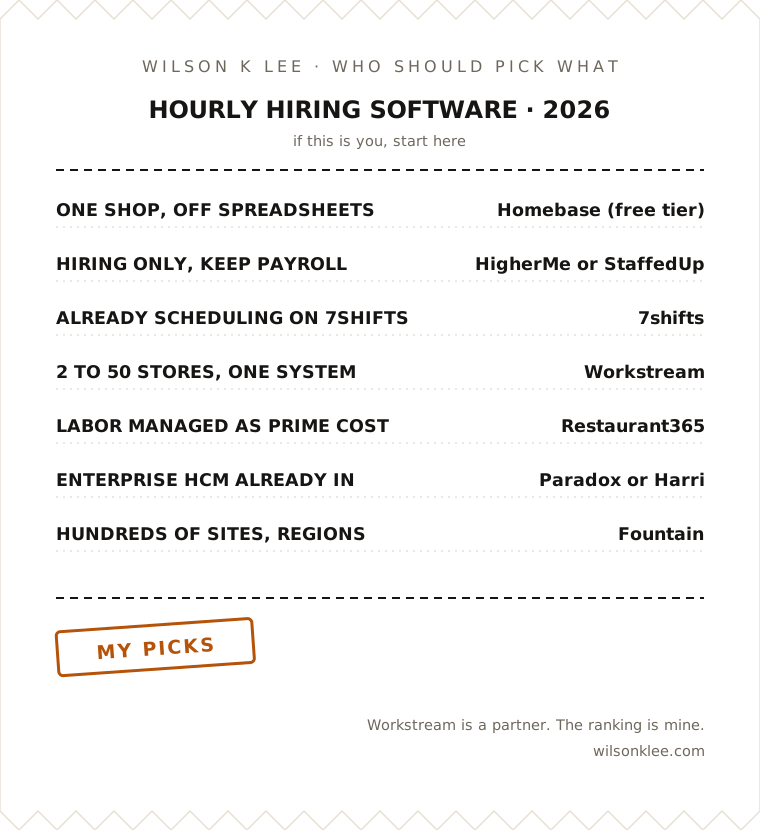
Want this receipt for your own article or deck? Take it, just credit wilsonklee.com.
One shop moving off spreadsheets: Homebase, free. Hiring is your only gap and payroll stays where it is: HigherMe or StaffedUp. Your managers already live in 7shifts: add hiring there. Two to fifty stores and you are tired of typing the same new hire into four systems: Workstream. You manage labor as a prime cost line: Restaurant365. You already run an enterprise HR stack: Paradox or Harri. Hundreds of sites across regions: Fountain.
The bottom line
Software gets the applicant to the door. It does not pick the right one. That part is still your job posting, your questions and a real trial shift. The right tool makes sure a good applicant hears from you today instead of Thursday. It also frees your GM to spend the interview judging attitude instead of chasing paperwork. For a multi-location group, Workstream is where I would start. Whatever you pick, the rule is the same: the fastest reply wins the hire, and the best-treated hire stays.
Questions owners actually ask
What should a multi-location restaurant look for first in hiring software?
Speed to first contact, then how much work the tool takes off your managers. Look for text-to-apply from a poster or QR code, automatic screening, interviews that book themselves, and onboarding forms that live in the same system. If you want one platform for the whole employee record, add multi-EIN payroll and POS integration to the list. That is where the admin hours go.
How does AI phone screening help restaurant hiring?
AI screening calls applicants within minutes, at any hour, and hands the manager a transcript and a rating, so nobody waits three days for a call back. Workstream says its VoiceAI reminder and rescheduling calls cut interview no-shows by 55%, a vendor-reported figure. Other platforms do the same job by chat or text. The win is the same either way: the applicant hears from you before the place down the street calls.
Does hiring software connect to a restaurant POS?
Some of it does, and it depends on the vendor. Workstream lists Square, Toast and PAR. 7shifts connects to Toast, Square and other major systems. What the connection actually moves varies: hours, tips, sales, or just the employee record. Ask before you sign.
How long does it take to set up hourly hiring software?
A hiring-only tool can be live in days, while a full payroll migration takes weeks. Workstream scopes it in tiers: about 10 days for a single-EIN setup, under 30 days for most multi-location groups, and four to eight weeks for complex multi-EIN or multi-brand groups. Ask every vendor what their setup team does for you and what lands on your GM.
Can hiring software keep a multi-state restaurant group compliant?
It can flag the risks, but it cannot guarantee compliance. Broader platforms offer labor-rule monitoring, ACA tracking and compliance dashboards that catch meal break and overtime problems before they become fines. Software supports the work. A qualified advisor in each state still signs off.
The Weekly Receipt
One brand story, one number, one answered question. 2 minutes, Tuesdays.
Free. Unsubscribe anytime, one click, no games.
You're in, friend. See you Tuesday.
Keep going: restaurant guides
How to Calculate Restaurant Labour Cost Per Meal (Formula)
Learn how to calculate labour cost per meal by dividing kitchen labour cost by meals produced, and how to use
5 Ways to Reduce Restaurant Labour Costs
Five practical strategies restaurant owners use to cut labour costs, protect profit margins, and keep their be