Restaurant · Guide Updated July 2026
5 Psychological Tactics Domino's Uses to Sell Millions of Pizzas Every Day
Domino's sells more than three million pizzas every single day by deliberately applying five psychological principles: decision fatigue, Occam's Razor convenience, the cashless effect, gamification, and the pratfall effect. Each tactic exploits how human brains actually make buying decisions. You can adapt every one of them to a small food business without a corporate budget.
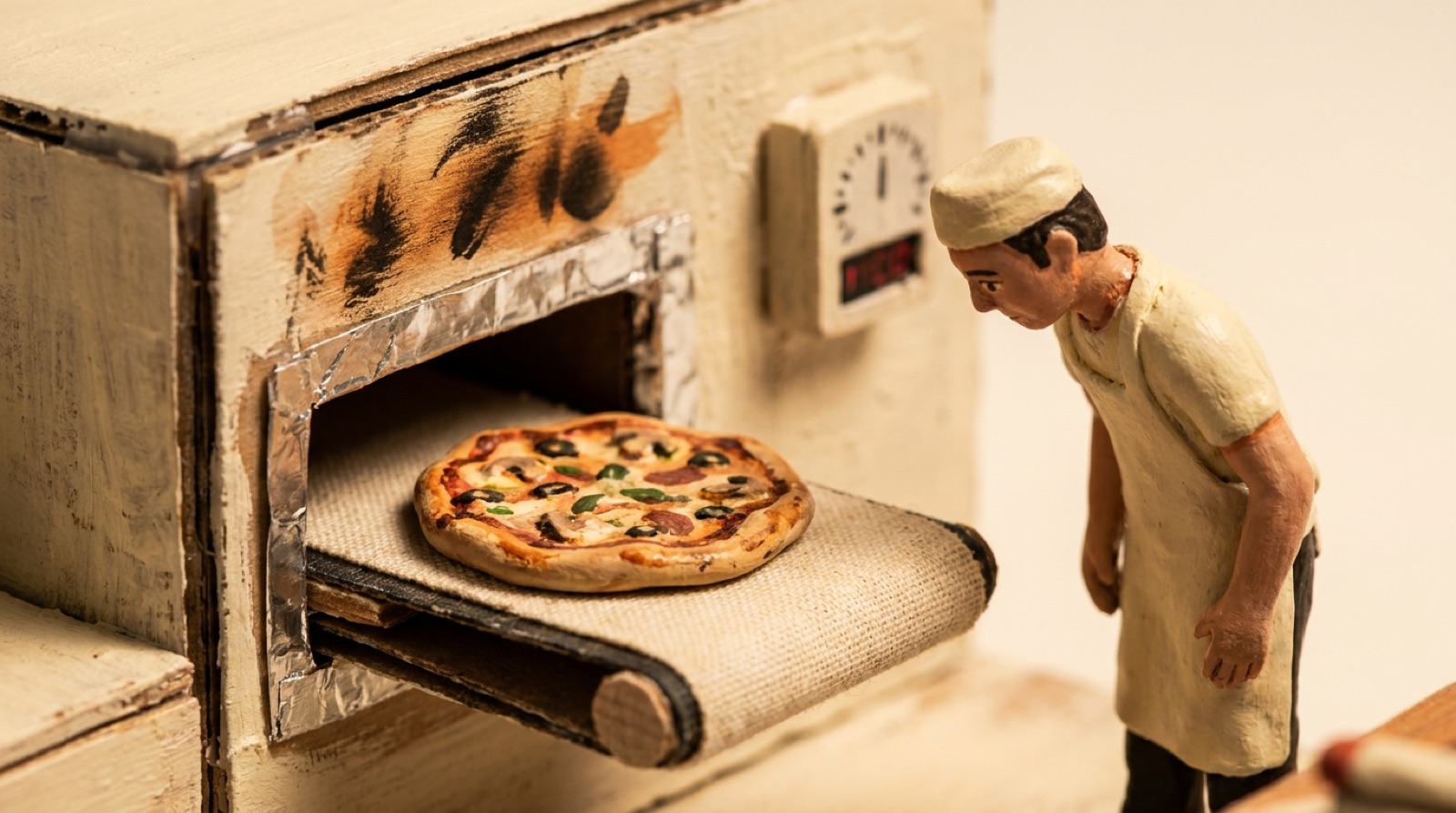
Domino’s sells more than three million pizzas every single day. They have more than 350 franchise and corporate team members operating around the world. That scale did not happen by accident. It happened because Domino’s runs on psychology, not just pepperoni.
Here are the five psychological tactics they use, and what each one means for your shop.
What Is Decision Fatigue, and How Does Domino’s Use It?
If you have watched any of my other content, you know I recommend keeping your dine-in menu to seven to nine items. Too many choices at the counter freeze customers. But when your customer is at home, the rules flip completely.
At home there is no line behind them, no social pressure, no time crunch. They can scroll a leaflet or a website for as long as they want. That abundance of time is exactly what produces decision fatigue: the mental tiredness that comes from processing too many options. When willpower tanks, people stop optimizing. They pick the weekly deal. They add the extra cheese bread. They say yes to the topping they would have skipped in the store.
Domino’s triggers this deliberately. Their weekly and monthly promotional leaflets are loaded with options. Their website mirrors that density. The critical detail is organization. Chaos without structure just frustrates people and sends them to a competitor. Domino’s organizes everything into clear category buckets, so the volume of choices feels abundant rather than confusing.
Your application: for off-premise customers ordering through your website, app, or a leaflet, give them more options than you would on a dine-in menu. Group those options cleanly. Run weekly specials. The cognitive tiredness will do the selling for you.
Why Does Simplicity Sell More? (Occam’s Razor)
Ask yourself: what is more convenient, ordering through a phone app in two minutes or calling the store, waiting on hold, talking over background noise, and hoping the person on the other end hears you correctly?
The simplest solution is almost always the best one. That is Occam’s Razor applied to restaurant ordering. Online ordering is accurate, fast, and requires zero human interaction, which is exactly what a lot of customers want on a Tuesday night.
Domino’s built their entire ordering experience around this principle. They invested in an interactive pizza builder that lets you click cheese, click bacon, and watch each topping appear on screen. You can see the crust. You can see the build. There are reportedly more than 24 million ways to customize a Domino’s pizza, and their app makes working through those options feel effortless rather than overwhelming.
According to a study cited by Trii, online orders generate more revenue per transaction than phone orders or counter orders. More average order value, from a simpler experience.
Your application: remove friction from ordering. Every extra step, every confusing screen, every phone hold is a leak in your revenue. If your online ordering is clunky, fix it before you spend a dollar on advertising.
How Does the Cashless Effect Make Customers Spend More?
Have you ever done a late-night online shopping run, bought what felt like a few things, and then been genuinely shocked at your end-of-month bill? There is a psychological reason for that.
The cashless effect describes the human tendency to spend more when no physical transaction is involved. Pressing a button on a screen is psychologically easier than pulling cash out of your wallet and handing it to another person. The pain of paying is real when you see and touch your money. Cards reduce that pain. Apps reduce it even further. The price feels less tangible, so you value the outgoing money less.
When you combine the cashless effect with the friction-free convenience of Occam’s Razor, you understand why Domino’s prioritized digital so aggressively. By 2020, more than 70% of Domino’s sales were generated online. They built 13 separate ways for customers to order from them digitally.
Your application: push your customers toward online payment. Make it the default, the easiest path, the most rewarded option. Every customer you move from cash at the counter to an app order will likely spend more with you.
What Is Gamification, and Can a Small Restaurant Use It?
Gamification is the use of game elements inside non-game activities. Done well, it increases engagement, builds loyalty, and drives repeat purchases.
Domino’s most famous gamification tool is the pizza tracker. Waiting for delivery is not fun. Not knowing where your food is makes people anxious. Domino’s understood that human beings crave certainty. We want to know what is happening and when. So they made the waiting process feel like a game, with a visual tracker showing every stage of your order, and later a GPS tracker for the driver.
They are not alone in this. Starbucks built a loyal base around golden star rewards. McDonald’s ran a Monopoly game that had people genuinely excited about stickers. Uber Eats uses a GPS tracker for the same psychological reason Domino’s does: certainty reduces anxiety, and reduced anxiety keeps customers happy and coming back.
You do not need a GPS fleet to apply this. A punch card loyalty program delivers the same psychological reward loop. A well-run marketing campaign with a simple challenge or collection mechanic gets customers engaging with your brand. The goal is the same: give people a reason to keep playing, and they will keep buying.
What Is the Pratfall Effect, and When Should You Use It?
The pratfall effect is the research finding that a competent person or brand becomes more likable when they admit a mistake. The flaw makes them human. It makes them one of us.
In 2008, Domino’s was in serious trouble. Customer feedback was brutal. Phrases like “cardboard crust” and “worst excuse for pizza I’ve ever had” were circulating. Most brands would have buried those comments. Domino’s did the opposite. They built a campaign around the negative feedback, showed the actual customer quotes on screen, and publicly committed to changing their recipe.
One of their executives said on camera: “You can either use negative comments to get you down, or you can use them to excite you and energize your process of making a better pizza.” Customers responded. Instead of abandoning the brand, people became supporters. They wanted to see Domino’s get it right. They rooted for the comeback.
There is a serious caveat here. The pratfall effect only works if your brand is already perceived as competent and successful. If your fundamentals are shaky, admitting a flaw reads as a brand in freefall, not a brand being brave. Get your operations, your food quality, and your branding solid first. Then, if something goes wrong, you have the credibility to own it publicly and turn it into a strength.
Your application: if you make a mistake, do not hide. Address it directly, tell your customers what you are doing to fix it, and invite them along for the process. Very few small businesses have the courage to do this, which is exactly why it works when you do.
The Bottom Line
Domino’s scale comes from understanding human psychology at every touchpoint: how people get mentally tired when choosing, how friction kills conversions, how digital payments lower the psychological cost of spending, how certainty and reward loops build loyalty, and how honesty builds trust that no ad budget can buy. None of these tactics require a corporate team or a national budget. They require you to study how your customers actually think, then design your ordering experience, your menu, your marketing, and your customer communication around those realities. Build the system before you scale the volume.
Watch the full video
Source — YouTube · the full breakdown, free
Tool — free · not sponsored, I built it
Want your exact numbers for a restaurant? The free calculator runs your cost to open, the ×1.4 cash reserve, and your break-even in about 30 seconds. Prefer paper? The One-Page Fundable Business Plan is the printable version.
Run your numbers →Questions owners actually ask
How many pizzas does Domino's sell per day?
Domino's sells more than three million pizzas every single day. That volume is supported by more than 350 franchise and corporate team members operating around the world. Their digital-first ordering strategy, which generated more than 70% of sales online as of 2020, is a core driver of that scale.
What is the cashless effect, and does it apply to small restaurants?
The cashless effect is the psychological tendency for people to spend more when no physical money changes hands. Pressing a button is less painful than handing over cash, so customers spend more freely. It applies directly to small restaurants: moving customers from cash-at-the-counter to app or online ordering typically increases average order value.
What is decision fatigue, and how does Domino's use it to increase order size?
Decision fatigue is the mental tiredness that sets in when someone processes too many choices over time. Domino's uses dense promotional leaflets and a feature-rich website to trigger this effect in at-home customers who have no time pressure. Once willpower drops, customers default to the easiest option, which is usually a deal or an add-on that increases the total order value. The key is organizing those options into clear categories so the volume feels inviting rather than chaotic.
What is the pratfall effect, and when should a restaurant use it?
The pratfall effect is the finding that admitting a mistake makes a competent brand more likable and relatable. Domino's used it in 2008 by building an entire campaign around brutal customer criticism of their pizza, publicly owning the feedback and committing to change. The critical caveat is that this only works if your brand is already seen as successful. If your fundamentals are weak, admitting flaws reads as a brand failing rather than a brand being authentic.
How can a small food business use gamification without a big tech budget?
You do not need GPS tracking or a custom app. Simple loyalty punch cards and stamp programs deliver the same psychological reward loop that Domino's pizza tracker does. You can also build gamification into marketing campaigns, for example challenges, collection mechanics, or milestone rewards, to give customers a reason to engage with your brand repeatedly and keep coming back.
Why does Domino's invest so heavily in online ordering?
By 2020, more than 70% of Domino's sales were generated online, and they built 13 different ways for customers to order digitally. Online ordering combines two powerful psychological effects: Occam's Razor (the simplest, most convenient option wins) and the cashless effect (digital payment reduces the psychological pain of spending). Research cited by Trii also found that online orders produce a higher average order value than phone or counter orders.
The Weekly Receipt
One brand story, one number, one answered question. 2 minutes, Tuesdays.
Free. Unsubscribe anytime, one click, no games.
You're in, friend. See you Tuesday.
Keep going: restaurant guides
How Much Does It Cost to Open a Restaurant? (2026 Complete Breakdown)
The real, itemized cost to open a full-service restaurant in 2026, including Wilson's x1.4 cash rule, break-ev
12 Restaurant Assets Every Owner Needs to Build
The 12 restaurant assets that build your brand, from logo to uniforms, ranked by priority before you open in 2
3 Tactics to Position Your Restaurant Brand for Growth
Awards, media features, and strategic associations are the three free tactics that build customer trust and po
3 Things to Know Before Opening a Restaurant (And What Happens If You Skip Them)
Wilson K Lee breaks down the three foundational principles every restaurant owner must master: know your numbe
360 Ads for Restaurants: How to Build Customer Touchpoints Across Every Channel
Learn how 360-degree advertising builds the 20 touchpoints your restaurant needs to turn strangers into custom
Low Labor Restaurant Concepts: Fast vs QSR Compared
Fast concept and QSR are the lowest labor restaurant concepts. See real costs, staffing needs, and revenue to
4 Actionable Steps to Prevent Your Restaurant from Going Bankrupt During a Crisis
Four concrete steps every restaurant owner needs to assess financial health, cut inefficiencies, secure fundin
5 Deadly Mistakes Every New Food Business Owner Makes
60% of restaurants fail in year one. Wilson K Lee breaks down the 5 deadly mistakes killing food businesses in