Restaurant · The complete guide Updated July 2026
How Much Does It Cost to Open a Restaurant in 2026?
Opening a standard full-service restaurant (~2,800 sq ft, mid-size US market) costs $969,000 in total startup spend, with a realistic planning band of $727,000 to $1,211,500. Before you sign any lease, you need $1,356,500 in accessible cash using Wilson's x1.4 rule. At an average ticket of $35, you break even at roughly 50 covers per day.

Watch the interview
Source: YouTube · the full conversation, free
What Is the Real Number to Open a Restaurant?
Stop looking for a range so wide it tells you nothing. Here is the 2026 number for a standard full-service restaurant, roughly 2,800 square feet in a mid-size US market, built out in a second-generation space: $969,000.
The honest planning band runs from $727,000 to $1,211,500, depending on your market, your buildout condition, and how many surprises the walls hide. Neither end of that range is a rounding error. Treat the midpoint, $969,000, as your working target and plan for the top.
Here is every dollar accounted for.
What Does the Full Line-Item Breakdown Look Like?
| Line item | Cost |
|---|---|
| Build-out (2800 sq ft, 2nd-gen space, +20% contingency) | $588,000 |
| Equipment & smallwares | $150,000 |
| Permits, licensing & pro fees | $35,000 |
| Opening inventory | $25,000 |
| Soft-launch & pre-open burn | $25,000 |
| Lease deposits (~3 months rent) | $42,000 |
| Working capital (~4 months of fixed costs) | $104,000 |
| Total | $969,000 |
A few of these lines deserve plain talk.
Build-out is the biggest check you will ever write before you serve a single plate. The 20% contingency is not optional padding. Every second-generation space has something wrong inside the walls. Budget it in before you find it, not after.
Equipment is where the full-service model punishes you. A full kitchen means a hood, a line, a walk-in, and a dish station. Each one is a capital line item. A bubble tea shop or an ice cream counter does not have this problem. A restaurant does, and that $150,000 number reflects it.
Working capital is the line most first-timers skip. Four months of fixed costs sitting in the bank means you can absorb a slow opening, a permit delay, or a staffing crisis without going to zero. Skip this line and you are one bad month from closing.
What Is the x1.4 Rule and Why Does It Matter?
The total cost to open is $969,000. That is not the number you need in the bank.
The number you need before you sign the lease is $1,356,500.
That is $969,000 multiplied by 1.4. The extra 40% covers the costs you cannot fully anticipate: the contractor who runs over, the equipment that arrives damaged, the two weeks of training payroll before a single dollar comes in, and the personal runway you need so you are not making desperate decisions in month three.
Signing a lease without this cushion is not bold. It is the setup for the failure story you will be telling two years from now. The x1.4 rule is not conservative caution. It is the minimum.
How Does the Money Model Actually Work?
Three numbers govern your day-to-day survival.
Average ticket: $35. Every operational decision you make, menu pricing, table turns, section sizes, flows from this number. If your menu is priced below this, your math changes for the worse.
Monthly burn at zero sales: $26,000. This is what the restaurant costs you every month before a single customer walks in. Rent, insurance, base labor, utilities. The clock starts the day you get the keys, not the day you open.
Break-even: approximately 50 customers per day, generating roughly $52,500 per month. Fifty covers per day sounds modest until you are standing in an empty dining room at 6pm on a Tuesday. That is your first target. Not profit. Break-even.
The prime cost target is 25/25/25. That means food cost at 25% of revenue, labor cost at 25% of revenue, and occupancy and overhead at 25% of revenue. Hit all three and you are operating at a 25% net. Miss any one of them and you feel it immediately because restaurant margins at the industry average run between 5% and 10%. The 25/25/25 model is how you beat that average.
What Are the Traps That Specifically Sink Restaurant Owners?
The full-service restaurant is the most operationally complex concept you can choose. It runs the widest hours, carries the highest headcount, and demands your presence more than any other format. These are the three traps that operators walk into with their eyes open and still do not avoid.
Trap one: equipment cost creep. A full kitchen is where equipment doubles on you. The hood alone is a project. Add the line, the walk-in, and the dish station and you have spent more than many other concept types spend on their entire buildout. Get your equipment list locked before you finalize your budget, not after.
Trap two: labor is the silent killer. A full-service floor plus a full kitchen is the highest headcount of any food and beverage concept. You are paying a FOH team and a BOH team simultaneously. One bad scheduling week, one high-turnover month, and your labor line blows past 25% before you notice. Track it weekly, not monthly.
Trap three: the burnout wall hits at month 9. This is the one nobody warns you about clearly enough. If you are working every shift, covering every callout, and running every line, you will hit a wall. The restaurant does not care. It opens tomorrow whether you are rested or not. The operators who survive build the system first, hire to the system, and step out of the daily operations before month 6. The ones who do not build the system become the system, and that is not a business. That is a job with higher stakes.
Location is also a foundational risk, not just an operational one. A bad location does not get saved by a great menu. Spend real time counting foot traffic at any site you consider. Sit next to it, count by the hour, log the data. The traffic tells you whether your 50-covers-per-day break-even is realistic before you spend a dollar on buildout.
Is a Full-Service Restaurant the Right Concept for You?
Here is the direct answer: a full-service restaurant is the right concept if you have the capital, the operational depth, and a clear system for how it runs without you in every role.
It is not the right concept if you are trying to test a food idea with limited capital. For that, a ghost kitchen, a food truck, or a counter-service format gives you proof of concept at a fraction of the cost and risk.
It is not the right concept if you are attracted to the romance of the dining room but have not yet worked inside a restaurant operation. The 80% first-year failure rate is not a myth. The number one documented reason for that failure is not having a plan, which means not knowing your numbers, not knowing your break-even, and not knowing what the business actually costs before the doors open.
If you have the capital, you have operator experience, and you are willing to build systems before you build your schedule around working every shift, then a full-service restaurant can absolutely generate strong returns. The 25/25/25 model puts you well above the industry average margin. But you have to earn that structure. It does not come automatically with a nice space and a good menu.
How Do You Fund a Restaurant Opening?
The sources that work for a $969,000 project in 2026 are combinations, not single checks.
SBA 7(a) and SBA 504 loans are the most common structured financing for restaurant buildouts. They require a solid business plan, demonstrated operator experience, and personal collateral. Banks want to see that you understand the numbers before they underwrite them.
Investor capital from friends, family, or angel investors can supplement an SBA loan, but investors who are not operators will need to see a real financial model, not a concept deck. Show them the $26,000 monthly burn, the 50-cover break-even, and the 25/25/25 prime cost target. That is how you demonstrate you know what you are doing.
Equipment financing is available separately from your buildout loan and can reduce the cash required at signing. The $150,000 equipment line is a natural candidate for this structure.
What does not work: opening with less than the x1.4 figure in accessible capital and hoping the revenue catches up fast enough. It almost never does. The restaurants that close in year one are not usually killed by bad food. They run out of cash.
The whole thing, on one receipt
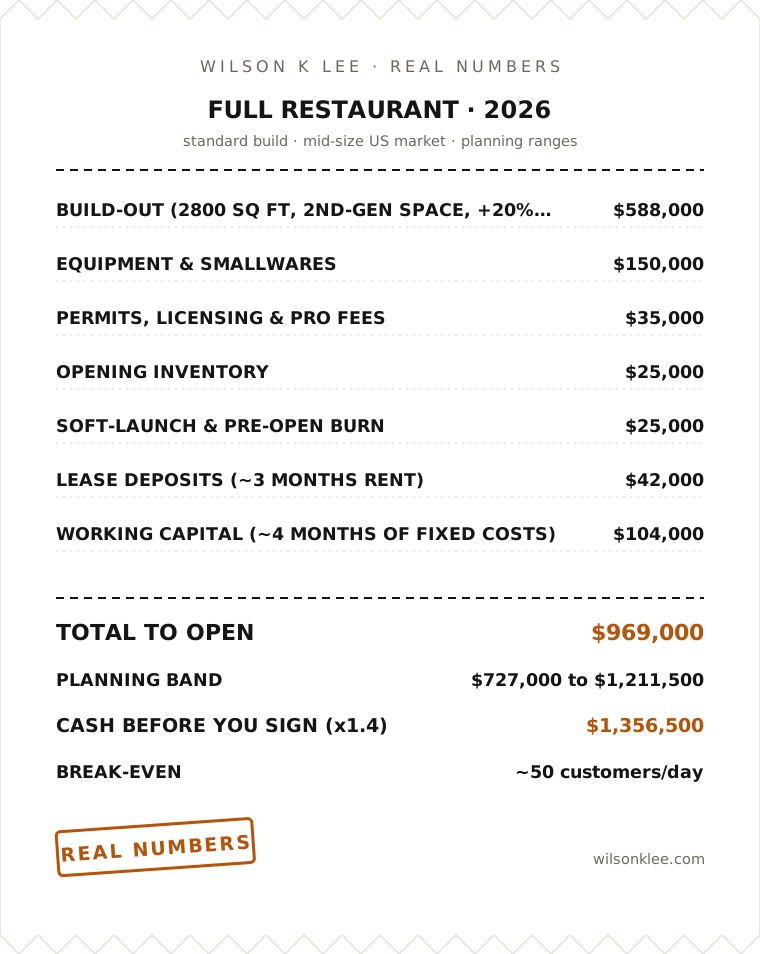
Tool — free · not sponsored, I built it
Want your exact numbers for a restaurant? The free calculator runs your cost to open, the ×1.4 cash reserve, and your break-even in about 30 seconds. Prefer paper? The One-Page Fundable Business Plan is the printable version.
Run your numbers →Questions owners actually ask
I'm 10 years old and want to open a restaurant when I'm 24. Is that too late to start?
24 is not too late. It is actually a strong age to open your first restaurant because you have time to work inside the industry first, which is the single most valuable thing you can do before you spend close to a million dollars. Use your teens to save, use your early twenties to work in a restaurant operation and learn how it actually runs. The operators who succeed are almost always the ones who have stood on both sides of the pass before they signed a lease. Keep saving and keep learning.
Are restaurant consultants worth hiring, or is it mostly theory that does not apply to my actual business?
A consultant is worth the money only if they have real operator experience, meaning they have opened and run restaurants themselves, not just advised on them. The question to ask any consultant is: what did you actually build and operate? If the answer is thin, so is their advice. A consultant who has lived the $26,000 monthly burn and the 50-cover break-even will give you different guidance than one who has only built decks. On used equipment: yes, there are auction sites and restaurant liquidation platforms where you can buy used commercial equipment at significant discounts. Warranty coverage on used equipment is limited and varies by seller, so budget for service contracts or repair reserves on any used purchase.
How do I protect my restaurant business plan when presenting it to investors or a bank? What if they steal the idea?
A business plan for a restaurant is almost never stolen by a bank or investor. Banks are in the lending business, not the restaurant business. Investors who are worth working with have no interest in running your restaurant themselves. What protects you is execution, your operator skill, your systems, your team, and your location, none of which can be copied from a document. Present your plan with confidence. The operators who hold their cards too close to the chest are usually the ones who never get funded.
What is the right way to think about labor cost in a full-service restaurant?
Target labor at 25% of revenue. That is your ceiling. A full-service restaurant runs the highest headcount of any food and beverage concept because you are staffing both a front-of-house floor team and a full back-of-house kitchen simultaneously. Track your labor cost weekly, not monthly. By the time a monthly report tells you labor is at 32%, you have already lost three weeks of margin you cannot recover. Labor is the line item most likely to quietly destroy your profitability if you are not watching it in real time.
Any advice on how to start a bar? Is the financial model similar to a restaurant?
A bar shares several cost structures with a full-service restaurant: buildout, permits, lease deposits, and working capital are all comparable line items. The key differences are in the cost of goods sold and the licensing. Liquor licensing is significantly more expensive and time-consuming than a standard food service permit, and it varies widely by state and city. The good news is that beverage margins are higher than food margins, which gives a well-run bar more room to hit strong net numbers if labor is controlled. Use the same prime cost framework: keep your combined cost of goods and labor under 50% of revenue as your starting discipline.
How important is location when opening a restaurant, and how do I actually evaluate one?
Location is the number one reason restaurants go bankrupt. A great menu in the wrong location does not survive. To evaluate a site properly, go sit near it and count foot traffic manually, by the hour, across multiple days and dayparts. Log the data. You need to know not just whether people walk by, but whether the people walking by match the customer you are trying to serve. Also spend time at nearby competitors. Watch who comes in, how often repeat customers appear, and what the energy is like. Your 50-cover-per-day break-even is only realistic if the traffic is there to support it.
How do I think about marketing to attract the right customers for my restaurant concept?
Start hyperlocal before you spend anything on broad marketing. You do not need the whole city to find you. You need a loyal base of customers within your immediate community who come back consistently. Choose a community you genuinely want to serve, then build your menu, your atmosphere, and your outreach around the people already spending money in that neighborhood. Study what your local competitors are doing and where they fall short. Repeat customers are worth more than any paid ad because they bring their own network. Build for retention first, then reach.
The Weekly Receipt
One brand story, one number, one answered question. 2 minutes, Tuesdays.
Free. Unsubscribe anytime, one click, no games.
You're in, friend. See you Tuesday.
Keep going: restaurant guides
Low Labor Restaurant Concepts: Fast vs QSR Compared
Fast concept and QSR are the lowest labor restaurant concepts. See real costs, staffing needs, and revenue to
5 Deadly Mistakes Every New Food Business Owner Makes
60% of restaurants fail in year one. Wilson K Lee breaks down the 5 deadly mistakes killing food businesses in
7 Instagram Tools Every Restaurant Owner Should Be Using
Wilson K Lee breaks down the 7 Instagram tools his team uses to grow restaurant marketing, save time, and brin
7 Money-Making Mindsets Every Restaurant Owner Needs
The 7 mindsets shared by hundreds of successful restaurant owners, from dropping perfectionism to owning your
Postmates for Restaurants: Big Network, Small Market Share
Postmates lists 500,000 restaurants, the biggest of any app, but only holds 7% market share. Here's how to act
Best Hourly Hiring Software for Multi-Location Restaurants (2026)
Ten hourly hiring platforms for restaurant groups with two or more locations, ranked by an operator who ran se
10 Best HR and Payroll Software for Restaurant Groups (2026)
Ten HR and payroll platforms for restaurant groups, ranked by how much of the hiring-to-payroll stack each cov
Best Payroll Software for Restaurant Franchises (2026)
Twelve payroll platforms for restaurant franchises, judged on what franchise payroll actually breaks on: multi