Restaurant · Guide Updated August 2026
How to Choose the Right Food Business Structure: Home Office, Cloud Kitchen, or Retail Location
There are three food business structures: home office, cloud kitchen, and retail location. The right one depends on six characteristics: volume, location, commitment, earning potential, investment, and delivery app availability. Pick the structure that fits your current life, not an idealized version of it.
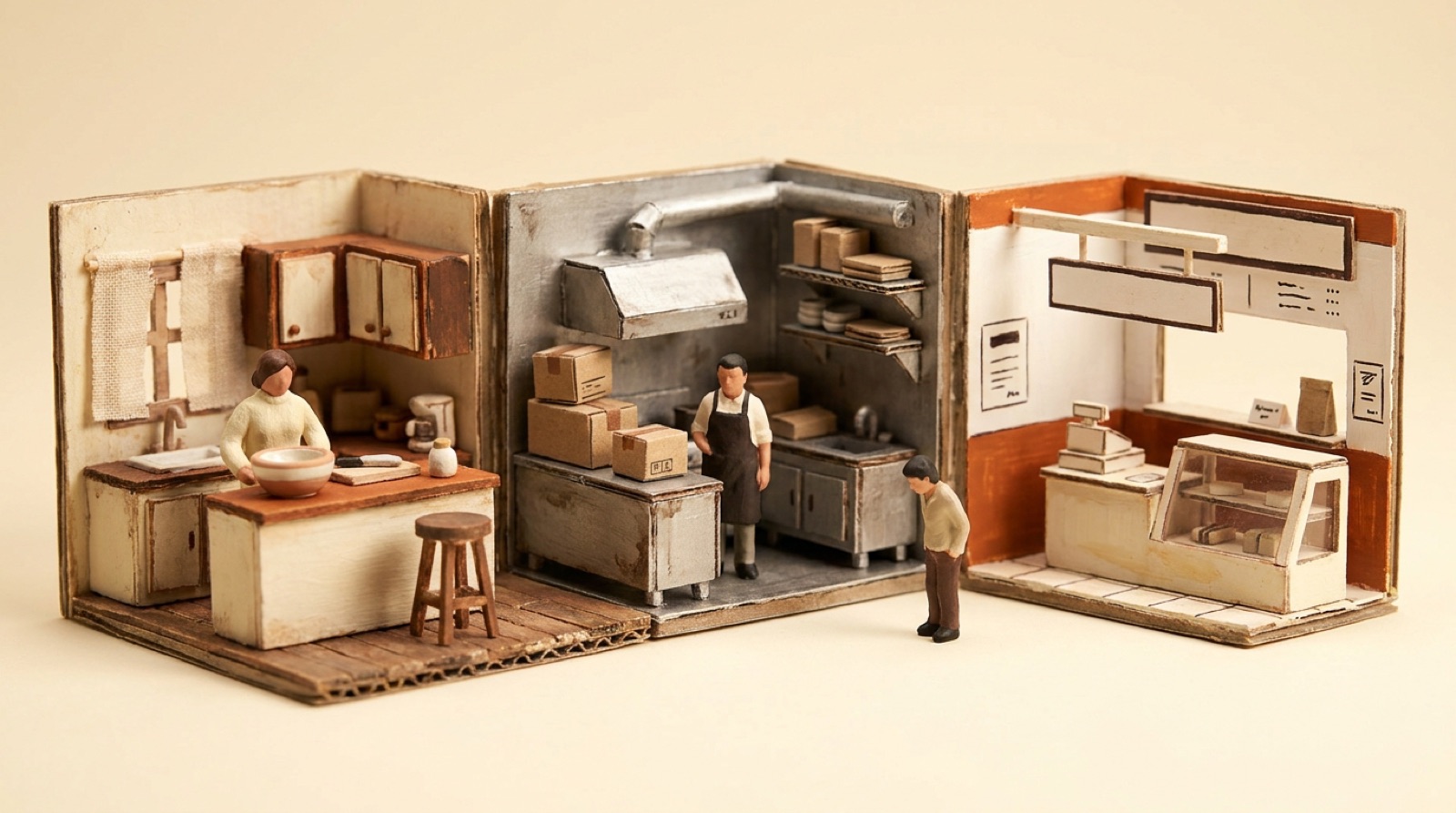
The structure you choose for your food business shapes everything else: how much you earn, how many hours you work, how much you invest, and whether the whole thing actually fits your life. Get this decision wrong and none of the other work matters. Get it right and you have a foundation worth building on.
What Are the Three Food Business Structures?
Home office. You run your food concept from your home. You can sell on Instagram, sell online, and sign up for delivery apps depending on your city. There is no dine-in service.
Cloud kitchen or virtual kitchen. This is a newer model. A cloud kitchen is a professional food preparation and cooking facility that you rent by the hour or by the week. You own nothing. You pay for access to the facility, use it to prep and cook, and fulfill online and delivery orders. There is no dine-in service here either.
Retail location. This is a physical storefront. It covers the full range of service, including dine-in, and requires the largest investment and commitment of the three.
Each structure can work. The question is which one works for you right now.
Why Does Choosing the Right Structure Matter So Much?
You need a structure that lets you plan and shape your business around your actual lifestyle. If the structure does not fit your needs, it will not work, and that defeats the entire purpose of starting a business in the first place.
A lot of aspiring operators skip this step. They romanticize the restaurant before they have honestly assessed whether a restaurant is the right move at this point in their life. The six characteristics below stop that mistake before it costs you real money.
What Are the Six Characteristics That Point You to the Right Structure?
1. Volume
How much can you realistically produce? A friend of mine in Seattle, Mark, runs one of the top fine dining restaurants in the world. His kitchen produces more than 1,500 units per day. A home kitchen cannot come close to that output. If your concept requires high daily volume to be profitable, a home office structure will not support it.
2. Location
Is your location convenient for customers or delivery drivers? If you live in a tall high-rise building, think about whether a delivery driver can reach you easily and whether there is parking nearby. These are not small details. They directly affect whether delivery apps will even service your address and whether customers will actually order from you.
3. Commitment
How much time are you willing to put in? If you have a nine-to-five job and want to build something on the side, a home office running five to ten hours per week makes sense. If you are ready to quit and go all in, a retail location might be on the table. Your commitment level and your business structure need to match. Trying to run a restaurant on side-hustle hours is a path to burnout and closure.
4. Earning Potential
What does success look like financially for you? Are you aiming for a few extra thousand dollars a month, or are you trying to build a business that generates tens of thousands? A home office food business typically earns around $1,000 or more per month. Some people have made significantly more working from home, but that is not the typical outcome. A retail location has a higher ceiling but also a much higher floor in terms of what it costs to survive.
5. Investment
How much capital do you have available right now? A home office setup runs roughly $1,000 to a few thousand dollars. A retail location or restaurant is a different conversation entirely: you are looking at hundreds of thousands of dollars. As of 2026, opening a full restaurant runs approximately $727,000 to $1,211,500, with closer to $1,356,500 in accessible cash recommended before you sign a lease. These numbers mean a retail location is not a decision you make on a whim.
6. Food Delivery App Availability
Not every delivery app operates in every city, and not every app will pick up orders from a home address. In some cities, drivers will come directly to your home. In many others, that option does not exist. Before you build your entire model around delivery, call the apps that operate in your market and confirm they will service your setup.
What Legalities Apply to All Three Structures?
No matter which structure you choose, the legal requirements do not change. You need a business license, a registered business name, business insurance, and a food safety and sanitation plan. These apply whether you are working out of your kitchen or managing a full restaurant.
A lot of people operate without all of these in place. That is their choice to make. My obligation is to tell you clearly that you need them. Make sure you check with your city officials and local permits office before you start selling.
How Do the Three Structures Compare Side by Side?
Here is how each structure maps to the six characteristics:
Home office: Low volume, home-based location with potential access limitations, five to ten hours per week commitment for a side hustle or full time if you go all in, roughly $1,000-plus monthly earning potential, $1,000 to a few thousand dollars to start, and delivery app availability depends heavily on your city.
Cloud kitchen: Higher volume than a home office, professional facility with good logistics access, moderate to full-time commitment, stronger earning potential than a home setup, moderate investment to rent time in the facility, and good delivery app compatibility since the facility is designed for it.
Retail location: High volume capacity, customer-facing storefront with full dine-in capability, full-time commitment required, the highest earning ceiling of the three, hundreds of thousands of dollars to open, and full delivery app and in-person service options.
The Bottom Line
Choose the structure that matches your life today, not the business you imagine having in five years. A home office is a real, legitimate business with real earning potential. A cloud kitchen lets you operate professionally without the overhead of owning a space. A retail location is powerful but demands serious capital and full commitment. Pick the one that fits your volume, your location, your hours, your money, and your market, and you will have something worth growing.
As I always say: a business that fits your life will outlast one that looks impressive on paper but drains you dry.
Watch the full video
Source — YouTube · the full breakdown, free
Tool — free · not sponsored, I built it
Want your exact numbers for a restaurant? The free calculator runs your cost to open, the ×1.4 cash reserve, and your break-even in about 30 seconds. Prefer paper? The One-Page Fundable Business Plan is the printable version.
Run your numbers →Questions owners actually ask
What is a cloud kitchen and how is it different from a home office?
A cloud kitchen, also called a virtual kitchen, is a professional food preparation and cooking facility you rent by the hour or by the week. You do not own anything. A home office means you cook and prep from your own home. Both structures focus on online sales and delivery, and neither offers dine-in service. The main difference is scale, professionalism of the facility, and logistics access for delivery drivers.
How much money do I need to start a home-based food business?
Starting a home office food business typically costs around $1,000 to a few thousand dollars. This is one of its biggest advantages over a retail location, which requires hundreds of thousands of dollars to open. Keep your initial investment lean, prove the concept, and scale from there.
How much can I realistically earn running a food business from home?
The typical earning range for a home office food business is roughly $1,000 or more per month. Some operators have made significantly more, but that is not the standard outcome. A home setup has a lower earning ceiling than a retail location, so be honest with yourself about your financial goals before choosing this structure.
What legal requirements apply to a home-based food business?
Regardless of your business structure, you need a business license, a registered business name, business insurance, and a food safety and sanitation plan. These requirements apply to home offices, cloud kitchens, and retail locations. Always check with your local city officials and permitting office to confirm what applies in your specific market.
Will delivery apps pick up orders from my home address?
It depends entirely on your city and the specific app. In some cities, delivery drivers will come directly to a home address. In many others, home office setups are not supported. Before building your business model around delivery, call the apps operating in your area and confirm they will service your location.
How do I know if I am ready to open a retail location instead of starting at home?
Assess all six characteristics honestly: your expected volume, whether your location works for customers and drivers, how many hours you can commit, your earning goals, your available capital, and which delivery apps serve your area. A retail location demands full-time commitment and hundreds of thousands of dollars in investment. If those two requirements do not match your current situation, start with a home office or cloud kitchen first.
Where can I learn more about opening a retail food location or restaurant?
Wilson covers retail and restaurant-specific operations in a separate advanced program called the Professional Restaurant Owners Academy. The Foodiepreneur's Finest Program focuses specifically on home office food businesses, covering online sales, Instagram selling, and delivery app setup without dine-in service.
The Weekly Receipt
One brand story, one number, one answered question. 2 minutes, Tuesdays.
Free. Unsubscribe anytime, one click, no games.
You're in, friend. See you Tuesday.
Keep going: restaurant guides
How Much Does It Cost to Open a Restaurant? (2026 Complete Breakdown)
The real, itemized cost to open a full-service restaurant in 2026, including Wilson's x1.4 cash rule, break-ev
12 Restaurant Assets Every Owner Needs to Build
The 12 restaurant assets that build your brand, from logo to uniforms, ranked by priority before you open in 2
3 Tactics to Position Your Restaurant Brand for Growth
Awards, media features, and strategic associations are the three free tactics that build customer trust and po
3 Things to Know Before Opening a Restaurant (And What Happens If You Skip Them)
Wilson K Lee breaks down the three foundational principles every restaurant owner must master: know your numbe
360 Ads for Restaurants: How to Build Customer Touchpoints Across Every Channel
Learn how 360-degree advertising builds the 20 touchpoints your restaurant needs to turn strangers into custom
Low Labor Restaurant Concepts: Fast vs QSR Compared
Fast concept and QSR are the lowest labor restaurant concepts. See real costs, staffing needs, and revenue to
5 Deadly Mistakes Every New Food Business Owner Makes
60% of restaurants fail in year one. Wilson K Lee breaks down the 5 deadly mistakes killing food businesses in
4 Actionable Steps to Prevent Your Restaurant from Going Bankrupt During a Crisis
Four concrete steps every restaurant owner needs to assess financial health, cut inefficiencies, secure fundin