Bakery · The complete guide Updated August 2026
How Much Does It Cost to Open a Bakery? (2026)
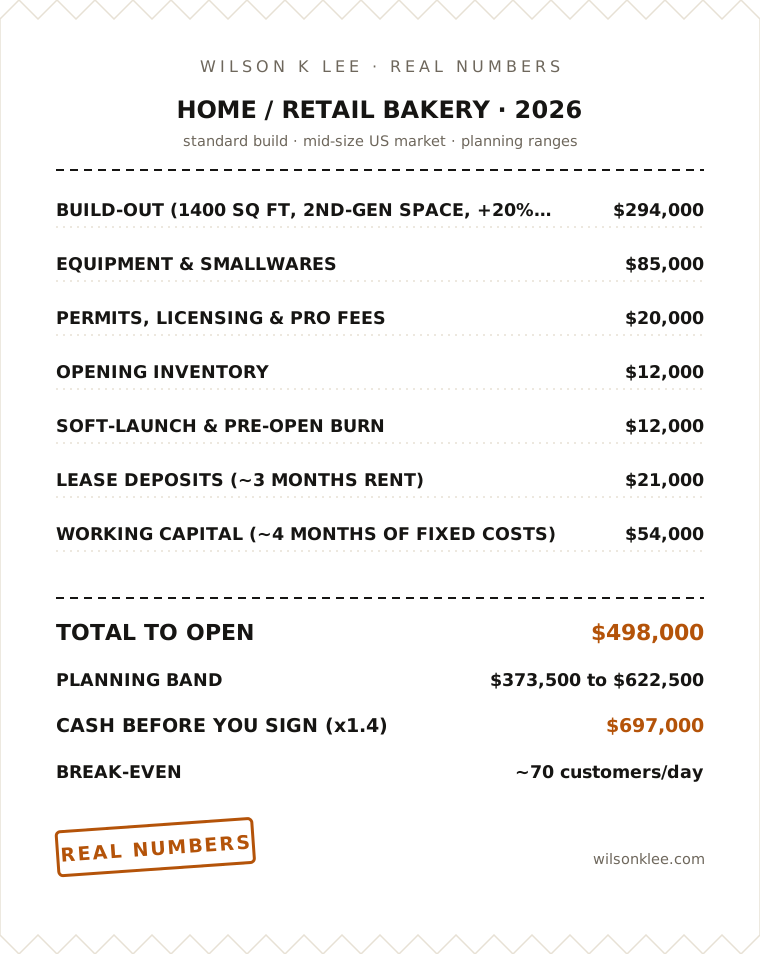
Owning a bakery costs $498,000 to open (planning band $373,500 to $622,500), plus a monthly fixed-cost floor of $13,500 even at zero sales. Wilson's x1.4 rule says you need $697,000 in accessible cash before you sign a lease. Break-even sits at roughly 70 customers per day at a $12 average ticket, with a 25/25/25 prime-cost target (food, labor, overhead) to stay profitable once the doors are open.

Watch the interview
Source: YouTube · the full conversation, free
What Is the Real Number to Open a Bakery?
Stop searching for a vague range. The real number to open a standard retail bakery, roughly 1,400 square feet in a second-generation space in a mid-size US market, is $498,000 in total startup capital. The honest planning band runs from $373,500 on the low end to $622,500 on the high end, depending on your city, your space condition, and how disciplined your build-out stays.
That number surprises most people. It surprised a lot of my own students when they first saw it. But I would rather you be surprised now, sitting at your laptop, than surprised when you are six months into construction and your contractor hands you a change order.
Here is where every dollar goes.
The Full Line-Item Breakdown
| Line item | Cost |
|---|---|
| Build-out (1,400 sq ft, 2nd-gen space, +20% contingency) | $294,000 |
| Equipment and smallwares | $85,000 |
| Permits, licensing and pro fees | $20,000 |
| Opening inventory | $12,000 |
| Soft-launch and pre-open burn | $12,000 |
| Lease deposits (~3 months rent) | $21,000 |
| Working capital (~4 months of fixed costs) | $54,000 |
| Total | $498,000 |
A few things to notice here.
Build-out is the biggest line at $294,000, and it already includes a 20% contingency. That contingency is not padding. Construction always finds something: a grease trap the landlord swore was there, electrical that needs upgrading to handle your proofers, a floor that has to be resealed to pass your health inspection. The 20% gets used. Budget it from day one.
Equipment and smallwares at $85,000 is the second spike, and it is a bakery-specific pain. Ovens, proofers, and a walk-in cooler are capital-heavy per square foot in a way that, say, a smoothie bar is not. You cannot cheap out on production equipment and still hit consistent product quality. This is the line where operators try to cut and regret it.
Working capital at $54,000 covers roughly four months of fixed costs. That buffer is what keeps you alive during the slow ramp-up period before your regulars are regulars. Underfunding working capital is the single most common reason a bakery with good product still closes in year one.
What Is Wilson’s x1.4 Rule, and Why Does It Matter?
The total cost to open is $498,000. But the number you need in accessible cash before you sign a lease is $697,000.
Here is the math: $498,000 times 1.4 equals $697,200, call it $697,000.
The extra 40% is not a safety net. It is the float that covers the gap between when money goes out and when revenue comes in consistently. Build-outs run long. Health department approvals take longer than the permit office tells you. Your soft launch will not immediately produce the volume you need. Suppliers want payment terms you have not earned yet. All of that costs cash, and none of it shows up in the line-item table.
If you can only access $498,000, you are already undercapitalized on the day you open. The x1.4 rule protects you from becoming a statistic.
What Does the Money Model Actually Look Like?
Here is the operating math you need to know before you commit.
Your monthly burn at zero sales is $13,500. That is your fixed cost floor. Rent, labor, utilities, insurance, every recurring obligation you have whether you sell one croissant or one thousand.
Your average ticket target is $12. That is a realistic per-transaction number for a retail bakery with a focused menu.
Your break-even is roughly 70 customers per day, which translates to about $25,200 per month in revenue.
Seventy customers a day sounds manageable until you remember that bakeries run on very early mornings. Prep and baking start before most people are awake. Your product has a short shelf life. Unsold product at the end of the day is not inventory you can move tomorrow. It is waste, and waste is a direct hit to your margin.
The prime-cost target to hit profitability is the 25/25/25 model: 25% food cost, 25% labor cost, 25% occupancy and overhead. That leaves you 25% for profit, debt service, and reinvestment. It is tight. Every point of food waste pushes you off that target, which is why forecasting and pre-orders are not optional extras. They are the margin protection system.
What Are the Concept’s Biggest Traps?
Trap one: the equipment spike catches operators off guard. Ovens, proofers, and a walk-in cooler together are the reason bakeries are capital-heavy per square foot compared to other food concepts. Price out your equipment package before you finalize your budget. Do not treat the $85,000 line as a variable you can shrink later.
Trap two: shelf life is the enemy of margin. Every unsold loaf, every unsold pastry tray, is pure waste. There is no way to repackage yesterday’s croissants as today’s croissants. Operators who forecast badly, or who bake to optimism instead of to data, lose margin every single day in ways that never show up as a single dramatic moment. The damage is slow and invisible until it is not. Pre-orders, par management, and honest daily sell-through tracking are the tools that protect you here.
Trap three: the home-to-retail capital cliff. Starting from a home bakery is the cheapest entry point on this list. Many great operators start exactly that way, testing demand, building a customer base, learning their product before they sign a lease anywhere. But the jump from a home setup to a retail storefront is a real capital cliff. The $498,000 number is for the retail storefront. The home bakery costs a fraction of that. The problem is that operators sometimes treat the home stage as proof the retail stage will be easy. It is not. Plan the retail jump as its own capital event, with its own fundraising, its own timeline, and its own underwriting.
Is a Bakery the Right Concept for You?
A bakery rewards operators who love early mornings and are genuinely excellent at production consistency. If your product varies batch to batch, customers notice fast and they do not come back. If you hate 4 a.m. prep, you will burn out inside six months regardless of how good your financials look.
The home bakery path is legitimate and smart as a starting point. Check your local cottage food laws, which govern what you can sell, where you can sell it, and the revenue threshold before additional regulations kick in. Every city and state has different rules. Search your city name plus “cottage food laws” and read the actual regulations before you sell your first item.
At 10 to 15 orders per week at premium prices with quality ingredients, you are building proof of concept. That volume alone will not replace a full income. To put a real number on it: at a $60 average order value (reasonable for a premium custom bakery), 10 orders a week is $600 in weekly revenue, roughly $2,400 per month. After ingredients at 30% cost, you net around $1,680 before your time. That is a side income at that volume, not a replacement salary. Scaling to 40 to 50 orders per week, or adding a retail channel, is where it starts to become a real business.
A food trailer is a lower-cost entry than a full retail buildout. The $498,000 figure is for a permanent retail space. A trailer has a meaningfully different cost structure, though it still carries equipment costs, commissary fees, permits, and working capital requirements.
You do not need a culinary school certificate to start a home bakery or to open a retail shop. What you need is proven product, a clear target market, and enough capital to operate through the ramp-up period without panicking. School can sharpen your craft. It does not replace the business fundamentals.
How Do You Fund a Bakery?
The business plan is not a formality. It is the document that shows investors, lenders, or partners that you understand all parts of your business, from your target market to your financials to your competitive position. A bakery with a clear “why,” a defined customer, and a credible financial model has a real case to make to a bank or to family investors. A bakery with “I make great cookies” does not.
If you are seeking partners, treat it as a serious professional decision. Shared values and shared vision matter more than friendship or convenience. A business plan forces you to articulate both, which means it also filters out the wrong partners before you are legally tied to them.
Start building the plan at the home bakery stage, not when you are ready to sign a lease. By the time you need funding, you want 12 to 18 months of real revenue data, real customer feedback, and a real record of how your margin behaves. That data is worth more than any pitch deck.
What Does It Cost to Own a Bakery Once You’ve Opened?
Owning a bakery costs more than the opening bill. Even after your $498,000 in startup capital is spent, you carry a fixed-cost floor of $13,500 a month, rent, labor, utilities, and insurance, whether you sell one croissant or one thousand. That number does not move with slow weeks. It is the price of keeping the lights on and the ovens running.
To cover that floor and turn a profit, you need roughly 70 customers a day at a $12 average ticket, about $25,200 a month in revenue, just to break even. Past break-even, the 25/25/25 model is your target: 25% food cost, 25% labor cost, 25% occupancy and overhead, leaving 25% for profit, debt service, and reinvestment. That 25% profit margin is tight, and it erodes fast if you are not careful.
Shelf life is the biggest threat to that margin. A bakery cannot repackage yesterday’s croissants as today’s croissants. Every unsold pastry tray is a direct hit to the bottom line, which is why forecasting, par management, and honest daily sell-through tracking are not optional. They are what protects the ownership economics after the ribbon-cutting is long forgotten.
The whole thing, on one receipt
Tool — free · not sponsored, I built it
Want your exact numbers for a bakery? The free calculator runs your cost to open, the ×1.4 cash reserve, and your break-even in about 30 seconds. Prefer paper? The Startup Budget Worksheet is the printable version.
Run your numbers →Questions owners actually ask
How do I manage accounting for a home bakery when starting out?
Keep it simple and separate from day one. Open a dedicated bank account for the business, even before you are making real money. Log every ingredient purchase and every sale in a spreadsheet or basic bookkeeping software. Track your cost per batch so you know your actual food cost percentage on each product. The habit of separation and tracking matters more at the start than the tool you use. Once you are consistently over $2,000 per month in revenue, bring in a bookkeeper for a quarterly review at minimum.
How do I identify my target market as a home baker?
Start with the problem your product solves. If you make exceptional vegan pastries because you could not find good ones yourself, your target market is people who share that problem. Profile them specifically: where they live, what they earn, where they already spend money on food, what communities they belong to online and in person. Then survey real people from that group before you invest heavily in product or branding. Your target market shapes your pricing, your messaging, and every product decision you make, so getting it right early saves you from building the wrong thing.
How do I realistically price my menu if I'm in a lower-middle-income neighborhood?
Price to your cost structure first, not to your neighborhood's comfort level. Calculate your food cost, labor, and overhead per item, then apply a markup that gets you to a 25% food cost target. If that price feels high for your area, the answer is not to lower the price and compress your margin. The answer is to reconsider your product mix, your portion size, or whether that location is the right fit for your concept. Selling below sustainable margin to match the neighborhood eventually closes the business, which helps no one.
What certifications and physical things do I need to open a bakery?
On the certification side: a food handler's permit or food manager certification (requirements vary by state and city), a business license, a seller's permit if your state taxes food sales, and a health department inspection and permit for your commercial space. For a home bakery, check your local cottage food laws specifically. On the physical side: production equipment (ovens, proofers, a walk-in or reach-in refrigerator, mixers), smallwares (sheet pans, proofing baskets, packaging), a POS system, and display cases if you are running a retail counter. The permits and licensing line in the budget is $20,000, which covers professional fees to navigate this process correctly.
How much can I realistically take home at 10 to 15 orders per week as a premium home baker?
At a $60 average order value for a premium custom bakery, 10 orders per week is $600 in weekly revenue, roughly $2,400 per month. After a 30% ingredient cost, you net around $1,680 before your time. At 15 orders per week, that becomes approximately $2,520 net before labor. That is real money as supplemental income, but it is not a full salary replacement at that volume. To make it a primary income, most operators need to reach 40 to 50 orders per week, add a recurring wholesale or catering channel, or move into a retail format with walk-in traffic.
I can't bake from home legally and I can't afford my own space. What are my options as a student?
The path used by many operators in this exact situation is a shared commercial kitchen, also called a ghost kitchen or commissary kitchen. You rent production time by the hour in a licensed commercial space, which means you get legal, inspected kitchen access without the capital cost of building your own. Rates vary by city, but hourly rentals are a fraction of the cost of a lease. Start with the minimum hours you need to fulfill your current orders, prove demand, build savings, and scale your rented hours as the business grows. It is a slower path than having your own space, but it keeps you legal and keeps your startup cost manageable.
Should I use DoorDash or UberEats to deliver baked goods?
Third-party delivery apps work for bakeries, but they come with a real cost. Commission rates on platforms like DoorDash and UberEats typically run 15% to 30% of the order value. On a bakery with tight margins, that commission can erase your profit on a delivery order entirely. The better starting model for a home or small bakery is direct delivery on your own schedule, with customers ordering in advance and you batching deliveries by neighborhood or pickup window. Use third-party apps selectively, for customer acquisition and visibility, not as your primary fulfillment channel. Always calculate whether the net revenue after commission still covers your food cost and time.
Do I need a business partner to open a bakery, or can I do it alone?
You do not need a partner. Many successful bakeries are sole-owner operations. The real question is whether your skills cover the full range of what the business needs: production, marketing, finance, operations, and customer experience. A partner can fill genuine gaps, but only if their values and vision align with yours. Bringing in a partner because you are nervous or because they are a friend is a common mistake that often ends the partnership and sometimes the friendship. If you do consider a partner, the business plan is the first filter. If they cannot engage seriously with your plan, they are not the right partner.
How much does it cost to own a bakery?
Opening a standard 1,400 sq ft retail bakery costs $498,000 in total startup capital, with a realistic planning band of $373,500 to $622,500. But owning it does not stop at opening day. You carry a fixed-cost floor of $13,500 a month even with zero sales, covering rent, labor, utilities, and insurance. You need roughly 70 customers a day at a $12 average ticket just to break even on that monthly burn.
What are the ongoing monthly costs of owning a bakery?
Your fixed costs run about $13,500 a month whether you sell one croissant or one thousand. On top of that, the 25/25/25 model is your target once sales come in: 25% food cost, 25% labor cost, 25% overhead, leaving 25% for profit and debt service. Shelf life makes this harder than most food concepts, because unsold product at the end of the day is pure waste, not inventory you can sell tomorrow.
The Weekly Receipt
One brand story, one number, one answered question. 2 minutes, Tuesdays.
Free. Unsubscribe anytime, one click, no games.
You're in, friend. See you Tuesday.
Keep going: bakery guides
How to Start a Home Bakery Business: A Step-by-Step Guide
A practical step-by-step guide to starting a home bakery business, from cottage food laws and target market to
How to Write a Home Bakery Business Plan Step by Step
A home bakery business plan covers eight parts: your why, team, target market, location, menu, brand, SWOT, an