Bar / lounge · The complete guide Updated August 2026
How Much Does It Cost to Open a Bar? (2026)
Opening a lounge or bar (about 2,800 sq ft in a mid-size US market) costs $946,000 in 2026, with a realistic planning band of $709,500 to $1,182,500. Before you sign a lease, you need $1,324,500 in accessible cash, using Wilson's x1.4 rule. At an average ticket of $28, break-even lands around 50 customers per day, or roughly $42,000 per month in revenue.
What Does It Actually Cost to Open a Bar in 2026?
The number people throw around at cocktail parties is $150,000. The number operators cry about at 2 a.m. is much higher.
For a standard bar or lounge, roughly 2,800 square feet in a mid-size US market, the real 2026 cost is $946,000. That is the planning target. The honest band, accounting for markets and decisions that go cheaper or more expensive, is $709,500 on the low end and $1,182,500 on the high end.
Here is every line item, computed from Wilson’s own bar cost calculator, with nothing hidden.
| Line item | Cost |
|---|---|
| Build-out (2,800 sq ft, 2nd-gen space, +20% contingency) | $588,000 |
| Equipment and smallwares | $130,000 |
| Permits, licensing and pro fees | $40,000 |
| Opening inventory | $30,000 |
| Soft-launch and pre-open burn | $20,000 |
| Lease deposits (~3 months rent) | $42,000 |
| Working capital (~4 months of fixed costs) | $96,000 |
| Total | $946,000 |
A few things worth calling out before we go line by line.
First, the build-out already assumes you are taking a second-generation space, meaning a location that was previously a bar or restaurant. That matters because the plumbing, ventilation, and basic infrastructure are already in place. A raw shell or a retail-to-bar conversion will push that build-out number substantially higher. The 20% contingency baked into $588,000 is not padding, it is pattern recognition from operators who have done this more than once.
Second, the $40,000 for permits, licensing, and professional fees is a planning floor, not a ceiling. The liquor license is the wildcard in that number. Cost, wait time, and rules vary wildly by city and can dwarf your other permits. In some markets you buy a license on the open market for a fraction of that total. In others, a full liquor license transfer alone can cost six figures and take 12 to 18 months. You need to know your specific jurisdiction before you commit to a space.
Third, the $96,000 in working capital represents roughly four months of fixed costs. This is the money that keeps the lights on while you are still building your customer base. Most operators who run out of cash do not fail because their concept was wrong. They fail because they ran out of runway before the bar found its rhythm.
Why You Need $1,324,500 in Cash Before You Sign Anything
The total build cost is $946,000. So why does Wilson say you need $1,324,500 before you sign the lease?
Because the $946,000 is the cost to open. It is not the cost to survive.
The x1.4 rule is simple: take your total projected opening cost and multiply it by 1.4. The result is the minimum accessible cash position you should hold before you commit to a location.
$946,000 x 1.4 = $1,324,500
That 40% buffer exists to absorb the things every bar operator encounters: the permit that takes three months longer than expected, the HVAC that fails during buildout, the soft-launch month that brings in half the revenue you modeled, the insurance premium that came in higher than your broker quoted. None of those are worst-case scenarios. They are average outcomes.
If you are within your $946,000 and stretched, you are not ready. The moment you are cash-tight before opening, every decision you make inside the bar becomes a financial decision instead of an operational one. That is how you cut corners on training, on quality, on the one thing that builds a loyal customer base.
Raise more. Open when you have the buffer. The x1.4 rule is not conservative, it is correct.
What Does the Money Model Look Like?
Knowing the cost to open is step one. Understanding whether you can actually make money is the more important conversation.
Here is the 2026 money model for a standard bar at this scale.
Average ticket: $28 per customer. This is a bar with a real cocktail program, some food or late-night snacks, and a service experience worth paying for. It is not a dive, but it is not a premium cocktail lounge either.
Monthly burn at zero sales: $24,000. This is your fixed overhead: rent, base labor, insurance, utilities, licensing fees, and debt service. Even if nobody walks through the door for 30 days, you owe $24,000.
Break-even: approximately 50 customers per day, which translates to roughly $42,000 per month in revenue. That is the floor. Below that number, you are burning through your working capital. Above it, you are building a real business.
Prime cost target: 25/25/25. This is Wilson’s framework for bar economics. Target 25% on cost of goods sold for your beverages, 25% on labor, and 25% on occupancy and overhead. The remaining 25% is your margin to work with, covering debt, reinvestment, and eventually profit. Bars carry higher margins on liquor than food, but that margin has to carry real overhead: late-night labor, security staffing, and an insurance profile that is more expensive than a daytime cafe.
The math works when you run disciplined operations. It breaks when you let any of those three buckets creep past 30%.
What Are the Traps That Actually Kill Bar Concepts?
Bars are not uniquely dangerous businesses, but they do have a specific set of failure patterns that operators who come from other industries do not see coming.
The liquor license trap. The $40,000 line item for permits and licensing is a planning estimate. In a competitive urban market, the license alone can exceed that number, and the wait time can run over a year. If your lease clock starts before your license is approved, you are paying rent on a space you cannot legally operate. Map your licensing timeline before you sign, not after.
Beverage inventory shrinkage. Beverage inventory is expensive to stock and easy to shrink. Shrinkage in a bar context means two things: theft and over-pouring. Both are invisible until you run a true cost-of-goods audit. A bartender who over-pours by a quarter ounce per drink across a busy Saturday night can cost you hundreds of dollars in a single shift. You need pour standards, you need a POS that tracks by the drink, and you need a culture where the team understands that controls protect everyone’s job, not just your margin.
Late-night overhead stack. The bar concept lives on late-night revenue. That is also where the cost stack gets heavy. Late-night shifts carry overtime exposure. Security staffing adds a line item that a daytime coffee shop never sees. Your insurance policy, once underwriters see the hours and the liquor license, will price accordingly. The higher margin on spirits is real, and it is necessary, because it is the margin that has to absorb all of this overhead. If you model a bar like a restaurant on a per-dollar-of-sales basis, your projections will be wrong.
Is a Bar the Right Concept for You?
A bar is not the right first concept for an operator with no hospitality background. It is also not the right concept for someone who cannot tolerate regulatory complexity or late hours. Be honest about both.
A bar is a strong concept if you have an existing audience, a clear reason someone should choose your room over the one down the street, and the operational discipline to run tight controls on beverage cost and labor. The margin is real when the operations are clean.
If you are drawn to the bar concept primarily because you love going to bars, take a moment. Owning a bar and being a great customer at one are completely different activities. The first requires you to be present, sober, and detail-oriented, often at exactly the hours you would previously have been a customer.
The operators who build durable bar businesses are usually obsessive about hospitality, rigorous about their numbers, and genuinely excited by the operational problem, not just the social experience.
How Do You Fund a Bar at This Scale?
A $946,000 opening with a $1,324,500 cash requirement is a real capital raise. The most common funding paths for a bar at this scale are SBA 7(a) loans, which allow you to finance a portion of the build-out and equipment, combined with personal capital and, frequently, friends-and-family rounds structured as equity or convertible debt.
Equipment financing is a legitimate tool for the $130,000 equipment line. Lenders will collateralize against the equipment itself, which preserves your cash for the higher-risk line items like build-out and working capital.
What you should not do is fund a bar entirely on credit cards or on a revolving line of credit with a variable rate. The monthly burn at this scale does not leave enough cushion to carry high-interest short-term debt if your ramp-up takes longer than the model.
Know your sources before you sign anything, and make sure the total accessible capital clears $1,324,500 with room to breathe.
How Much Does It Cost to Open a Lounge?
A lounge, at a standard size of about 2,800 square feet in a mid-size US market, costs $946,000 to open in 2026. That is the planning target, not a worst case. The honest range, once you account for market and design decisions, runs from $709,500 on the low end to $1,182,500 on the high end.
That total breaks down into build-out at $588,000 (assuming a second-generation space that was already a bar or restaurant), equipment and smallwares at $130,000, permits and licensing at $40,000, opening inventory at $30,000, soft-launch burn at $20,000, lease deposits around $42,000, and working capital of $96,000 to cover roughly four months of fixed costs.
The biggest wildcard in a lounge budget is the liquor license. Cost and wait time vary enormously by city, and in a competitive market the license alone can exceed the entire $40,000 permits line. Before you sign a lease, know your local licensing timeline. If your lease clock starts before your license clears, you are paying rent on a room you cannot legally operate.
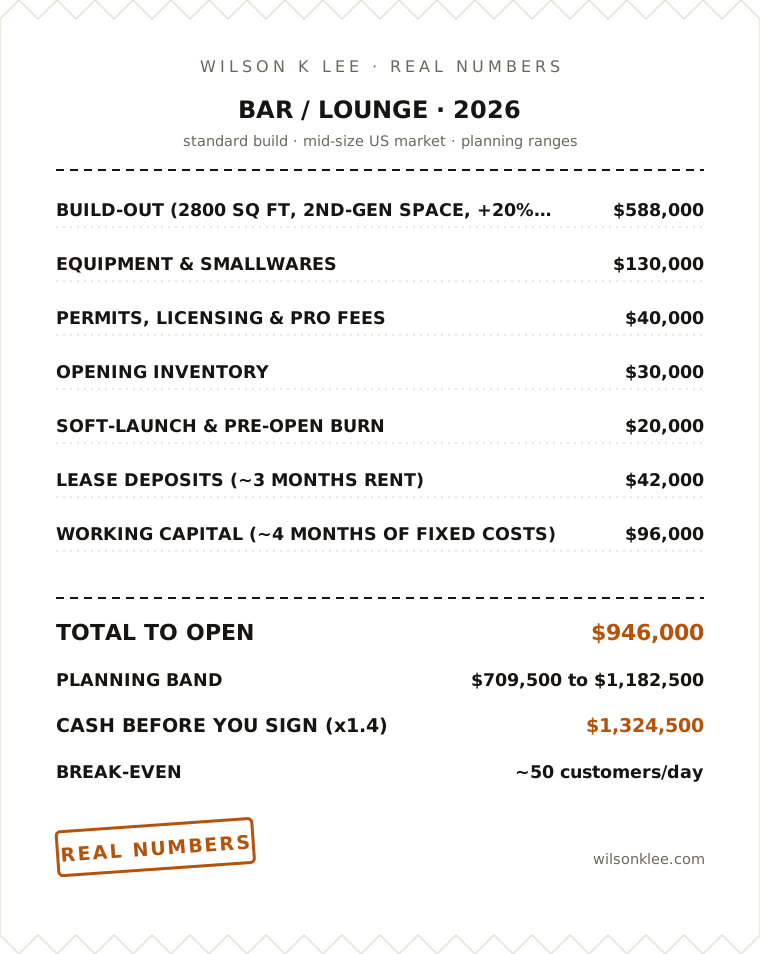
The whole thing, on one receipt
Tool — free · not sponsored, I built it
Want your exact numbers for a bar / lounge? The free calculator runs your cost to open, the ×1.4 cash reserve, and your break-even in about 30 seconds. Prefer paper? The Startup Budget Worksheet is the printable version.
Run your numbers →Questions owners actually ask
Why does the build-out cost $588,000 if I'm taking a second-generation space?
A second-generation space already has plumbing, ventilation, and basic bar infrastructure, which is why this number is lower than a raw shell conversion. The $588,000 includes a 20% contingency on top of the base build cost. That contingency is not padding; it reflects what consistently happens during construction: permit delays, code requirements that surface after demolition, and material cost changes. If you are converting a retail or office space to a bar, budget higher.
How much does a liquor license cost?
There is no single answer, and that is exactly the problem. Liquor license cost, wait time, and rules vary wildly by city and can dwarf your other permits combined. In some markets a license is a few thousand dollars and approves in weeks. In others, a transferable full-liquor license trades on the open market for six figures and can take 12 to 18 months to transfer. The $40,000 permits and licensing line item in the total cost is a planning estimate. Research your specific jurisdiction before you commit to a lease.
What is the x1.4 rule and why does it exist?
The x1.4 rule says you should hold 1.4 times your total projected opening cost in accessible cash before you sign a lease. On a $946,000 opening, that is $1,324,500. The 40% buffer covers the predictable unpredictables: permits that run long, equipment that needs replacement before opening, soft-launch months that bring in less revenue than modeled, and insurance or legal costs that come in above estimate. Operators who open at exactly their build budget with no buffer are one bad month away from a crisis.
How do I hit break-even at 50 customers a day?
At an average ticket of $28 and a monthly burn of $24,000, break-even sits at roughly 50 customers per day, or about $42,000 per month in revenue. Getting there consistently requires a bar that gives people a specific reason to choose it, a reliable weekend draw, and a weekday strategy (happy hour, events, private bookings) to smooth out the slow nights. The number itself is achievable, but it does not happen on its own in the first month. That is why the working capital line funds four months of fixed costs.
What does the 25/25/25 prime cost target mean for a bar?
It means you are targeting 25% of revenue for cost of goods sold (your beverage and food cost), 25% for labor, and 25% for occupancy and overhead. That leaves 25% as the margin to service debt, reinvest in the business, and eventually generate profit. Bars carry higher gross margins on liquor than restaurants do on food, but that margin is not free money. It carries late-night labor costs, security staffing, and a heavier insurance load. The 25/25/25 model accounts for all of that.
How do I prevent shrinkage and over-pouring from killing my margins?
Beverage inventory is expensive to stock and easy to shrink. The two main culprits are theft and over-pouring. Controls that work: standardized pour specs enforced at training, a POS system that tracks every drink rung in, regular variance audits comparing theoretical cost against actual cost, and a team culture where controls are framed as protecting the business everyone works in. Over-pouring by a quarter ounce per drink sounds small. Across a high-volume Saturday shift it adds up to real dollars.
Can I open a bar for less than $946,000?
The planning band runs from $709,500 to $1,182,500, so yes, the low end is meaningfully below the midpoint. You get there by taking a smaller footprint, negotiating a stronger tenant improvement allowance from your landlord, sourcing used equipment, and operating in a lower-cost market. What you cannot meaningfully cut is the working capital buffer or the liquor license cost in your specific jurisdiction. Cutting those creates the cash-flow crises that close bars before they find their audience.
Is a bar a good first food and beverage concept?
For most first-time operators, a bar is a high-difficulty first concept. The regulatory complexity around the liquor license, the late-night operational demands, the theft and shrinkage controls, and the insurance profile all require experience or the right operational partner. That said, operators who come in with a clear hospitality background, a specific concept that fills an identifiable gap in their market, and the capital to fund properly have built strong bar businesses as their first venture. The concept is not the barrier. Underfunding and underestimating the operational complexity are.
How much does it cost to open a lounge?
For a standard lounge around 2,800 square feet in a mid-size US market, the real 2026 cost is $946,000. The honest planning band runs from $709,500 on the low end to $1,182,500 on the high end, depending on your market and how much of that build-out you can negotiate down. That figure covers build-out, equipment, permits and licensing, opening inventory, soft-launch burn, lease deposits, and working capital.
Is opening a lounge cheaper than opening a bar?
A lounge and a bar at the same footprint carry the same cost structure in this model, roughly $946,000 for a 2,800 square foot second-generation space. Where the number moves is your specific build-out condition, your city's liquor license cost and wait time, and how premium your equipment and design choices are. A smaller lounge footprint or a stronger tenant improvement allowance from your landlord can pull you toward the $709,500 low end.
The Weekly Receipt
One brand story, one number, one answered question. 2 minutes, Tuesdays.
Free. Unsubscribe anytime, one click, no games.
You're in, friend. See you Tuesday.