Boba / bubble tea · The complete guide Updated August 2026
How Much Does It Cost to Open a Boba Tea Shop in 2026?
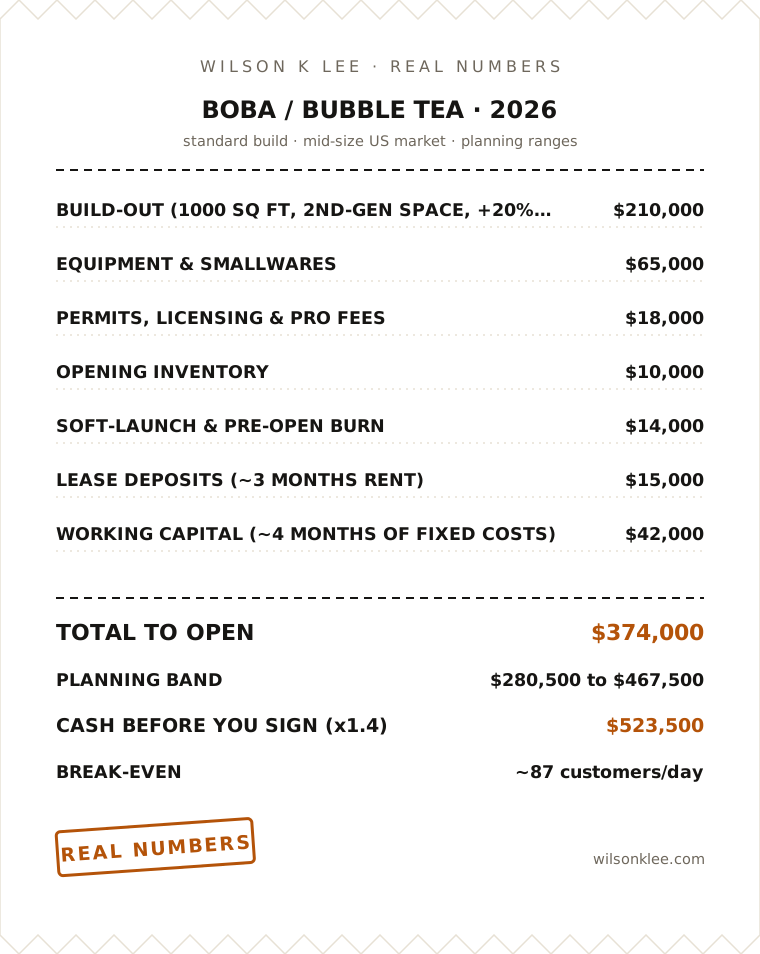
Opening a standard boba shop (roughly 1,000 sq ft, mid-size US market) costs $374,000 in total startup spend, with a planning band of $280,500 to $467,500. You need $523,500 in cash before you sign a lease, using Wilson's x1.4 rule. Break-even lands at roughly 87 customers per day, or about $18,300 in monthly revenue.

Watch the interview
Source: YouTube · the full conversation, free
What Is the Real Cost to Open a Boba Shop in 2026?
The number most people find online is too low. It does not account for contingencies, working capital, or the months of fixed costs you burn before a single customer walks through the door. Here is the full, honest picture for a standard boba shop, roughly 1,000 square feet in a second-generation (previously built-out) space in a mid-size US market.
| Line item | Cost |
|---|---|
| Build-out (1,000 sq ft, 2nd-gen space, +20% contingency) | $210,000 |
| Equipment and smallwares | $65,000 |
| Permits, licensing and pro fees | $18,000 |
| Opening inventory | $10,000 |
| Soft-launch and pre-open burn | $14,000 |
| Lease deposits (~3 months rent) | $15,000 |
| Working capital (~4 months of fixed costs) | $42,000 |
| Total | $374,000 |
The planning band is $280,500 on the low end to $467,500 on the high end. Use the midpoint, $374,000, as your working number. Use the high end for your stress test.
A few line items deserve more explanation.
Build-out: $210,000
This assumes a second-generation space, meaning someone else already built the shell. A raw vanilla shell in a strip mall or mixed-use building costs significantly more. The 20% contingency is not optional. Construction almost always runs over. Bake it in from day one.
Equipment and smallwares: $65,000
This covers your tea brewers, sealing machines, blenders, refrigeration, POS system, smallwares, and the miscellaneous gear you forget until the week before you open. Boba equipment is genuinely lower-cost than a full-service kitchen, and that is one of the real advantages of the concept.
Permits, licensing, and pro fees: $18,000
City business license, health department permits, food handler certifications, architect or expeditor fees, and legal review of your lease. These costs vary by city, but $18,000 is a solid planning number for a US urban or suburban market in 2026.
Working capital: $42,000
This is four months of fixed costs when sales are zero or near zero. Most operators underfund this line item and then panic at month two. Do not be that operator.
Why You Need $523,500 in Cash Before You Sign the Lease
The total project cost is $374,000. So why do you need $523,500?
Because the project cost is not the same as what you need to control before committing. Wilson’s x1.4 rule: multiply your total startup cost by 1.4 before you sign anything. That multiplier covers cost overruns, a slower ramp than projected, a supplier problem in the first 90 days, and the personal expenses you still have while you are not yet drawing a salary. $374,000 times 1.4 is $523,500. That is your number.
This is not pessimism. This is the rule that separates operators who survive year one from operators who close in month eight and spend the next three years paying off debt. The build-out runs over. The equipment takes longer to arrive than the vendor promised. You run a soft launch and your throughput is slower than you modeled. All of this is normal. The x1.4 cash position absorbs it.
If you do not have $523,500 in accessible capital, you are not ready to sign a lease on a standalone boba shop. That is a direct statement, not a judgment. It means you have more saving or funding to do first.
What Does the Money Model Actually Look Like?
Here are the three numbers that govern your boba shop’s financial life.
Average ticket: $7
Boba is a low-ticket item. That is the concept’s core constraint. You are not running a steakhouse where one table covers your labor for the night. Every dollar of profit comes from volume.
Monthly fixed cost burn at zero sales: $10,500
Rent, utilities, insurance, and base labor do not stop when customers do. $10,500 per month is what leaves your account whether you serve 0 drinks or 500.
Break-even: about 87 customers per day
That works out to roughly $18,300 per month. At a $7 average ticket and 30 operating days, you need roughly 2,614 transactions per month to cover your fixed costs. That is 87 people per day. In a well-located, well-run boba shop, that is achievable. In a slow location with a complicated menu and a slow line, it is not.
The 25/25/25 prime-cost target
Aim for food cost at 25% of revenue, labor at 25% of revenue, and occupancy at 25% of revenue. That leaves 25% for everything else: debt service, repairs, owner draw, and profit. Boba’s food cost can come in well under 25% on the right menu items, which is part of why the concept attracts so many operators. But low food cost does not rescue you from high labor or overpriced rent.
What Are the Traps That Sink Boba Shops?
Three problems show up again and again. All three are avoidable.
| Trap | Why it sinks shops | The fix |
|---|---|---|
| Ignoring throughput | At a $7 ticket, a slow line cannot cover fixed costs | Design the production line before signing the lease; aim for two drinks per minute |
| A bloated menu | More items mean more waste, slower service, and higher food cost | Run a focused menu of your best-margin, highest-velocity drinks |
| Cheap rent in the wrong spot | Low foot traffic means you never reach 87 customers a day | Pay for a high-density, high-traffic location with the right demographic |
Trap one: ignoring throughput
Boba is a volume business. At a $7 ticket, you cannot afford a slow line. The shops that make serious money run two drinks per minute or better during peak hours. That pace does not come from hiring talented baristas. It comes from systems. Design your production line before you sign the lease. Know exactly where each ingredient lives, how each drink is built, and how many steps each build requires. If you design the space first and figure out the workflow later, you will spend money on a renovation you did not plan for.
Trap two: a bloated menu
More menu items feel like more revenue. They are actually more waste, slower throughput, more training complexity, and more inventory to manage. The fewer builds you have, the faster your line runs and the lower your cost of goods. A focused menu of your best-margin, highest-velocity drinks outperforms a sprawling menu every time.
Trap three: cheap rent in the wrong spot
Foot traffic is the variable that determines whether you hit 87 customers a day or fall short of it. A younger, social customer base in a high-density area, near residential towers, near campuses, or in active retail corridors, gives you the volume the model requires. Saving $500 a month on rent in a location where nobody walks by costs you $5,000 a month in revenue. The math is not close.
Is a Boba Shop the Right Concept for You?
Boba works when three things are true. First, you have or can access a high foot-traffic location with the right demographic. Younger customers who treat bubble tea as a social ritual, not just a beverage, are your core. Second, you are willing to build and enforce operational systems from the beginning, not after things go wrong. Third, you have the capital position described above, $523,500 in accessible cash, before you commit.
This guide covers the numbers. If you want the operational walkthrough, the licensing, the menu build, and the launch sequence, read how to start a bubble tea shop next.
Boba is also a concept that can be tested at smaller scale before you open a standalone shop. A booth at a farmer’s market or a night market is a real way to validate your recipes, your branding, and your throughput before you are on the hook for a multi-year lease. Wilson has run two to three boba booths at a large Vancouver marketplace every year. The operational lessons from a booth, how fast you can build drinks, how your signage converts foot traffic, which items people actually order, transfer directly to a brick-and-mortar.
One more honest note: boba is afternoon-to-late biased in its demand curve. Your lunch rush will be smaller than a sandwich shop. Your late-afternoon and evening windows are where volume concentrates. Staff and schedule accordingly. Do not pay morning labor for a morning rush that is not there.
Franchise vs. Independent: What Does It Actually Cost?
If you choose a franchise route, you are adding a franchise fee of $30,000 to $50,000 on top of the build-out and startup costs above, plus ongoing royalties of 6% to 8% of revenue every month. The trade-off is a proven system, an established menu, and a brand the customer already recognizes. You do not have to figure out your demographic, your menu, or your supply chain from scratch.
If you build your own brand, you skip those fees and royalties. You keep more margin long-term. The cost is that every decision, menu, branding, supplier relationships, systems, falls on you. Neither path is automatically better. The franchise path is lower-risk if you are a first-time operator who needs structure. The independent path creates more value if you are willing to do the foundational work.
The whole thing, on one receipt
Tool — free · not sponsored, I built it
Want your exact numbers for a boba / bubble tea? The free calculator runs your cost to open, the ×1.4 cash reserve, and your break-even in about 30 seconds. Prefer paper? The Startup Budget Worksheet is the printable version.
Run your numbers →Questions owners actually ask
How much does boba shop equipment cost?
Budget $65,000 for equipment and smallwares in a standard 1,000 sq ft US shop. That covers tea brewers, sealing machines, blenders, refrigeration, a POS system, and the smallwares you will inevitably need in the first week. Boba equipment runs lower than a full-service kitchen, which is a genuine advantage of the concept, but $65,000 is the honest all-in planning number, not the optimistic one.
How much does a boba shop spend on inventory each month?
The 25/25/25 prime-cost model targets food cost at 25% of revenue. At break-even revenue of roughly $18,300 per month, that is about $4,575 in monthly food cost. On some high-margin items, like a simple tea-and-syrup build, ingredient cost can drop to 30 to 40 cents per drink on a drink that sells for $5 to $6, so your actual cost per drink varies widely by menu. Opening inventory is $10,000, which gets you stocked and through your first weeks of service.
Where can I learn how to make bubble tea and get recipes?
The operational and recipe foundation matters, but it is only one piece of what you need to learn. On the recipe side, look for formal barista or tea training programs, supplier training offered by your tea and tapioca vendors (many offer this as part of the wholesale relationship), and structured courses from established boba educators. On the business side, getting the systems right, menu, line design, cost controls, is what determines whether your shop is profitable, not just whether your drinks taste good.
Is a mix of a bakery and a boba shop a good idea?
Adding a bakery component raises your food cost, your equipment cost, your labor complexity, and your build-out requirements. The throughput advantage of boba, that a well-designed line can produce two drinks per minute, disappears when your team is also managing baked goods production. If a baked item is a high-margin add-on that requires no additional equipment or labor, it can work. If it requires a separate production system, it competes with the thing that makes boba shops profitable: simplicity and speed. Nail the boba operation first.
Should I worry about tapioca or boba ball supply chain shortages?
Supply chain disruptions for tapioca pearls have been real and they do affect operators, especially small ones with no purchasing leverage. The practical response is to establish relationships with at least two suppliers before you open, not one. Carry more inventory buffer than you think you need in the early months, and design your menu so that at least some of your top-selling drinks do not depend exclusively on tapioca pearls. Supplier diversification is an operational system, not a reaction to a crisis.
Should I open a standalone shop or test with a market booth first?
A market booth is a legitimate way to validate before committing to a lease. A business license for a farmers market or night market booth typically costs $100 to $200 and you can be operational within weeks. You learn your throughput speed, which menu items convert, and how your branding performs in a competitive row of vendors, all before you are on the hook for a multi-year commercial lease and $374,000 in startup costs. The booth experience translates directly to the brick-and-mortar operation.
Is there a program or team that can help new boba shop owners with systems and setup?
Franchise systems are one structured path: you get the menu, the supply chain, and the operational playbook built in, at the cost of a $30,000 to $50,000 franchise fee plus 6% to 8% monthly royalties. For independent operators, investing in formal business education focused on food and beverage operations, and building your line design and systems before you open rather than after, is the highest-leverage thing you can do. The system is the business. Getting it right at the start costs far less than fixing it later.
How do I think about location when opening a boba shop?
Location determines whether you hit break-even, which is 87 customers per day. High-density residential areas, blocks near younger demographics, and active retail corridors give you the foot traffic the volume model requires. Saving on rent in a low-traffic location costs you more in lost revenue than the rent savings are worth. Cheap rent in the wrong spot is one of the three documented traps that sink boba shops.
The Weekly Receipt
One brand story, one number, one answered question. 2 minutes, Tuesdays.
Free. Unsubscribe anytime, one click, no games.
You're in, friend. See you Tuesday.
Keep going: boba / bubble tea guides
How to Open a Boba Shop in 2026: The 9-Step Blueprint
Learn how to open a boba shop in 2026 with this 9-step blueprint covering community, vertical focus, location
How to Start a Boba Shop: A Step-by-Step Guide
A step-by-step guide to starting a boba shop: customer, location, menu, equipment, and systems, from an operat
How to Start a Boba Booth at Farmers Markets and Events
A step-by-step guide to launching a bubble tea booth at farmers markets and events, covering licensing, brandi
Why Busy Bubble Tea Shops Still Close: The Rent Math
A busy line does not mean a healthy shop. The real numbers behind boba shop failures, and whether franchise fe