Coffee shop · The complete guide Updated August 2026
How Much Does It Cost to Open a Coffee Shop in 2026?
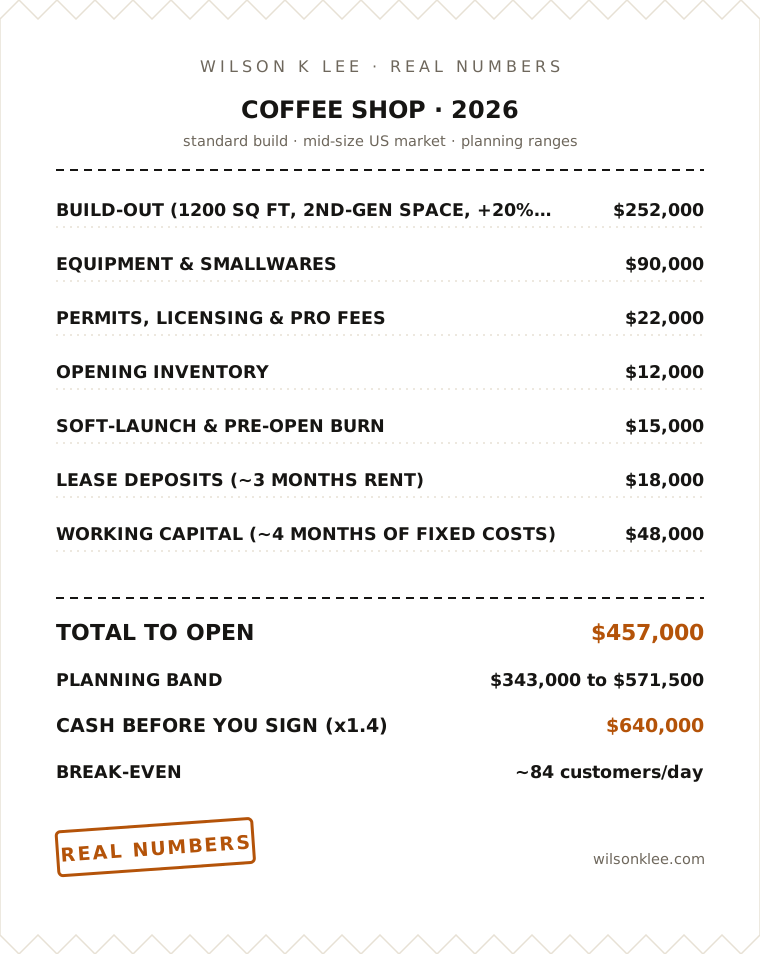
Opening a standard 1,200 sq ft coffee shop in a mid-size US market costs $457,000 all-in, with a planning band of $343,000 to $571,500. Before you sign a lease, Wilson's x1.4 rule says you need $640,000 in accessible cash. At an average ticket of $8, you break even at roughly 84 customers per day.

Watch the interview
Source: YouTube · the full conversation, free
What is the real number to open a coffee shop?
The real number is $457,000.
Not the number you see on a forum. Not the “$80k home espresso bar” someone opened in their garage. A proper 1,200 sq ft, second-generation space, mid-size US market coffee shop that a real customer would walk into in 2026.
The planning band is $343,000 on the low end to $571,500 on the high end. If you are anywhere in that range, you are not doing it wrong. If someone quotes you $150,000, they are leaving out half the list.
Here is every line item, computed for 2026:
| Line item | Cost |
|---|---|
| Build-out (1200 sq ft, 2nd-gen space, +20% contingency) | $252,000 |
| Equipment & smallwares | $90,000 |
| Permits, licensing & pro fees | $22,000 |
| Opening inventory | $12,000 |
| Soft-launch & pre-open burn | $15,000 |
| Lease deposits (~3 months rent) | $18,000 |
| Working capital (~4 months of fixed costs) | $48,000 |
| Total | $457,000 |
A few things worth calling out before you move on.
Build-out is the biggest single line at $252,000, and that already includes a 20% contingency. Second-generation spaces, meaning spaces that previously housed a food or beverage tenant, save you money on plumbing, hood rough-ins, and grease trap work. If you go raw retail, that number climbs fast.
Equipment is $90,000. That is not a typo, and it is not padded. A commercial 2-group espresso machine, the grinders that go with it, water treatment, a brewer, a reach-in refrigerator, bar equipment, and smallwares add up to exactly this range once you spec it out properly. More on this in the traps section below.
Working capital at $48,000 represents four months of fixed costs. That is your survival runway. Burn through it before you find your morning rhythm and you are negotiating with your landlord, not serving coffee.
What is the x1.4 rule, and why does it matter before you sign anything?
The total investment figure is $457,000. The number you need in accessible cash before you sign a lease is $640,000.
That is Wilson’s x1.4 rule, and it exists because the gap between what you plan and what actually happens is never zero.
Permits take longer than quoted. Your contractor hits a structural issue behind the wall. The equipment vendor is backordered six weeks and you are still paying rent. A soft launch runs longer than expected because your team needs more reps. Every one of these is normal, and every one of them costs money you did not budget.
Multiply your total projected cost by 1.4. That is your cash threshold. If you do not have it, you are not underfunded by a little. You are one surprise away from closing before you ever find your regulars.
This is not pessimism. It is the math of how construction and pre-opening periods actually work.
What does the money model look like once you are open?
Three numbers run your coffee shop: your average ticket, your daily cover count, and your prime cost.
Your average ticket in a standard coffee shop sits around $8. That is your planning number. It is a low-ticket business. That is not a bug, it is the nature of the model, and it shapes every other decision you make, including where you sign a lease and how fast your throughput needs to be.
Your monthly fixed cost burn at zero sales is approximately $12,000. That is rent, baseline labor, and utilities before a single cup pours.
Your break-even sits at roughly 84 customers per day, which translates to about $20,200 per month in revenue.
84 people a day sounds approachable until you realize 80% of them need to show up between 6am and 10am. The morning rush is not one part of your day. It is the day. If your throughput chokes at 8am because your workflow is wrong, your bar layout is slow, or your team is not trained to move, you lose the majority of your revenue opportunity in a 90-minute window and nothing you do the rest of the day makes it back.
On the cost side, target a 25/25/25 prime cost structure. That is 25% food and beverage cost, 25% labor cost, and 25% occupancy and overhead. That leaves 25% for everything else, including your own income and any profit you plan to reinvest. If any one of those three buckets runs above 25%, you are compressing the others.
Coffee shops run on volume, not margin. Low ticket means you need covers per hour, not just covers per day. A great location, a fast bar, and a trained team are not nice-to-haves. They are the business model.
What are the traps that blow up coffee shop budgets?
Three traps kill coffee shop openings before the shop ever gets a chance to find its audience.
Espresso equipment. This is where budgets blow up most reliably. A 2-group espresso machine plus grinders plus water treatment runs more than most first-time operators plan for. People see a price on a consumer machine, extrapolate to commercial, and get to the equipment quote with sticker shock they cannot absorb. The $90,000 equipment line in this guide already reflects real commercial specs. Do not plan around a lower number and hope to negotiate down.
Morning rush throughput. Your morning rush is 80% of your day. If your bar is laid out wrong, your workflow has a bottleneck, or your staff is not yet fast enough to handle the line at 8am, you lose the whole day’s revenue in that window. Bad throughput is not a training problem you fix later. It is a design problem you fix before you open, in the build-out phase, when changes cost labor instead of demolition.
Rent as a percentage of a low ticket. A coffee shop lives and dies on covers per hour, not on price. When your average ticket is $5 to $9, your rent tolerance is much lower than a full-service restaurant running $40 average tickets. A rent number that looks reasonable on paper, say $6,000 a month, requires 750 transactions at $8 average just to cover that single line item. Before you sign, run the math at your actual projected ticket. If the break-even on rent alone requires more daily covers than your location can physically deliver, the lease is wrong.
The 75% first-year failure rate for coffee shops is not a mystery. It is these three things, compounded by poor hiring (bringing in people who do not share your values, which leads to theft, comps, and toxic culture) and bad location selection (choosing a space based on rent rather than foot traffic density and neighborhood characteristics). Location is a volume game. Low ticket means you need high density. If you cannot afford a high-traffic location, you need a neighborhood with high residential density and a delivery strategy to go with it.
Is a coffee shop the right business for you?
A coffee shop is a hard, physical, early-morning business. It opens at 6am. You are on your feet for long hours. The margin per unit is thin, the volume requirement is high, and the business is only as strong as the team you build around you.
The people who make it through the first year are not the ones who made the best coffee. They are the ones who hired based on values, not just availability. They are the ones who managed inventory tightly enough to avoid spoilage eating their cost of goods. They are the ones who built a vendor relationship instead of just a vendor transaction, which matters when supply gets tight and you need a partner instead of just a supplier.
If your reason for opening is to have a relaxed, laid-back lifestyle business, the math will correct that expectation quickly. If your reason is to build something, to create a place where people want to come back every morning, to run a tight operation and grow it into multiple locations, the model supports that.
Know your why before you spend $457,000 finding out.
How do you fund a coffee shop opening?
The most common funding path combines personal savings with a small business loan, typically an SBA 7(a) loan for operators who have a completed business plan, a personal credit history that can support the application, and enough of their own capital to show meaningful skin in the game.
Lenders want to see a real business plan, not a concept overview. That means a projected profit and loss with line-item assumptions, a break-even analysis (you now have the numbers to build one), a location thesis, and evidence you understand the operational model. The numbers in this guide are your foundation for that document.
The x1.4 rule applies to funded openings too. If you are borrowing part of the capital, make sure your own accessible cash plus the loan proceeds together reach that $640,000 threshold before you commit to a lease. A loan that gets you to $457,000 but leaves you with no buffer is a loan that gets you to your first crisis with no options.
How Much Does It Cost to Open a Coffee Shop, All In?
It costs $457,000 to open a standard 1,200 square foot coffee shop in a mid-size US market in 2026. Your real planning range runs from $343,000 on the low end to $571,500 on the high end, depending on your space condition and build-out scope.
Break that $457,000 into six pieces: build-out at $252,000, equipment and smallwares at $90,000, permits and licensing at $22,000, opening inventory at $12,000, soft-launch burn at $15,000, lease deposits at $18,000, and four months of working capital at $48,000. Build-out and equipment alone make up more than 75% of your total spend, so that is where your research time belongs before you fall in love with a space.
That $457,000 figure is your project cost, not your cash requirement. Multiply it by 1.4 to get the $640,000 you need sitting in accessible cash before you sign a lease. That buffer covers the permit delays, the contractor surprises, and the longer-than-planned soft launch that hit almost every opening. Skip the buffer and you are financing your first crisis instead of your first year.
The whole thing, on one receipt
Tool — free · not sponsored, I built it
Want your exact numbers for a coffee shop? The free calculator runs your cost to open, the ×1.4 cash reserve, and your break-even in about 30 seconds. Prefer paper? The Startup Budget Worksheet is the printable version.
Run your numbers →Questions owners actually ask
How much does it cost to open a coffee shop on average in 2026?
The all-in cost for a standard 1,200 sq ft coffee shop in a mid-size US market is $457,000, with a realistic planning band of $343,000 to $571,500. Before you sign any lease, you need $640,000 in accessible cash, applying the x1.4 rule to cover the gap between your plan and what actually happens during build-out and pre-opening.
How do I get approved for a loan to open a coffee shop?
Start with a completed business plan that includes a line-item budget, a projected profit and loss, and a break-even analysis. The numbers in this guide give you the foundation. Lenders, especially SBA 7(a) lenders, want to see that you understand your cost structure, that your revenue assumptions are grounded in real unit economics (average ticket, daily cover count, monthly burn), and that you have meaningful personal capital in the deal. A plan you built yourself, using real numbers, signals operational seriousness in a way a generic template does not.
How many customers a day does a coffee shop need to break even?
At an average ticket of $8 and a monthly fixed cost burn of approximately $12,000, break-even sits at roughly 84 customers per day, which equals about $20,200 per month in revenue. The critical point is that the majority of those customers need to come through during your morning rush. If throughput at 8am is slow, you cannot make it back later in the day.
Does insurance cost differ by country or region when opening a coffee shop?
Yes, insurance costs vary significantly by country, state, and even municipality. Policies differ in what they cover, what minimums are legally required, and what landlords demand as a condition of the lease. The $22,000 permits, licensing, and professional fees line in this guide reflects a US mid-market context. If you are opening outside the US, treat that line item as a research task specific to your jurisdiction, and add a buffer to your working capital accordingly.
If two menu items have the same food cost and price but one takes twice as long to make, how do I account for that?
The food cost percentage looks identical on paper, but the labor cost per item is not equal. The item that takes twice as long is consuming twice the labor time per sale. The correct way to account for this is to calculate a labor cost per item based on your hourly wage rate and the actual prep time, then add that to your food cost when evaluating true item profitability. This is especially important during your morning rush, where throughput speed directly determines how many customers you can serve in a fixed window. A slower item at the same price point is a less profitable item.
What is the biggest single budget trap when opening a coffee shop?
Espresso equipment. A commercial 2-group espresso machine, the grinders required to run alongside it, and proper water treatment cost more than most first-time operators budget for when they first start planning. The $90,000 equipment line in this guide already reflects real commercial specs. Plan to that number, not to a lower figure you hope to negotiate down.
Is there a reliable ratio between foot traffic passing a coffee shop and actual sales?
There is no single universal conversion ratio that holds across all locations, concepts, and formats. What Wilson's model does give you is a firm target to work backward from: you need roughly 84 customers per day to break even at an $8 average ticket. Use that number to evaluate any location you are considering. Ask yourself whether the foot traffic, visibility, and neighborhood density can realistically deliver 84 paying customers per day, with the bulk arriving in the morning hours. If the honest answer is no, the location is wrong regardless of the rent.
Did Wilson actually build and run a coffee shop, or is this just theory?
Wilson built 720 Sweets from a single shop to seven locations before selling the chain. The operational principles in this guide, the x1.4 cash rule, the 25/25/25 prime cost structure, the morning rush throughput problem, come from running a multi-unit food and beverage business, not from reading about one. The specific numbers are computed from his own planning calculator for 2026 market conditions.
How much money do you need to open a coffee shop?
You need $457,000 for the actual build-out and opening, and $640,000 sitting in accessible cash before you sign a lease. That gap is Wilson's x1.4 rule, and it covers permit delays, contractor surprises, and a soft launch that runs longer than planned. Anyone quoting you $150,000 or less is leaving major line items off the list.
What is the biggest expense when opening a coffee shop?
Build-out is the single largest line item at $252,000, even with a 20% contingency built in and even assuming you find a second-generation space that already had plumbing and grease traps. Equipment is the next biggest surprise at $90,000, mostly driven by the espresso machine, grinders, and water treatment. Together these two lines make up more than 75% of your total $457,000 opening cost.
The Weekly Receipt
One brand story, one number, one answered question. 2 minutes, Tuesdays.
Free. Unsubscribe anytime, one click, no games.
You're in, friend. See you Tuesday.
Keep going: coffee shop guides
8 Steps to Building a Profitable Coffee Shop Business
Wilson K Lee breaks down the 8 essential steps to start and run a profitable coffee shop, from knowing your cu
How Grounds & Hounds Built a $1.2M Coffee Brand
Wilson K Lee breaks down how Grounds & Hounds went from $100K to $1.2M in revenue selling coffee online by bui
How to Calculate Food Cost Percentage for a Cafe
How to calculate food cost percentage, the difference between ideal and actual, and how to use both to protect
How to Open a Coffee Shop: Concept to Opening Day
Wilson K Lee breaks down every step to open a coffee shop, from finding your why and choosing a concept to bud
How to Write a Coffee Shop Business Plan (Step-by-Step)
A step-by-step guide to writing a coffee shop business plan: concept, team, location, menu and financials, fro
5 Reasons Coffee Shops Fail in Their First Year
75% of coffee shops fail in year one. Here are the five real reasons why, and exactly what you can do to make
5 Unique Coffee Shop Concepts That Actually Work
Five unusual coffee shop concepts from Asia and beyond, why each one works, and how to apply the ideas to your