Ice cream shop · The complete guide Updated August 2026
How Much Does It Cost to Open an Ice Cream Shop? (2026)
Opening a standard ice cream shop (~1,100 sq ft, mid-size US market) costs $404,500 in total investment, with a planning band of $303,500 to $505,500. Before you sign a single lease, you need $566,500 in accessible cash using the x1.4 rule. Break-even lands at roughly 68 customers per day, or about $18,400 in monthly revenue.

Watch the interview
Source: YouTube · the full conversation, free
What Is the Real Number to Open an Ice Cream Shop?
Stop budgeting from vibes. The real number to open a standard ice cream shop, roughly 1,100 square feet in a second-generation space in a mid-size US market, is $404,500.
That is the planning midpoint. The honest band is $303,500 on the low end to $505,500 on the high end, depending on your market, your landlord’s tenant improvement allowance, and how disciplined you are with your build-out.
Here is every line item, computed for 2026:
| Line item | Cost |
|---|---|
| Build-out (1,100 sq ft, 2nd-gen space, +20% contingency) | $231,000 |
| Equipment and smallwares | $75,000 |
| Permits, licensing and pro fees | $18,000 |
| Opening inventory | $10,000 |
| Soft-launch and pre-open burn | $12,000 |
| Lease deposits (~3 months rent) | $16,500 |
| Working capital (~4 months of fixed costs) | $42,000 |
| Total | $404,500 |
Walk through each line before you borrow a dollar.
Build-out at $231,000 is your biggest number and your biggest risk. The 20% contingency is not optional padding. City inspections, permit delays, and surprise structural work will find you. The contingency is there because construction always costs more and takes longer than the contractor’s first quote.
Equipment at $75,000 is the spike that surprises first-time operators. Freezers and display cases are the core of that number. They also run 24 hours a day, 7 days a week, so they show up again every month on your utility bill. Buy the right equipment for your concept from the start. Swapping a soft-serve machine for a batch freezer mid-build costs you twice.
Working capital at $42,000 covers roughly four months of fixed costs at zero sales. This is not a cushion for mistakes. It is the planned runway between your doors opening and your shop actually breaking even. Most ice cream shops do not break even in month one. Budget for that reality now.
What Is the x1.4 Rule, and Why Does It Change Everything?
The total investment is $404,500. The cash you need before you sign the lease is $566,500.
The x1.4 rule is simple: take your total project cost and multiply it by 1.4. That is your actual cash position target before you commit to a space.
The gap between $404,500 and $566,500 is not waste. It is protection. Lease negotiations require deposits. Contractors want draws before work is done. Your opening inventory needs to be paid before you have any revenue. Pre-opening payroll, grand-opening marketing, and the slow first weeks all pull from the same account.
If you sign a lease at $404,500 in the bank with no buffer, a single inspection delay or a slow opening month can put you in a position where you cannot make rent. That is when good concepts close for reasons that have nothing to do with the food.
Get to $566,500 first. Then sign.
What Does the Money Model Actually Look Like?
Three numbers anchor the financial model for an ice cream shop.
Average ticket: $9. Ice cream is a low-ticket category. That is not a problem, but it does define how you win. You win on volume and on add-ons. Toppings, bundles, and combo upgrades are how your average order value climbs. A customer who comes in for a $6 soft serve and leaves with a $12 waffle cone combo is the model. Design your menu and your service flow to make that easy.
Monthly burn at zero sales: $10,500. This is your fixed cost floor. Rent, utilities, baseline labor, and debt service. If your shop is closed and generating no revenue, you are still spending roughly $10,500 every month. That number defines your urgency to reach break-even.
Break-even: ~68 customers per day, or ~$18,400 per month. That is the number. Sixty-eight transactions at a $9 average gets you to a revenue line that covers your fixed costs. Everything above that contributes to profit and to building back your reserves.
The prime-cost target for a healthy ice cream shop is 25/25/25: 25% food cost, 25% labor cost, 25% occupancy cost. That leaves 25% for everything else, including debt service, repairs, and eventually profit. If any one of those three buckets is running over 25%, you have a structural problem, not a bad week.
One more truth about the money model: this is a seasonal, weather-driven business. Summer and evenings carry the year. You will make a disproportionate share of your annual revenue in a few months. Your cash reserve has to survive a slow winter. Build your financial plan around that reality, not around a smooth average monthly revenue assumption.
What Are the Traps This Concept Sets for You?
Three specific traps show up in ice cream shop financials more than anywhere else.
Trap one: Seasonality. You make the year in summer. A slow January and February feels manageable when you have reserves. It becomes a crisis when you do not. The operators who close in winter are almost always operators who spent their summer revenue instead of holding it. Treat your peak-season cash like it has to last twelve months, because it does.
Trap two: Equipment cost and energy draw. Freezers and display cases are the single largest equipment line in your build-out. They also run continuously. Your utility bill is a fixed cost that most first-time operators underestimate until they get the first full month’s statement. Get actual utility cost estimates from your landlord or neighboring tenants before you sign. Factor that number into your break-even math.
Trap three: Low ticket, high volume dependency. At $9 average, you need traffic to survive. A quiet Tuesday is not covered by a great Saturday. This means your location decision is one of the most consequential choices you make. You need foot traffic, visibility, and proximity to your core customer. For 720 Sweets, that was young Asian millennials on or near a campus who wanted a place to hang out and take photos. The concept, the flavors, and the location all served the same customer. Your concept needs that same clarity.
Is an Ice Cream Shop the Right Concept for You?
The ice cream category has real advantages. The product creates genuine joy. The concept is visually compelling and earns organic social sharing. The operations are simpler than a full-service restaurant. And the demand, especially for premium and experiential formats, is durable.
But the category also demands specific operator skills. You need to understand your product at a technical level. Butterfat content and overrun (the amount of air churned into the mix) determine everything about texture, richness, and how your product holds in the display case. Soft serve ranges from 3% to 5% butterfat. Premium formats like Haagen-Dazs run 12% to 14%. The equipment you need, the space you need, and the logistics you manage are completely different depending on which category you choose. Make the product decision first. The equipment, the suppliers, and the space all follow from it.
You also need to be honest about seasonality. If your market has a real winter, your business model has to account for 3 to 4 slow months every year. That is not a reason to avoid the category. It is a reason to plan the finances correctly.
The concept is right for you if you have the cash position to open properly, a clear customer in mind, a location that serves that customer, and the patience to build volume over time. It is the wrong concept if you are undercapitalized, operating without a cash reserve, or counting on break-even in the first 60 days.
How Do You Fund an Ice Cream Shop?
The source of capital matters less than the total amount. What you need is $566,500 in accessible cash before you sign a lease.
The most common funding paths are personal savings, friends and family investment, SBA loans, and equipment financing. A business plan is not optional for any of these. When you ask someone for money, you are asking them to trust that they will get it back. A detailed business plan, with the line-item breakdown above and a clear path to break-even, is how you demonstrate that. The more specific your numbers, the more confidence you create. Vague plans do not get funded.
If you are starting with less capital than the full number requires, the honest move is to start smaller before you commit to a brick-and-mortar lease. A food truck, a pop-up, or a market stall lets you build your product, your customer base, and your operating experience while you accumulate the capital to open properly. Starting small is not a failure. Opening undercapitalized is.
The whole thing, on one receipt
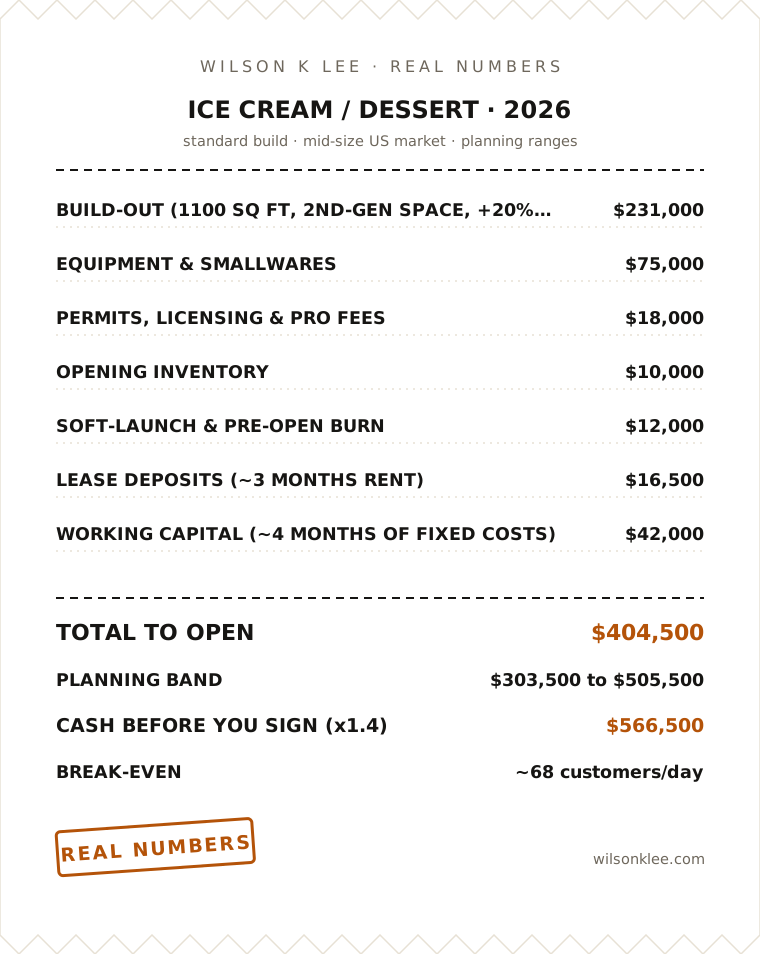
Tool — free · not sponsored, I built it
Want your exact numbers for a ice cream shop? The free calculator runs your cost to open, the ×1.4 cash reserve, and your break-even in about 30 seconds. Prefer paper? The Startup Budget Worksheet is the printable version.
Run your numbers →Questions owners actually ask
What are the pros and cons of a sit-down ice cream shop versus a grab-and-go format?
Sit-down gives you a higher average ticket and longer dwell time. Customers linger, they order more, and the experience itself becomes the product. 720 Sweets was built as a dine-in concept specifically to give young customers a place to belong and take photos, and the experiential element was a core part of the revenue model. Grab-and-go gives you faster throughput, lower labor, and a simpler operation. Your rent-per-square-foot works harder because you are turning customers quickly. The tradeoff is that your average ticket is lower and there is less reason for customers to tell the story of visiting you. Neither format is universally better. The right one depends on your location, your target customer, and whether your concept is built around an experience or a product.
Should I launch with a wide menu of flavors or specialize in a few and make them famous?
Start narrow and get famous for something specific. At 720 Sweets, the menu was built around the target customer first: young Asian millennials who wanted milk tea flavor, green tea, and a soft-serve experience worth photographing. The flavors served the concept and the demographic, not the other way around. A wide menu at launch splits your purchasing, complicates your prep, and makes it harder to build a signature identity. Pick three to five flavors that are undeniably yours, execute them perfectly, and add from there once you know what your customers actually order.
How do I start an ice cream shop with no cash? Are there grants?
The honest answer is that opening a brick-and-mortar shop without capital is the fastest way to close one. The numbers are real: $404,500 total investment, $566,500 in cash before you sign. If you do not have that, the move is to start smaller. A food truck, a pop-up, or a farmers market stall lets you build your product, earn revenue, and stack capital toward a real opening. On grants: they exist at the local and federal level, particularly for minority-owned and women-owned businesses, and an SBA loan is a legitimate funding path. A detailed business plan is required for all of them. But grants alone rarely cover a full opening. Use them as a component of your funding stack, not your entire plan.
How do I know if my rent is too high when I am just starting out?
The rule is that your monthly rent should not exceed 15% of your projected monthly revenue. At a $9 average ticket and 68 customers per day break-even, your monthly revenue target is about $18,400. That means your rent should land at or below $2,760 per month. The reason you can apply this before you open is that you build the projection first, then find a space that fits the model. If the only available spaces in your target market push rent above 15% of your realistic revenue projection, either the market is wrong for this concept at this ticket price or you need to find a different location. Do not let a great-looking space override the math.
I have about $20,000 saved. Can I open an ice cream truck instead of a shop?
Twenty thousand dollars is a real starting point for a mobile concept, not a brick-and-mortar shop. The total investment for a standard shop is $404,500, so a truck or cart is the right first move at your current capital level. A truck has lower fixed costs, no lease deposit, and lets you test locations and customer response before committing to a permanent space. The tradeoffs are real too: weather dependency is higher, your operating radius is limited, and scaling is harder. But starting with a truck, building a customer base, and accumulating capital toward a shop is a legitimate path. The goal is to open right, not to open fast.
What do I need to know about food safety for an ice cream shop?
Ice cream is a temperature-controlled product at every stage. Your display cases and storage freezers run 24/7 and need to hold consistent temperatures. Soft-serve machines require daily cleaning and sanitizing cycles. Health inspectors focus on temperature logs, cross-contamination protocols, and proper storage labeling. The specific requirements vary by city and state, so your local health department is the authoritative source before you build out. What does not vary: if your equipment fails or your temps drift, you have a food safety problem and a potential spoilage loss on the same day. Reliable equipment and a daily temperature-check routine are non-negotiable from day one.
What if I want to open an ice cream shop outside the US?
The framework applies anywhere: define your concept, know your target customer, and build a financial model around your local costs. The specific dollar figures in this guide are calibrated for a mid-size US market. In another country, your build-out costs, equipment import duties, ingredient sourcing, and labor costs will be different. The methodology stays the same: start with the end product, work backward to equipment and space requirements, build a line-item budget, apply a contingency buffer, and identify who your customer is and what problem you are solving for them. Local suppliers and local operators in your market are the best source for country-specific cost benchmarks.
I don't know how to actually make ice cream. How do I learn before I open?
Start with your supplier. Most equipment suppliers and mix distributors offer hands-on training as part of the purchase process. If you are running soft serve, your machine supplier will walk you through the mix ratios, the cleaning cycle, and the draw consistency. If you are making house-made product, a culinary program or a stage (a working apprenticeship) at an existing shop will teach you faster than any video. You do not need to be the best ice cream maker in the world to open a shop, but you do need to understand your product technically, including butterfat content, overrun, and how storage temperature affects texture, so you can train your team and maintain consistency.
The Weekly Receipt
One brand story, one number, one answered question. 2 minutes, Tuesdays.
Free. Unsubscribe anytime, one click, no games.
You're in, friend. See you Tuesday.