Restaurant · Guide Updated September 2026
How to Skip Third-Party Delivery Fees and Keep Profit
Third-party delivery apps charge up to 30% commission, which destroys margins in an industry already running thin. You skip that fee by using your own online ordering with on-demand delivery, paying roughly $1.50 per transaction plus a per-kilometer delivery rate instead of surrendering 30 cents of every dollar. On $60,000 in monthly sales, a conservative 20% savings puts more than $12,000 back in your pocket every single month.
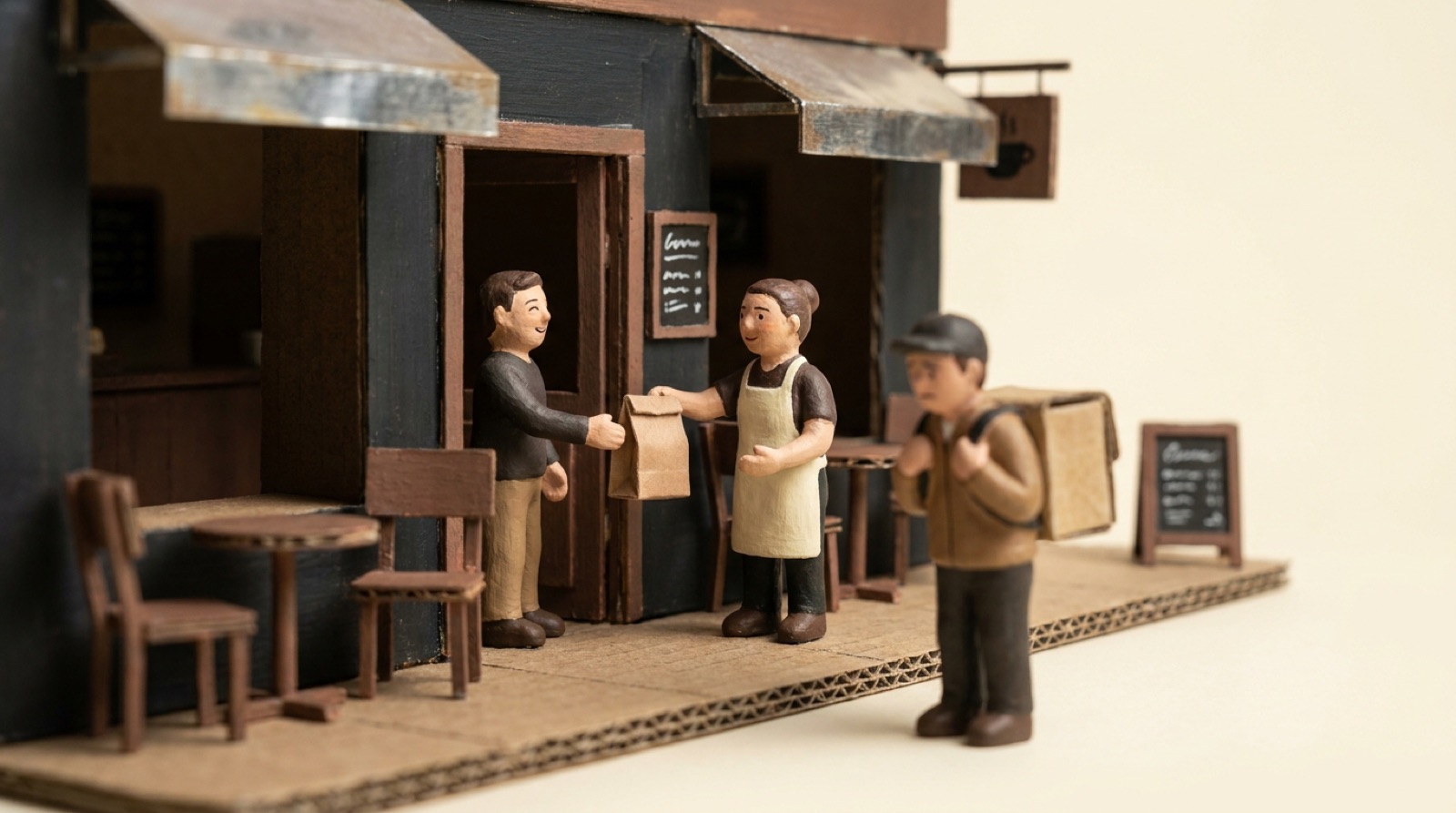
Third-party delivery apps take up to 30% of every order you process through them. That is not a marketing fee you can afford forever. Here is a concrete, numbers-first breakdown of how to stop subsidising those platforms and start keeping that money yourself.
Why Third-Party Delivery Apps Are Your Biggest Profit Problem Right Now
The four major costs eating a restaurant alive are labor, cost of goods sold, rent, and third-party delivery commissions. The first three you expect. The fourth one crept in and now it is just as damaging.
Here is the honest picture of the relationship: you love these apps because they hand you delivery logistics on a plate, expose you to customers who would never have found you otherwise, and generate real revenue. But revenue is not profit. When a platform charges up to 30% commission, and your restaurant is already operating on slim margins, that revenue can actually cost you money.
Every operator I have consulted with has the same reaction to third-party apps: they hate them. That is the universal sentiment. Which is why I treat them as a short-term marketing tool, not a long-term business model. Use them to acquire customers and collect their data. Then bring those customers onto a channel you own and control.
The Math: What 30% Commission Actually Costs You
Let me make this concrete with a simple example. Call the restaurant Wilson’s Wings.
Wilson’s Wings receives a $100 order through a third-party app. Roughly $30 of that goes to the platform covering their transaction fee, commission, and delivery handling. Wilson’s Wings receives $70 back. Out of that $70, you still need to cover food cost, labor, and rent. There is very little left.
Now run the same order through Square Online’s on-demand delivery feature instead.
Wilson’s Wings receives the same $100 order. Square Online charges $1.50 per transaction. The delivery itself is handled by a third-party fleet at a base rate of $4.20 plus $0.75 per kilometer between your restaurant and the customer. If the customer lives five kilometers away, that delivery fee works out to $7.95. ($0.75 x 5 + $4.20 = $7.95.)
The platform commission is gone. You are now deciding what happens with that $7.95 delivery cost, not handing it over as a fee on top of everything else.
How Do You Handle the Delivery Fee? You Have Three Options
This is where you take back control. Square Online gives you three ways to structure the delivery fee.
Option 1: Pass the full fee to the customer. The customer pays the $7.95. Wilson’s Wings keeps $98.50 after the $1.50 transaction fee. You cover food cost, rent, and labor from $98.50 instead of $70. The difference is 40% more money retained per order.
Option 2: You cover the delivery fee yourself. Wilson’s Wings keeps $90.55 after the $1.50 transaction fee and the $7.95 delivery cost. Even covering delivery yourself, you are still significantly ahead of the $70 you were keeping with the third-party app.
Option 3: Split it. Cap what the customer pays, say $5.00, and you absorb the remaining $2.95. Wilson’s Wings keeps $95.55. The customer feels taken care of. You still keep far more than you would through a commission-based platform.
The hybrid option opens up a useful tactic: waive the delivery fee entirely when a customer orders above a certain threshold. Set that threshold at, say, $100 and you are incentivising larger orders. Your average order value goes up, which gives you more margin to absorb the delivery cost anyway, and the customer feels rewarded. Everyone wins.
What Does This Look Like at Scale?
One order saved is a small win. But this compounds fast.
If Wilson’s Wings does $60,000 in monthly sales and uses a conservative 20% savings estimate by switching away from commission-based apps, that is more than $12,000 back in the business every single month. Over a full year, that is more than $144,000 that was previously going to a platform and is now yours.
That number is not hypothetical. It is straightforward math on the commission differential. The on-demand delivery model eliminates the percentage cut and replaces it with a flat fee structure you can plan around.
Why You Own the Customer Relationship Now
The commission fee is the obvious win, but the customer data is the one that compounds over time.
When a customer orders through DoorDash or Uber Eats, that customer belongs to the platform. You cannot message them. You cannot tell them about a new menu item, a promotion, or your brand story. If that platform changes its algorithm or raises its fees, you have zero recourse because you have zero relationship with your own customer.
When the order comes through your own website, you own that data. You can reach out directly. You can share promotions, announce new products, and build a brand that customers actually feel connected to. A restaurant with a loyal, direct customer base is worth significantly more if you ever decide to sell it than one that depends entirely on third-party platforms for visibility.
I built 720 Sweets from one shop to seven locations and eventually sold it. One of the things I wish I had during those years was a tool that let me handle delivery without surrendering either the commission or the customer data. Both matter.
Three Steps to Get This Running in Your Restaurant
First, set up your own online ordering with on-demand delivery enabled. The setup is free at the baseline level, meaning no monthly subscription to get started, and the site renders cleanly on mobile, which is where the majority of your customers are browsing anyway.
Second, decide your delivery fee structure before you go live. Work through the three options above with your own numbers. Know your average ticket, know your average delivery distance, and set a policy you can communicate clearly. Guessing at this after launch creates confusion with customers.
Third, tell your customers loudly and often. Post it on your social channels. Put a card in every in-store order. Send a message to everyone who has eaten with you before. Tell them you now take orders directly from your own website and delivery is available. Customers already know the third-party apps are expensive. Many of them want to support you directly. Give them the way to do it.
The Bottom Line
Third-party apps are a customer acquisition tool, not a long-term revenue channel. Use them to find customers, then move those customers to a channel where you keep the margin and own the relationship. The numbers are not subtle: saving 20% on a $60,000 monthly revenue base is more than $12,000 a month staying in your business instead of going to a platform. Run your delivery like a business owner, not a passenger. Your restaurant’s profit margin is yours to protect.
How Do You Skip Third-Party Delivery Fees Entirely?
You skip third-party delivery fees by taking orders on your own website instead of through an app like Uber Eats or DoorDash. Set up online ordering with an on-demand delivery feature, such as Square Online’s, and the 30% commission disappears. In its place you pay a flat $1.50 transaction fee plus a delivery rate of $4.20 base plus $0.75 per kilometer between your restaurant and the customer.
Once the commission is gone, you decide what happens with the delivery cost. Pass it fully to the customer and you keep $98.50 out of a $100 order instead of $70. Cover it yourself and you still keep $90.55, well ahead of what a commission-based app leaves you. Split it, capping the customer’s share at something like $5.00, and you keep $95.55 while the customer feels taken care of.
This is not a small tweak. On $60,000 in monthly sales, a conservative 20% savings from switching away from commission-based apps puts more than $12,000 back into your restaurant every month. Set the fee structure up before you launch, then tell every customer, in-store and online, that you now take orders directly.
Watch the full video
Source — YouTube · the full breakdown, free
Tool — free · not sponsored, I built it
Want your exact numbers for a restaurant? The free calculator runs your cost to open, the ×1.4 cash reserve, and your break-even in about 30 seconds. Prefer paper? The One-Page Fundable Business Plan is the printable version.
Run your numbers →Questions owners actually ask
Will this on-demand delivery model work for a cloud kitchen?
The on-demand delivery structure described here, where you pay a flat transaction fee plus a per-kilometer delivery rate, applies to any operation fulfilling delivery orders, including cloud kitchens. A cloud kitchen has no front-of-house foot traffic, so controlling your delivery channel and the fees attached to it matters even more. The key question for any cloud kitchen operator is whether the on-demand delivery platform integrates with your existing order management system, since cloud kitchens often rely on aggregator tools to consolidate incoming orders from multiple sources.
Does Square Online on-demand delivery work outside the United States?
The transcript does not specify which countries Square Online's on-demand delivery feature is available in beyond the examples given. Availability of specific Square features, including on-demand delivery, varies by region. You should verify current availability directly with Square for your specific country before building your ordering workflow around it.
How much do third-party delivery apps actually charge in commission?
Third-party platforms like Postmates, Uber Eats, and DoorDash charge up to 30% per order. That 30% covers their transaction fee, commission, and delivery handling. For a $100 order, you receive $70 back before paying your food cost, labor, and rent.
What is the actual cost of on-demand delivery per order?
The flat transaction fee is $1.50 per order. The delivery cost itself starts at a base rate of $4.20 plus $0.75 per kilometer between your restaurant and the customer's address. A customer five kilometers away generates a $7.95 delivery fee. You choose whether the customer pays that, you pay it, or you split it.
Can you waive the delivery fee to increase average order size?
Yes, and this is one of the more practical tactics in the model. You can set a threshold, for example free delivery on orders above $100, which pushes customers to add more items. Your average order value goes up, which gives you more gross margin to absorb the delivery cost, and the customer feels they are getting a better deal.
Why is owning customer data important for a restaurant?
When orders come through a third-party app, the platform owns the customer relationship. You cannot contact those customers directly. When orders come through your own site, you own the data and can reach out with promotions, new products, and brand updates. A restaurant with a direct, loyal customer base is also worth significantly more if you ever sell it compared to one fully dependent on third-party platforms for visibility.
How can I skip third-party delivery fees?
Stop routing orders through Uber Eats, DoorDash, or Postmates and set up your own online ordering with an on-demand delivery feature instead, like Square Online offers. You pay a flat $1.50 transaction fee plus a delivery rate of $4.20 base plus $0.75 per kilometer, instead of handing over up to 30% commission. You then decide whether the customer pays that delivery fee, you cover it, or you split it.
Is there a real alternative to paying commission on delivery apps?
Yes. On-demand delivery through your own website replaces the percentage-based commission with a flat, predictable cost. On a $100 order, a third-party app leaves you with $70. Using on-demand delivery and passing the delivery fee to the customer, you keep $98.50 after the $1.50 transaction fee.
The Weekly Receipt
One brand story, one number, one answered question. 2 minutes, Tuesdays.
Free. Unsubscribe anytime, one click, no games.
You're in, friend. See you Tuesday.
Keep going: restaurant guides
How Much Does It Cost to Open a Restaurant? (2026 Complete Breakdown)
The real, itemized cost to open a full-service restaurant in 2026, including Wilson's x1.4 cash rule, break-ev
12 Restaurant Assets Every Owner Needs to Build
The 12 restaurant assets that build your brand, from logo to uniforms, ranked by priority before you open in 2
3 Tactics to Position Your Restaurant Brand for Growth
Awards, media features, and strategic associations are the three free tactics that build customer trust and po
3 Things to Know Before Opening a Restaurant (And What Happens If You Skip Them)
Wilson K Lee breaks down the three foundational principles every restaurant owner must master: know your numbe
360 Ads for Restaurants: How to Build Customer Touchpoints Across Every Channel
Learn how 360-degree advertising builds the 20 touchpoints your restaurant needs to turn strangers into custom
Low Labor Restaurant Concepts: Fast vs QSR Compared
Fast concept and QSR are the lowest labor restaurant concepts. See real costs, staffing needs, and revenue to
5 Deadly Mistakes Every New Food Business Owner Makes
60% of restaurants fail in year one. Wilson K Lee breaks down the 5 deadly mistakes killing food businesses in
4 Actionable Steps to Prevent Your Restaurant from Going Bankrupt During a Crisis
Four concrete steps every restaurant owner needs to assess financial health, cut inefficiencies, secure fundin