Restaurant · Guide Updated July 2026
How to Create a Winning and Profitable Restaurant Menu
A profitable restaurant menu is built around two inputs: what your customers are actually trying to accomplish (the job to be done) and a four-category matrix that separates high-profit items from menu dead weight. Your target is a 10-item menu with 3 stars, 5 cash cows, 0 hidden stars, and 2 skinny cows as temporary placeholders you plan to cut. Add one shooting star as a price decoy and every other item looks more affordable by comparison.
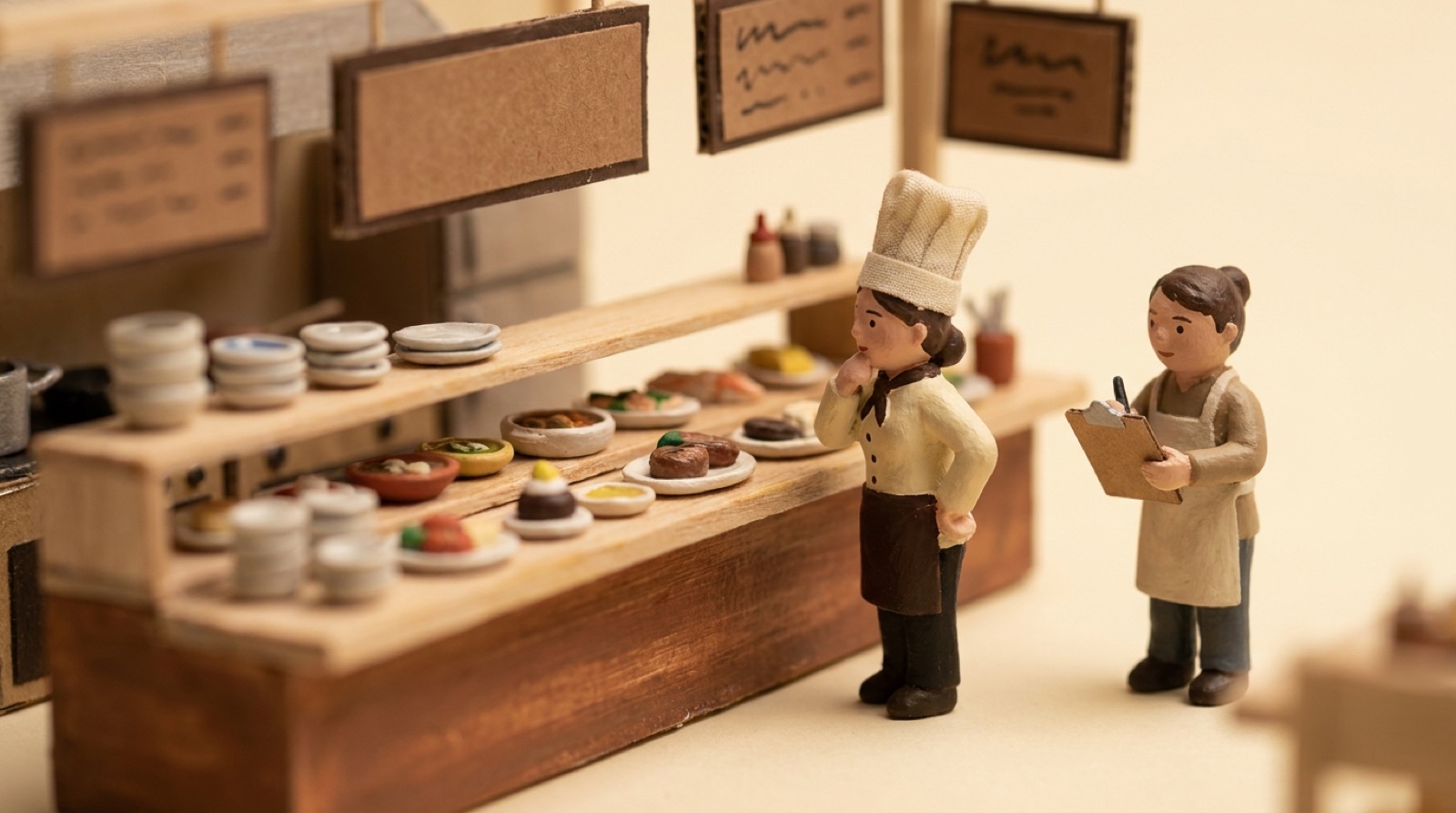
A profitable menu is not built by putting everything you love to cook on a board and hoping customers bite. It is built by starting with what your customers need, then engineering every item around profitability. Do both at once and you get a menu that sells itself.
Start With the Job to Be Done
Before you write a single item down, answer one question: what is my customer actually trying to accomplish when they walk in?
This is the “job to be done” framework. Customers do not buy products. They hire products to solve a problem. McDonald’s famously figured out that commuters were hiring milkshakes to fill them up during a long drive, not because they craved a milkshake. That insight changed how the product was positioned.
For your shop, the job depends entirely on who is walking through the door. Take an ice cream shop as an example. A family of four stopping in before the beach has a completely different job than an Asian couple on date night. The family needs something fast, fun, and kid-friendly. Chocolate cones with sprinkles win every time because kids do not have sophisticated palates and they cannot have caffeine. The couple wants something novel and Instagram-worthy. A smoking matcha ice cream hits that job precisely.
Serve both customers the same thing and you lose at least one of them.
For each customer type in your ideal audience, write down the specific job they are hiring your food to do. Then beside each job, write the product offering that actually solves it. That list becomes the raw material for your menu.
One rule here: you do not sell what you want to serve. You sell what your customers need. Keep that direction clear and your sales volume follows.
What Is the Winning Matrix?
Once you have your proposed offerings, you run each one through a four-category matrix. The matrix scores every item on two dimensions: profitability and popularity. Where an item lands tells you exactly what to do with it.
Stars: High Profitability, High Popularity
Stars are your best items. High margin, high demand. These are the items you emphasize, promote, and protect. Every menu decision you make should push more customers toward the stars.
Target 3 star items on your menu.
Cash Cows: Low Profitability, High Popularity
Cash cows are the staples. Customers order them constantly, but the margin is thin. Think of McDonald’s cheeseburger. It is not sexy, it is not the most expensive thing on the menu, but a massive percentage of orders include one. The profitability per unit is lower than something like an Angus beef burger, but the volume is enormous.
You want cash cows on your menu because they keep customers coming back and they keep you competitive on price. You just do not want your entire menu to be cash cows.
Target 5 cash cow items on your menu.
Hidden Stars: High Profitability, Low Popularity
Hidden stars have great margins but nobody orders them. The item itself is not the problem. The presentation, the name, or the placement is. A plain pasta dish sits ignored on a menu. Rename it “truffled meatball spaghetti,” reposition it on the page, and suddenly it has a shot at becoming a real star.
Your job with hidden stars is to repackage them, not cut them. Change the name. Change the description. Change where it sits on the menu. Sometimes a small price adjustment makes the item more accessible and drives enough volume to push it into star territory.
The goal is zero hidden stars at launch, because your aim is to convert all of them into stars before the menu goes live.
Skinny Cows: Low Profitability, Low Popularity
Cut these. A skinny cow is low profit and low popularity. It takes up menu space, takes up kitchen space, and complicates operations for no return. The hard truth is you will not always know which items are skinny cows until you launch and see real data. That is fine. Once you see it, cut it. Do not get attached.
How Does the Shooting Star Fit In?
The shooting star is a decoy. It is a super high-priced item you are not really trying to sell in volume. Its job is to make everything else on your menu look more reasonable by comparison.
At 720 Sweets, we had a $50 ice cream loaded with gold flakes and caviar. It was not particularly delicious. It was not popular. But a small number of people ordered it purely for the social media moment. More importantly, every customer who looked at that $50 item suddenly felt a lot better about spending $6 or $7 on a regular scoop. That $6 item felt like a bargain sitting next to a $50 one.
One shooting star. That is all you need. It is a pricing psychology tool, not a real revenue driver.
What Does a Target Menu Actually Look Like?
Your goal when you launch is a menu of roughly 10 items structured like this:
- 3 Stars
- 5 Cash Cows
- 2 Skinny Cows (temporary, earmarked for cutting once you have real data)
- 0 Hidden Stars (convert them before launch)
- 1 Shooting Star (decoy, not counted in the core 10)
The two skinny cows are not a contradiction. You include them at launch because you genuinely will not know which items underperform until real customers vote with their wallets. Label them as potential skinny cows in your planning worksheet, watch the data, and cut them once you have confirmation. The matrix is a living document, not a one-time exercise.
How Do You Scale the Matrix for a Larger Menu?
If you have 20 to 25 items rather than 10, keep the same proportions. Roughly 30 percent of your menu should be stars, roughly 50 percent cash cows, and the remainder split between items you are testing and any shooting star decoys. A 25-item menu would target about 7 to 8 stars, 12 to 13 cash cows, and 2 to 3 items you are actively evaluating or using as decoys. The ratios matter more than the exact counts.
Why Do the Customer Avatar and Job to Be Done Work Come First?
The matrix only works if the items in it were chosen for the right customers in the first place. If you skip the customer avatar and job to be done work and jump straight to categorizing items, you are just labeling things you already had. You might have a star-level margin on an item that zero people in your target audience actually want.
The sequence is intentional. Customer avatar first. Job to be done second. Product offering that solves that job third. Then run each offering through the matrix. When you follow that order, every item on your menu has a reason to exist before you ever ask whether it is profitable.
The Menu Is Never Finished
A menu matrix is not a one-time project. Every time you add an item, every time you revise your menu, pull out the customer avatar, the job to be done list, and the matrix side by side. Evaluate the new item against all three. That habit keeps your menu intentional instead of bloated.
At 720 Sweets, we kept iterating. Items came out, items went in. The matrix was always the filter. That ongoing process is what made the menu profitable, not any single brilliant idea at launch.
The Bottom Line
A profitable menu is the product of deliberate planning, not instinct. Know who you serve, know what problem you are solving for them, and then build a menu where every item earns its place through the winning matrix. If you launch without this framework, you will spend months discovering what the matrix would have told you in an afternoon. Plan for the menu you want, then keep revising until the data confirms it.
Watch the full video
Source — YouTube · the full breakdown, free
Tool — free · not sponsored, I built it
Want your exact numbers for a restaurant? The free calculator runs your cost to open, the ×1.4 cash reserve, and your break-even in about 30 seconds. Prefer paper? The One-Page Fundable Business Plan is the printable version.
Run your numbers →Questions owners actually ask
The video says the menu goal is 10 items including 2 skinny cows, but earlier you said to cut skinny cows. Is that a contradiction?
It is not a contradiction, it is a sequencing point. The 2 skinny cow slots exist at launch because you will not know which items truly underperform until real customers place real orders. You label those items as likely skinny cows in your planning worksheet, watch the sales data, and cut them once the results confirm it. The instruction to cut skinny cows is the endgame. Allowing 2 placeholder spots at launch gives you room to test before you eliminate.
If I have 20 to 25 items on my menu, how many should be stars, cash cows, hidden stars, and skinny cows?
Keep the same proportions as the core framework. About 30 percent of your menu should be stars, roughly 50 percent cash cows, and the remainder covers items you are actively testing or using as a shooting star decoy. For a 25-item menu, that means targeting around 7 to 8 stars, 12 to 13 cash cows, and 2 to 3 items in the evaluation or decoy category. The ratios matter more than hitting an exact count.
What is a shooting star and how is it different from a regular menu item?
A shooting star is a very high-priced item designed to act as a pricing decoy, not a genuine revenue driver. At 720 Sweets, a $50 ice cream with gold flakes and caviar served this purpose. Very few people ordered it, but its presence made the $6 to $7 regular items feel like obvious value by comparison. One shooting star on the menu is enough.
How do I figure out which category a new item belongs to before I have sales data?
You start by working through the job to be done and customer avatar frameworks first. If an item solves a clearly identified customer need and the margin is strong, it is a candidate star or hidden star. If the margin is thinner but demand is predictable, it belongs in the cash cow column. For items you are genuinely unsure about, treat them as potential skinny cows, launch them, and let the real data decide. The matrix is designed to be revised as you learn.
Why should I start with the job to be done before building the menu matrix?
The matrix only evaluates items that are already on your proposed list. If you skip the job to be done step, you might end up with a high-margin item that none of your target customers actually want. The correct sequence is customer avatar first, job to be done second, product offering that solves that job third, and then matrix categorization. That order ensures every item was chosen for the right customer before you ever ask whether it is profitable.
How do I turn a hidden star into a real star?
Repackage and reintroduce the item rather than cutting it immediately. Change the name to something more evocative, update the description, and reconsider its placement on the menu. A plain pasta dish becomes far more compelling when renamed truffled meatball spaghetti. You can also test a small price adjustment to make it more accessible, though that will reduce the margin. The goal is to drive enough popularity that the item earns star status on both dimensions.
The Weekly Receipt
One brand story, one number, one answered question. 2 minutes, Tuesdays.
Free. Unsubscribe anytime, one click, no games.
You're in, friend. See you Tuesday.
Keep going: restaurant guides
How Much Does It Cost to Open a Restaurant? (2026 Complete Breakdown)
The real, itemized cost to open a full-service restaurant in 2026, including Wilson's x1.4 cash rule, break-ev
12 Restaurant Assets Every Owner Needs to Build
The 12 restaurant assets that build your brand, from logo to uniforms, ranked by priority before you open in 2
3 Tactics to Position Your Restaurant Brand for Growth
Awards, media features, and strategic associations are the three free tactics that build customer trust and po
3 Things to Know Before Opening a Restaurant (And What Happens If You Skip Them)
Wilson K Lee breaks down the three foundational principles every restaurant owner must master: know your numbe
360 Ads for Restaurants: How to Build Customer Touchpoints Across Every Channel
Learn how 360-degree advertising builds the 20 touchpoints your restaurant needs to turn strangers into custom
Low Labor Restaurant Concepts: Fast vs QSR Compared
Fast concept and QSR are the lowest labor restaurant concepts. See real costs, staffing needs, and revenue to
4 Actionable Steps to Prevent Your Restaurant from Going Bankrupt During a Crisis
Four concrete steps every restaurant owner needs to assess financial health, cut inefficiencies, secure fundin
5 Deadly Mistakes Every New Food Business Owner Makes
60% of restaurants fail in year one. Wilson K Lee breaks down the 5 deadly mistakes killing food businesses in