Restaurant · Guide Updated August 2026
The Three Alter Egos Every Restaurant Owner Must Master
Every restaurant owner carries three alter egos: the entrepreneur (visionary), the technician (doer), and the manager (organizer). Letting any one of them dominate is the single biggest reason restaurants stall, burn out, or collapse. Recognizing all three, and knowing when to wear each hat, is what separates operators who grow from those who grind forever.
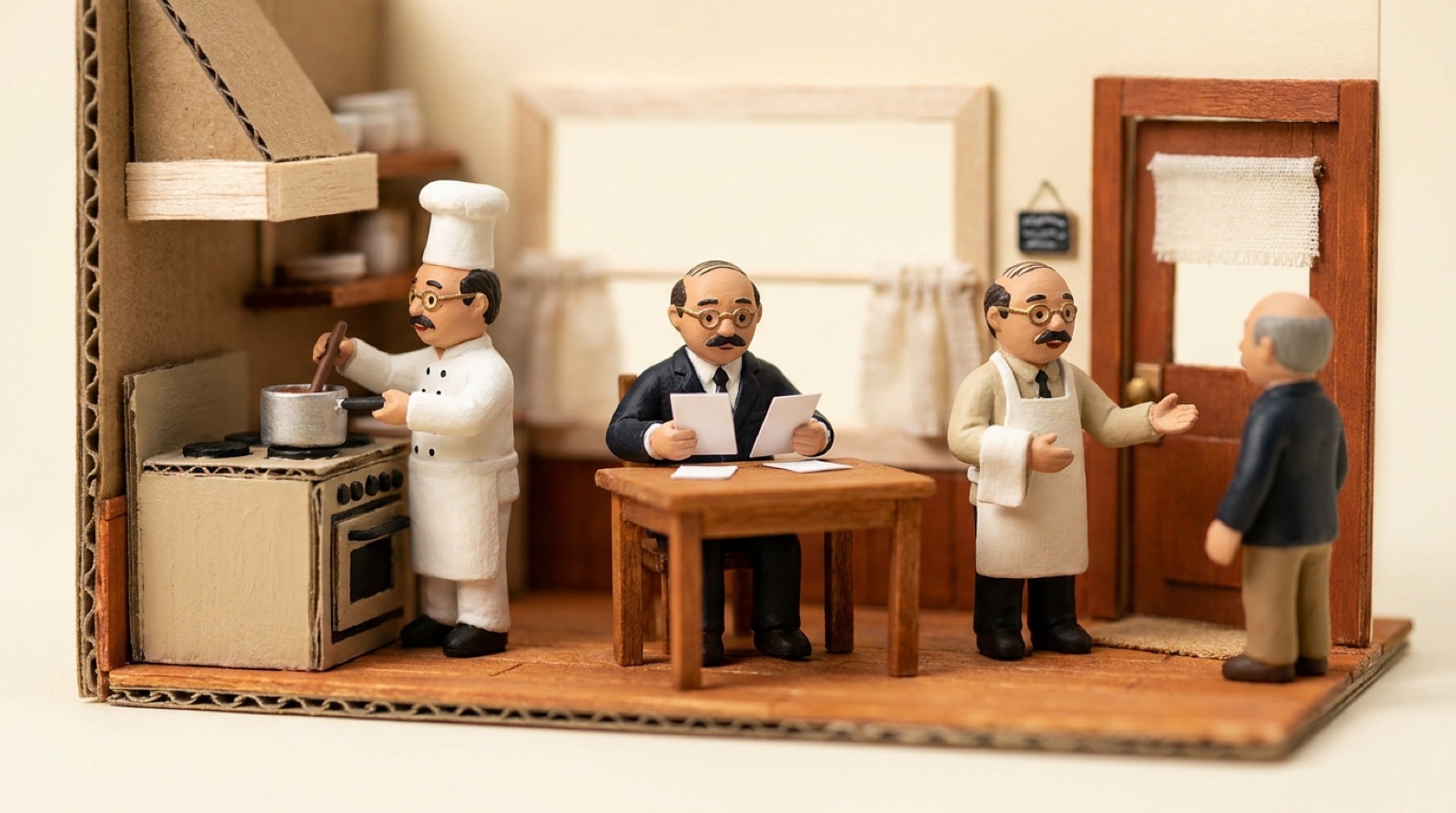
Building a successful restaurant does not come down to the best recipe or the best location. It comes down to whether you can play three distinct roles, at the right moments, without getting stuck in just one. Those roles are the entrepreneur, the technician, and the manager. All three live inside you already. The work is learning to call on the right one at the right time.
What Is the Entrepreneur Alter Ego?
The entrepreneur is the visionary. This alter ego lives in the future, craves control, and constantly spots new opportunities.
Picture walking into a new neighborhood, noticing the dense Asian demographic, and immediately thinking: this area needs a sushi restaurant. Nobody asked you to think that. You just did. That is the entrepreneur in you at work.
This alter ego is the one that started your restaurant in the first place. It saw something that did not exist yet and decided to build it. Without the entrepreneur, there is no restaurant at all.
What Is the Technician Alter Ego?
The technician is the doer. This alter ego lives in the present and works on one thing at a time.
The technician is often the chef, the person who notices that the kitchen flow is broken and redesigns the prep station to fix it. They are the ones suggesting new systems, new procedures, new menu items, and better ways to do the same work more efficiently and more profitably.
This alter ego is essential during build-out, launch, and any moment the operation needs hands-on problem solving. When something is broken, the technician figures out how to fix it.
What Is the Manager Alter Ego?
The manager is the pragmatist. This alter ego lives in the past, meaning they look at what has already worked and make sure it gets replicated consistently.
Managers are the planners. They follow the SOPs, organize the schedules, maintain order, and hold everything to the standard that was set. Their job is not to invent new things. Their job is to make sure the things that work keep working, every single shift, with every single team member.
Without the manager, your restaurant is only as good as your best day. With the manager running the right systems, your average day becomes your standard.
Why All Three Must Coexist
Here is the thing most operators miss: just because you are a natural entrepreneur does not mean you are off the hook for managing your books. Just because you are a strong manager does not mean you get to stop innovating. All three alter egos must be present inside you, and you must know how to put on each hat at each stage of your business.
This is something I have been personally guilty of getting wrong. I am a big entrepreneur by nature. Before I understood these three alter egos, I kept my dreamer hat on full time. The result: a beautiful restaurant with inconsistent food quality, poor service ratings, and a back office that was a complete mess. No processes. No systems. Bookkeeping in chaos. That is what happens when the entrepreneur dominates and the manager gets ignored.
The fix is not to become a different person. The fix is awareness. Once you know all three roles exist in you, you can choose which one the moment calls for. And where you genuinely lack a skill, you can hire someone who carries that alter ego naturally.
What Happens When One Alter Ego Takes Over?
There are three specific pitfalls that kill restaurants. Each one is caused by one alter ego crowding out the other two.
Pitfall 1: “No one else can do it better than me”
This is the technician running unchecked. The operator is in the building 18-hour days, for years, convinced that if they walk out the door the whole operation will fall apart. They refuse to delegate. They refuse to trust. And eventually, they burn out.
Burnout does not just hurt you. It damages the people around you and the relationships you care most about. About 80 percent of the operators I have met and seen struggling are caught in this exact trap. The restaurant owns them instead of the other way around. The solution is to build the processes and systems that let a manager or a trained team member replicate what only you are currently doing.
Pitfall 2: Too busy micromanaging to grow
This is the manager running unchecked. The operator has their systems, their SOPs, their routines, and they follow them religiously. Their daily operation is stable. But times are changing around them and they are not adapting.
They are so locked into what worked before that they cannot put the entrepreneur hat back on. Trends pass them by. Customer tastes shift. Competitors who are willing to add a vegan option, update the menu, or try a new format start pulling their customers away. A restaurant stuck in manager-only mode is a restaurant running out the clock without knowing it.
Pitfall 3: The dreamer with a chaotic shop
This is what happens when the entrepreneur and a little bit of the technician are present, but the manager is completely missing. There are big ideas. There is genuine hustle. But there is no quality assurance, no consistent service standard, no reliable food quality, because no one built the systems to hold it all together.
I see this constantly. A passionate, driven operator whose shop is genuinely chaotic because they never hired for, or developed, the management layer that keeps everything consistent.
How to Put on the Right Hat at the Right Time
Creating a restaurant that works without consuming your entire life requires all three roles to show up in sequence.
Start with the entrepreneur. Dream it, visualize it, see the opportunity clearly. This is where your concept, your location strategy, and your growth vision come from. You need this hat fully on when you are making big decisions about direction.
Switch to the technician. Go build it. Solve the problems that show up during construction, menu development, hiring, and launch. The technician does not wait for perfect conditions. They fix what is in front of them and move forward.
Then lock in the manager. Once you have figured out what works, write it down. Build the process. Train to the standard. Create the system that lets someone else replicate your best work consistently, so you are not the only person who can deliver it.
Then put the entrepreneur hat back on and repeat the cycle at a higher level.
Awareness Is More Than Half the Battle
You do not have to be equally strong in all three alter egos to succeed. You have to be aware that all three exist, honest about which one you default to, and willing to either develop the others or hire people who carry them naturally.
A restaurateur who knows they are a pure technician can hire a manager and bring in a visionary partner. A pure entrepreneur can hire an operations manager and a detail-oriented chef. The self-awareness is what makes the hiring decision obvious instead of random.
Most operators who struggle are not failing because they lack skill. They are failing because they are running their business with one hat permanently glued to their head.
The Bottom Line
Every restaurant needs a dreamer, a builder, and an organizer. The trap is assuming you only get to be one of them. Put on the entrepreneur hat when you are setting direction, the technician hat when you are solving problems, and the manager hat when you are locking in what works. The operators who do this are the ones who build something that runs without burning them alive in the process.
Watch the full video
Source — YouTube · the full breakdown, free
Tool — free · not sponsored, I built it
Want your exact numbers for a restaurant? The free calculator runs your cost to open, the ×1.4 cash reserve, and your break-even in about 30 seconds. Prefer paper? The One-Page Fundable Business Plan is the printable version.
Run your numbers →Questions owners actually ask
How do I know which alter ego I default to as a restaurant owner?
Honest self-observation over a few weeks will tell you. If you are always in the kitchen fixing problems and struggle to step back, you default to the technician. If your shop runs smoothly but you have not changed anything in years, the manager is dominating. If you have big plans but your operation is chaotic and inconsistent, the entrepreneur is running the show unchecked. The first step is simply naming the pattern.
What does setting up an LLC, permits, build-out, and hiring look like for a new cafe?
Each of those is a distinct alter ego task. Choosing the business structure and spotting the right location is the entrepreneur's work. Physically fitting out the space, building the menu, and sourcing inventory is the technician's work. Writing the SOPs, training the staff, and creating the processes that make service consistent is the manager's work. Separating them this way keeps you from trying to do all three at once and getting overwhelmed.
Why do so many mom-and-pop restaurants fail to grow?
The technician alter ego takes over completely. The owner is always inside the business, tinkering and improving what is already there, but never stepping back to put on the entrepreneur hat. They miss the foresight to see trends shifting, like customers wanting vegan options, because they are too focused on what is already working internally. Growth requires deliberately switching to the entrepreneur role, even when the technician work feels more urgent.
Is it okay to hire someone to fill an alter ego role I am weak in?
Absolutely. If you are not a natural manager, you can hire a general manager or operations lead to own that role. If you are not a technician, you hire a skilled chef or systems-oriented operator. The goal is to make sure all three alter egos are represented in your business, whether they all live in you or across your leadership team. Awareness of the gap is what makes the right hire obvious.
What is the cost of ignoring the manager alter ego?
Inconsistent food quality, poor customer service ratings, and chaotic back-office operations, including bookkeeping and scheduling. This is not hypothetical. Running a restaurant in pure entrepreneur mode without the manager layer produces a business that looks exciting from the outside but delivers an unreliable experience to customers. Inconsistency kills repeat business, and repeat business is what keeps a restaurant profitable.
How does neglecting delegation lead to burnout?
When you believe no one else can do the work as well as you, you end up doing everything yourself. That means 18-hour days, for years, with no off switch. Burnout in this situation does not just exhaust you physically. It damages the relationships around you and ultimately hurts the business you were trying to protect by refusing to let go. Delegation backed by solid systems, not just trust on faith, is the way out.
The Weekly Receipt
One brand story, one number, one answered question. 2 minutes, Tuesdays.
Free. Unsubscribe anytime, one click, no games.
You're in, friend. See you Tuesday.
Keep going: restaurant guides
How Much Does It Cost to Open a Restaurant? (2026 Complete Breakdown)
The real, itemized cost to open a full-service restaurant in 2026, including Wilson's x1.4 cash rule, break-ev
12 Restaurant Assets Every Owner Needs to Build
The 12 restaurant assets that build your brand, from logo to uniforms, ranked by priority before you open in 2
3 Tactics to Position Your Restaurant Brand for Growth
Awards, media features, and strategic associations are the three free tactics that build customer trust and po
3 Things to Know Before Opening a Restaurant (And What Happens If You Skip Them)
Wilson K Lee breaks down the three foundational principles every restaurant owner must master: know your numbe
360 Ads for Restaurants: How to Build Customer Touchpoints Across Every Channel
Learn how 360-degree advertising builds the 20 touchpoints your restaurant needs to turn strangers into custom
Low Labor Restaurant Concepts: Fast vs QSR Compared
Fast concept and QSR are the lowest labor restaurant concepts. See real costs, staffing needs, and revenue to
5 Deadly Mistakes Every New Food Business Owner Makes
60% of restaurants fail in year one. Wilson K Lee breaks down the 5 deadly mistakes killing food businesses in
4 Actionable Steps to Prevent Your Restaurant from Going Bankrupt During a Crisis
Four concrete steps every restaurant owner needs to assess financial health, cut inefficiencies, secure fundin