Cloud kitchen · Guide Updated August 2026
Cloud Kitchen vs Restaurant: Which Should You Open in 2026?
Open a cloud kitchen if your cash is under $300,000 and you can treat marketing as a fixed cost, because with no walk-by traffic, getting found is the whole game. Open a full restaurant if you have $1,356,500 within reach and the experience itself is your product. The cloud kitchen is the cheapest test this industry offers at $208,000 all-in; the restaurant is the expensive answer you earn after something is proven.

Here are the two concepts side by side, standard build, mid-size US market, 2026:
| The numbers | Cloud kitchen (~400 sq ft) | Full restaurant (~2,800 sq ft) |
|---|---|---|
| Total cost to open | $208,000 | $969,000 |
| Planning band | $156,000 to $260,000 | $727,000 to $1,211,500 |
| Cash before signing (x1.4 rule) | $291,000 | $1,356,500 |
| Average ticket | $22 | $35 |
| Monthly burn at zero sales | $7,000 | $26,000 |
| Break-even |
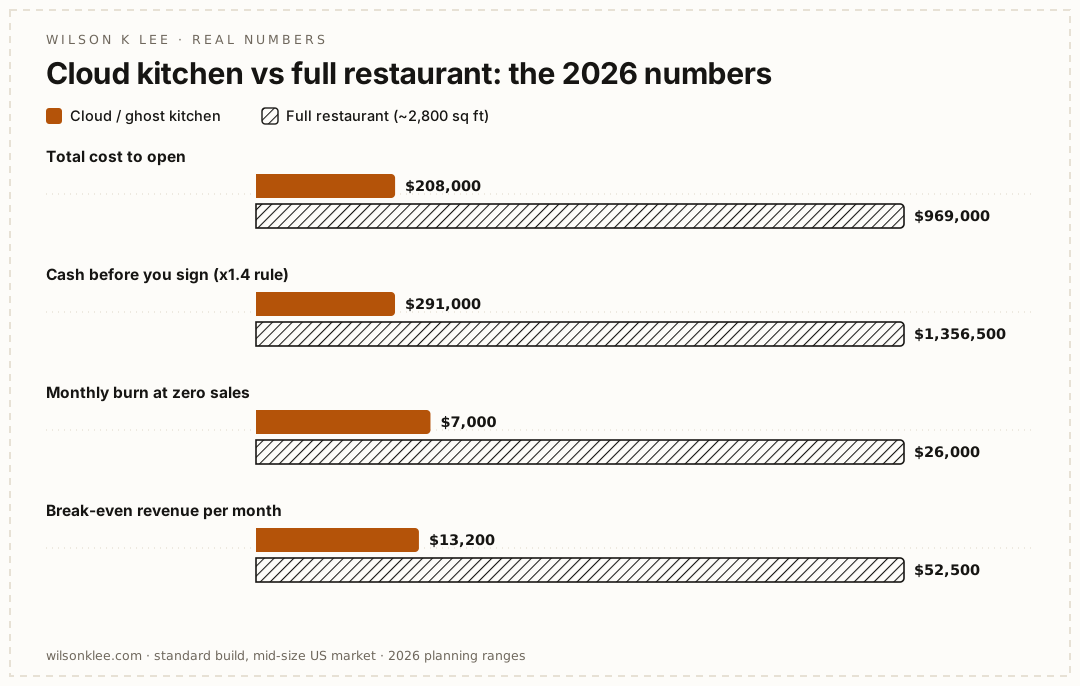
Want this chart for your own article or deck? Take it, just credit wilsonklee.com.
A cloud kitchen, also called a ghost kitchen, is a delivery-only restaurant. You cook in a rented commercial kitchen, your customers order through the apps, and no guest ever sees your dining room because there is not one. The restaurant is the full version: the address, the tables, the team, the experience. One is a fifth of the price of the other, and the missing four fifths buy something specific. Let me show you what.
Which is cheaper to open?
The cloud kitchen, by roughly $761,000. You are renting a kitchen that already works: the equipment is in, the build-out is done, and health and safety is already passed. You skip the two costs that swallow restaurant budgets, the dining-room build-out and the months of rent and labor you pay while renovating a space that is not earning yet.
Speed is the quiet half of that saving. A cloud kitchen can be in operation within days. A restaurant build takes months, sometimes longer, and every one of those months costs money while producing nothing.
Which breaks even faster?
The cloud kitchen needs about 20 customers a day at a $22 ticket, roughly $13,200 a month. The restaurant needs about 50 covers at $35, roughly $52,500 a month. And while you climb, the cloud kitchen burns $7,000 a month at zero sales against the restaurant’s $26,000.
But before you call that a landslide, price in the app tax. The delivery platforms take 20 to 30 percent of every order. That commission has to be built into your menu prices from day one, or you lose money on every order you sell. Margins in a good cloud kitchen can run past 15 percent, which beats the typical restaurant’s 3 to 5, and the apps are exactly what stands between you and that number.
What is each one really like to run?
The cloud kitchen strips the job down to cooking and marketing. No front of house, no servers, no broken toilet seat at 7pm on a Friday; the facility handles the building so you focus on the food. It is also the best experiment bench in the industry: because your brand is not tied to a location, you can run more than one concept from the same kitchen and watch which one finds product-market fit.
What you give up is being seen. There is no walk-by discovery, no storefront working for you all day. You have zero visibility except what you buy or build, and you hand the customer relationship to the apps along with the commission. You cannot build ambience through a delivery bag, and you do not control the last mile of your own product.
The restaurant is the opposite bargain. The address markets itself every day, and the experience is yours to design down to the light bulbs. You pay for that with the widest hours and highest headcount in food service, and with labor as the silent killer of the budget. It is the concept most likely to burn you out by month 9 if you are working every shift without a system.
The trap that sinks each one
The cloud kitchen trap is invisibility plus the app tax. Cheap to open is not the same as easy to grow. The operators who fail treat marketing as an afterthought; the ones who win budget for it like rent, because getting found is the whole game.
The restaurant trap is the payroll. The build-out gets all the fear, but the schedule is what quietly eats the margin. Full service means a floor team and a kitchen team through the widest hours of any concept, so watch prime cost against the 25/25/25 target from the first week.
So which should you open?
The cash rule first: under $300,000 in accessible cash, the cloud kitchen is your lane. Do not stretch cloud kitchen money into a restaurant lease.
Then the product question. If the food itself is the product and it travels well in a box, the cloud kitchen lets you prove it for $208,000. If the experience is the product, the room, the service, the night out, then no ghost kitchen can deliver it, and you are saving toward the $1,356,500 restaurant path whether you like it or not.
And if you want both: start ghost, finish real. Run the cloud kitchen as the cheapest concept test this industry offers, find the menu the market already wants, and let the winning concept earn the dining room. Spending $969,000 on a proven concept is a plan. Spending it on a guess is a prayer.
Tool — free · not sponsored, I built it
Want your exact numbers for a cloud kitchen? The free calculator runs your cost to open, the ×1.4 cash reserve, and your break-even in about 30 seconds. Prefer paper? The Startup Budget Worksheet is the printable version.
Run your numbers →Questions owners actually ask
Is a cloud kitchen cheaper than opening a restaurant?
Much cheaper. A standard cloud kitchen costs $208,000 all-in for 2026 versus $969,000 for a full-service restaurant, and it needs $291,000 in accessible cash versus $1,356,500. You are renting a working kitchen instead of building a dining room, and that is where the savings come from.
Why are cloud kitchens so much faster to launch?
Because the infrastructure already exists. The kitchen is built, the equipment is in, and health and safety is already passed, so you can be in operation within days instead of the months a restaurant build-out takes. You also skip paying rent and labor through a renovation.
What is the biggest downside of a cloud kitchen?
Nobody can see you. There is no walk-by traffic, no sandwich board, no storefront doing silent marketing all day. You rely on delivery apps for discovery, so marketing is not a nice-to-have, it is the business. Budget for it like rent.
How much do delivery apps take from a cloud kitchen?
Plan on 20 to 30 percent of every order going to the delivery platforms. That app tax has to be priced in from day one, or you lose money on every order you sell. It is the single most common cloud kitchen math mistake.
Can you test multiple food concepts from one cloud kitchen?
Yes, and it is one of the concept's real advantages. Because your brand is not tied to a location, you can run more than one menu from the same kitchen and watch which one finds its market. When one concept proves itself, that is the one that earns a real dining room.
How many orders does a cloud kitchen need to break even?
About 20 customers a day at a $22 average ticket, which is roughly $13,200 a month in revenue. A full restaurant needs about 50 covers a day, roughly $52,500 a month, before it turns a dollar of profit.
The Weekly Receipt
One brand story, one number, one answered question. 2 minutes, Tuesdays.
Free. Unsubscribe anytime, one click, no games.
You're in, friend. See you Tuesday.
Keep going: cloud kitchen guides
Cloud Kitchen Cost in 2026: The Full Breakdown
See the real 2026 cloud kitchen cost, $208,000 line-by-line, the cash you need before signing, and break-even
6 Cloud Kitchen Business Models Every F&B Operator Should Know
A plain-English breakdown of the six cloud kitchen business models, from independent single-brand to hub-and-s
How a New Cloud Kitchen Got 100+ Orders in Its First Month
A real operator story: how Glen Murray launched a ghost kitchen from home in the Philippines, hit 100+ orders
How to Start a Cloud Kitchen (Ghost Kitchen): A Starter Guide
Learn how to start a cloud kitchen from scratch: define your customer, pick a proven concept, build a delivery
How to Start a Cloud Kitchen: A Step-by-Step Guide
How to launch a cloud kitchen properly: choosing a concept, building a delivery menu, picking a location, and
Most Popular Food Delivery Items for Cloud Kitchens
The food delivery items trending on GrubHub and DoorDash, with practical advice for restaurant and cloud kitch