Cloud kitchen · The complete guide Updated August 2026
Cloud Kitchen Cost in 2026: The Full Breakdown
Opening a standard cloud kitchen (roughly 400 sq ft in a mid-size US market) costs $208,000 all-in, with a realistic planning band of $156,000 to $260,000. Before you sign a lease, you need $291,000 in accessible cash, applying Wilson's x1.4 rule. At an average ticket of $22, you break even at around 20 customers per day, or about $13,200 per month in revenue.

Watch the interview
Source: YouTube · the full conversation, free
What Does It Actually Cost to Open a Cloud Kitchen in 2026?
The cloud kitchen is the least expensive food business format to open. No dining room, no front-of-house staff, no expensive build-out for customer seating. That is the good news.
The honest number for a standard cloud kitchen, roughly 400 square feet in a second-generation space in a mid-size US market, is $208,000 total to open. The planning band runs $156,000 on the lean side to $260,000 if things go sideways. Neither number is small.
Here is every line item, broken down exactly.
| Line item | Cost |
|---|---|
| Build-out (400 sq ft, 2nd-gen space, +20% contingency) | $84,000 |
| Equipment & smallwares | $55,000 |
| Permits, licensing & pro fees | $15,000 |
| Opening inventory | $12,000 |
| Soft-launch & pre-open burn | $8,000 |
| Lease deposits (~3 months rent) | $6,000 |
| Working capital (~4 months of fixed costs) | $28,000 |
| Total | $208,000 |
The build-out is the biggest single check you write. Even in a second-generation space, which means a space that already has some kitchen infrastructure in place, you need to budget $84,000 and that number already includes a 20% contingency. Do not strip out the contingency to make the budget look prettier. Something will go over. It always does.
Equipment and smallwares at $55,000 covers the commercial cooking equipment, refrigeration, prep tables, and the smaller tools your team uses every single shift. Skimping here creates operational problems that cost you more in labor and food waste than the savings are worth.
Permits, licensing, and professional fees at $15,000 cover health permits, business licensing, and the accountant and attorney time you should not skip. Working capital at $28,000 covers roughly four months of fixed costs while you are building volume. That runway is not a luxury. It is what keeps you from making panicked decisions in month two.
What Is the x1.4 Rule and Why Does It Matter?
The number above, $208,000, is what it costs to open. It is not the number you need in the bank before you sign.
The rule is simple. Multiply your total opening cost by 1.4. That gives you the cash figure you need to have accessible before you commit to a lease.
$208,000 x 1.4 = $291,000
The gap between $208,000 and $291,000, roughly $83,000, is not a buffer for being careless. It is a buffer for reality. Build-outs run long. Equipment gets backordered. Your first few weeks of revenue are lower than projected. A health inspection creates a delay. These are not worst-case scenarios. They are normal operating conditions for a new food business.
If you have exactly $208,000 in the bank and nothing else, you are already under-capitalized before you open. Secure the $291,000 first. Then sign.
Does the Money Model Actually Work?
A cloud kitchen lives or dies on unit economics. Here are the baseline numbers to build your model around.
Average ticket: $22 Monthly burn at zero sales (fixed costs only): $7,000 Break-even: approximately 20 customers per day, or $13,200 per month in revenue
Twenty customers a day sounds manageable. It is not trivial when you have no walk-in foot traffic, no storefront, and you are competing against hundreds of other delivery listings on a third-party app. Those 20 customers have to find you entirely through digital discovery.
The prime cost target is 25/25/25: food cost at 25% of revenue, labor at 25%, and occupancy at 25%. That leaves 25% for other operating expenses and profit. Every line item matters because in a delivery-only model, the margin is already compressed before the app commission comes out.
What Are the Traps That Catch Most Cloud Kitchen Operators?
The delivery-app commission trap
Third-party delivery platforms charge 20 to 30% commission on every order. On a $22 ticket, that is $4.40 to $6.60 gone before you pay for the food, the labor, or the packaging. If you do not price the app tax in from day one, you lose money on every single order. The math does not recover at volume. It gets worse.
Price your menu for delivery from the start. Your delivery menu price is not your in-person price with a delivery fee added on top. It is a separate pricing calculation that accounts for the commission, the packaging cost, and the longer hold time before the customer eats.
The discovery trap
A traditional restaurant gets walk-by traffic. A cloud kitchen gets zero. Your location does not generate customers. Your marketing does.
This means your marketing budget is not optional and it is not a line item you trim when cash gets tight. Budget for marketing the way you budget for rent, because in a cloud kitchen, marketing is what rent pays for in a traditional restaurant. If people cannot find you on the app, the quality of your food is irrelevant.
The one-brand trap
New cloud kitchen operators put all their volume into a single brand. If that concept does not resonate with the market, the whole operation fails. The cloud kitchen format allows you to run multiple brands from one kitchen. That is one of its structural advantages over a traditional restaurant.
Study the third-party apps in your target area before you finalize your concept. Look at the most highly reviewed restaurants and their most popular items. That data tells you what the market in that specific geography is already buying. Build concepts to meet demand that exists, not demand you hope to create.
The long-lease trap
Anything longer than a six-month initial lease puts you at risk of the sunk-cost problem. You invest heavily, the concept underperforms, and instead of pivoting or closing, you keep going because you cannot emotionally walk away from what you already spent. Review your business every three to six months. If demand is there, renew. If it is not, pivot or close before the losses compound.
Is a Cloud Kitchen the Right Model for You?
A cloud kitchen is the right starting point if your concept is built for delivery, your menu travels well, and you are willing to treat marketing as a core operational function rather than an afterthought.
It is not the right model if your food does not hold up in a delivery container, if your concept depends on atmosphere or the social experience of dining out, or if you are expecting the low build-out cost to translate into an easy path to profitability. Cheap to open is not the same as easy to grow.
The hardest part of running a cloud kitchen is not cooking the food. It is getting found. Before you commit capital, answer this question honestly: do you have a real plan for customer acquisition, or are you assuming the app will do the work for you? If it is the latter, revisit the model.
You also need to know who your customer is before you finalize your concept. A family ordering dinner has completely different expectations than someone who tracks their macros at the gym, or a couple looking to indulge on a Friday night. The customer profile drives the menu, the price point, the platform you prioritize, and the way you write every single listing description. Skipping this step and jumping straight to the food concept is one of the most common and most expensive mistakes in this space.
How Do You Fund a Cloud Kitchen?
The source of your capital matters as much as the amount. A cloud kitchen with a short-term or month-to-month lease structure is a better fit for personal savings, small business loans, or a small group of investors than for large institutional financing, because the lease terms are shorter and the collateral story is thinner than a traditional brick-and-mortar restaurant.
Whatever the source, you need that $291,000 accessible and liquid before you sign anything. Not promised. Not in a deal that might close. Accessible.
What Is the Average Cloud Kitchen Cost in 2026?
A cloud kitchen costs $208,000 to open in 2026, all in, for a standard 400 square foot space in a mid-size US market. The realistic planning band runs from $156,000 on the lean end to $260,000 if things run long or over budget.
That number breaks into seven line items: build-out at $84,000, equipment and smallwares at $55,000, permits and professional fees at $15,000, opening inventory at $12,000, soft-launch burn at $8,000, lease deposits at $6,000, and working capital at $28,000. Build-out and equipment together make up two thirds of the total, so that is where most of your cash goes before you cook a single order.
But $208,000 is not the number you need sitting in the bank. Apply the x1.4 rule and you need $291,000 accessible before you sign a lease. That extra $83,000 covers the normal delays and slow first months every new cloud kitchen goes through. Weigh that against the break-even math: at a $22 average ticket, you need about 20 customers a day, or $13,200 a month, just to cover your fixed costs.
The whole thing, on one receipt
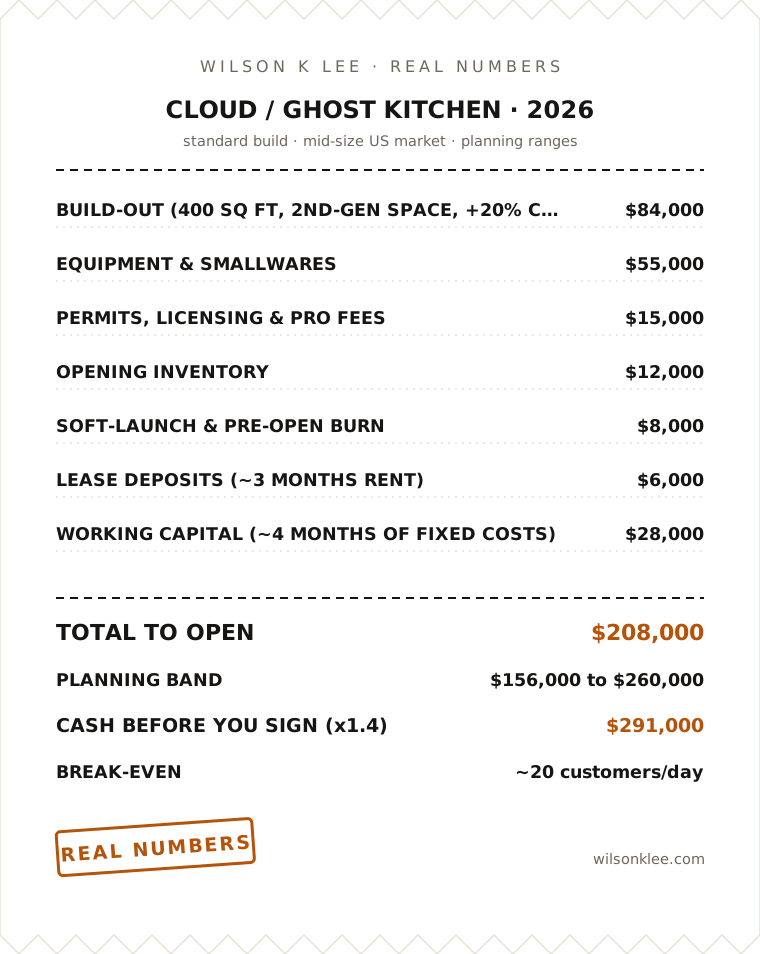
Tool — free · not sponsored, I built it
Want your exact numbers for a cloud kitchen? The free calculator runs your cost to open, the ×1.4 cash reserve, and your break-even in about 30 seconds. Prefer paper? The Startup Budget Worksheet is the printable version.
Run your numbers →Questions owners actually ask
How do I find a cloud kitchen space to rent?
Search Google for 'cloud kitchen' plus your specific city. A list of shared commissary and ghost kitchen facilities will come up. Call each one, ask about their rates, lease terms, what equipment is included, and whether storage is separate. You are looking for the shortest possible initial term, ideally month-to-month or six months, so you can exit or pivot without being trapped by sunk costs. Some operators also find second-generation restaurant spaces and build their own standalone kitchen, which is what the $208,000 figure above covers.
How much does it cost to rent a kitchen in the US?
The lease deposit in the $208,000 model covers roughly three months of rent, baked in at $6,000, which puts the monthly rent for this model at around $2,000. Rates vary significantly by market and by whether the space is a shared ghost kitchen facility or a standalone second-generation space. Shared ghost kitchen facilities typically charge by the hour or by a monthly membership rate that includes equipment access. Call facilities in your specific city to get current pricing, since rates differ materially between markets.
How many staff do I need for a cloud kitchen?
A lean cloud kitchen can launch with a very small team because there is no front-of-house, no servers, no hosts, and no bartenders. Your labor is entirely back-of-house: cooks and a prep person. The exact headcount depends on your volume and how many brands you run simultaneously. The prime cost target of 25% of revenue for labor is your constraint. At $13,200 per month in revenue (break-even), that means $3,300 per month in labor at the target ratio. Staff to that budget first, then add as revenue grows.
Can I use my home kitchen to start a cloud kitchen?
In most US jurisdictions, no. Commercial food sold to the public must be prepared in a licensed commercial kitchen that passes health department inspection. Some states have cottage food laws that allow very limited home-based food production, but those exemptions are narrow and typically exclude delivery-based restaurant concepts. The safest and most scalable path is a licensed commissary, a shared ghost kitchen facility, or your own commercially permitted space.
If I do not want to rely on third-party delivery apps, how do I handle logistics?
You have two practical options. First, build your own direct ordering system through your website or a white-label ordering platform, then contract with a local courier service or hire your own drivers for delivery. Second, use third-party apps for discovery but work hard to convert first-time customers to direct ordering through loyalty incentives. Running your own delivery operation adds labor and logistical complexity. The key point is that the 20 to 30% commission on third-party apps must be factored into your menu pricing from day one, whether you use them as your primary channel or not.
How many orders per day is realistic when you first open?
Break-even sits at approximately 20 customers per day. In the early weeks, expect to be well below that. A new cloud kitchen with no existing customer base, no reviews, and low ranking on delivery apps will typically see single-digit daily orders in the first month. That is normal and not a signal to panic, but it is exactly why the $28,000 working capital line exists in the budget. Plan financially for three to four months of below-break-even volume. If you hit break-even in month one, that is a strong early signal, not the baseline assumption.
Why do some large restaurant chains run exclusive virtual brands through delivery apps and not through their own channels?
Large chains sometimes negotiate exclusivity arrangements with delivery platforms as part of the deal structure, trading independent access for better placement, lower commission rates, or marketing support from the platform. For a small independent operator, exclusivity agreements like that are generally not worth pursuing. You want to retain the ability to sell direct and to control your own customer relationships over time.
Does a cloud kitchen work if my whole concept is about the dining experience and liquor sales?
No. A cloud kitchen has no dining room, no bar, and no atmosphere. Concepts that depend on in-person socializing, cocktail sales, or the energy of a full restaurant floor are the wrong fit for this model. The cloud kitchen format works for food concepts where the product travels well and the customer is ordering for convenience, not for an experience. If liquor margins and the social dining environment are core to your revenue model, a traditional restaurant or a bar-and-kitchen concept is the right structure.
How much does it cost to open a cloud kitchen?
A standard cloud kitchen, about 400 square feet in a mid-size US market, costs $208,000 all in to open in 2026. The realistic range runs from $156,000 on the lean side to $260,000 if the build-out or equipment costs run over. That figure covers build-out, equipment, permits, opening inventory, soft-launch burn, lease deposits, and about four months of working capital. It does not include the extra cash the x1.4 rule says you need on top before you sign a lease.
What is the biggest cost when opening a cloud kitchen?
The build-out is the single biggest expense, at $84,000 even in a second-generation space that already has some kitchen infrastructure, and that number already includes a 20% contingency. Equipment and smallwares come next at $55,000, covering commercial cooking equipment, refrigeration, and prep tables. Together, build-out and equipment make up more than two thirds of the full $208,000 budget.
The Weekly Receipt
One brand story, one number, one answered question. 2 minutes, Tuesdays.
Free. Unsubscribe anytime, one click, no games.
You're in, friend. See you Tuesday.
Keep going: cloud kitchen guides
6 Cloud Kitchen Business Models Every F&B Operator Should Know
A plain-English breakdown of the six cloud kitchen business models, from independent single-brand to hub-and-s
Cloud Kitchen vs Restaurant: Which Should You Open in 2026?
A cloud kitchen costs $208,000 to open in 2026, a full restaurant $969,000. The honest side-by-side, and the d
How a New Cloud Kitchen Got 100+ Orders in Its First Month
A real operator story: how Glen Murray launched a ghost kitchen from home in the Philippines, hit 100+ orders
How to Start a Cloud Kitchen (Ghost Kitchen): A Starter Guide
Learn how to start a cloud kitchen from scratch: define your customer, pick a proven concept, build a delivery
How to Start a Cloud Kitchen: A Step-by-Step Guide
How to launch a cloud kitchen properly: choosing a concept, building a delivery menu, picking a location, and
Most Popular Food Delivery Items for Cloud Kitchens
The food delivery items trending on GrubHub and DoorDash, with practical advice for restaurant and cloud kitch