Food truck · Guide Updated August 2026
Food Truck vs Restaurant: Which Should You Open in 2026?
Open a food truck if your accessible cash stops short of $250,000 and your menu has one signature item people will chase. Open a full restaurant only if you have $1,356,500 within reach and a plan for a big team, because at $969,000 to open and 50 covers a day just to break even, the restaurant is the harder machine to keep alive.

Here are the two machines side by side, standard build, mid-size US market, 2026 numbers:
| The numbers | Food truck | Full restaurant (~2,800 sq ft) |
|---|---|---|
| Total cost to open | $155,000 | $969,000 |
| Planning band | $116,500 to $194,000 | $727,000 to $1,211,500 |
| Cash before you commit (x1.4 rule) | $217,000 | $1,356,500 |
| Average ticket | $14 | $35 |
| Monthly burn at zero sales | $4,700 | $26,000 |
| Break-even |
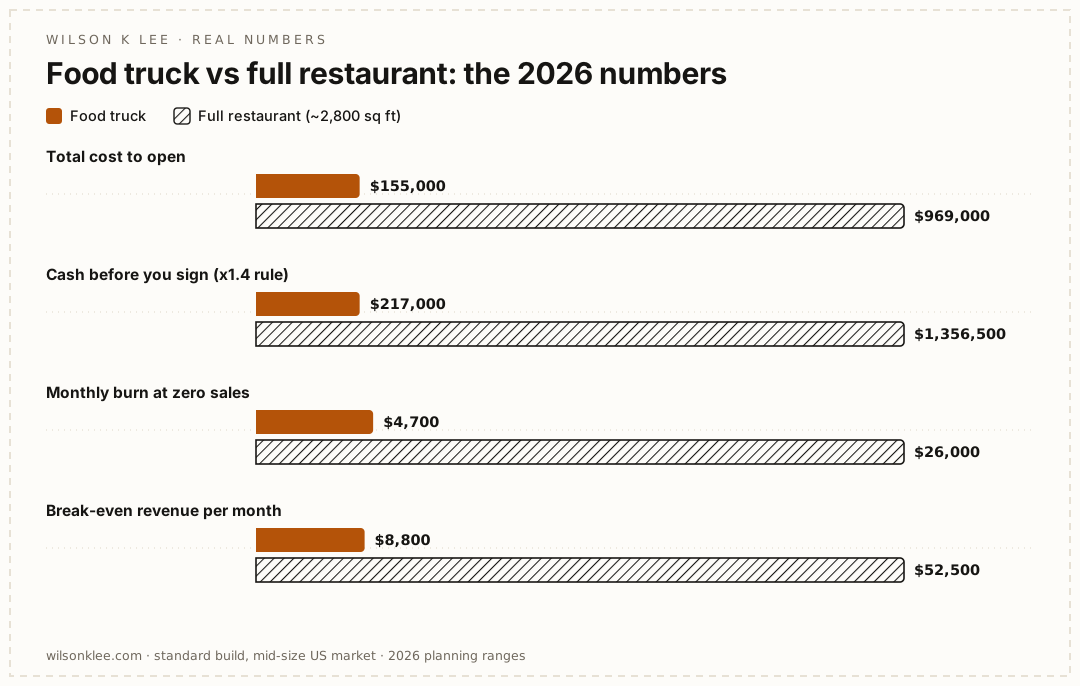
Want this chart for your own article or deck? Take it, just credit wilsonklee.com.
Same industry, same food, two completely different businesses. One is a machine you drive to your customers. The other is a machine that has to pull customers to a fixed address every single day. Pick based on your cash, your menu, and the life you actually want.
Which is cheaper to open?
The food truck, and it is not close. $155,000 all-in versus $969,000. The truck costs about one sixth of the restaurant.
But read the truck number carefully. The truck build is the whole budget. A wrapped, permitted, fully equipped truck is where the money goes, not rent. First-timers picture a cheap entry and then discover the commissary kitchen, the permits, and the parking, the recurring costs almost everyone forgets. That is why you still need $217,000 in accessible cash before you commit, not $155,000.
The restaurant’s budget has its own gravity. A full kitchen is where equipment spending doubles: the hood, the line, the walk-in, and the dish pit add up fast. And the x1.4 rule turns $969,000 into $1,356,500 of cash you need within reach before you sign a lease. Not because I like scary numbers. Because construction runs over, permits stall, and the first months are slow for almost everyone.
Which breaks even faster?
The truck needs about 21 customers a day at a $14 ticket. That is roughly $8,800 a month. A weekday lunch rush at one good office spot can carry that.
The restaurant needs around 50 covers a day at a $35 ticket, about $52,500 a month, before profit starts. And while you climb toward that number, the restaurant burns $26,000 a month at zero sales. The truck burns $4,700. When a bad month hits, and a bad month always hits, the truck bleeds five times slower.
What is each one really like to run?
The truck is the lowest fixed cost in food service, but you chase the business. You chase locations, you chase events, you chase the weather. Nobody walks past a parked truck at a dead corner. Your calendar is your real estate.
The restaurant is the opposite. The address works for you, but you feed the address. Full service means the widest hours and the highest headcount of any concept. Labor is the silent killer: a floor team plus a kitchen team, open to close, week after week. This is the concept most likely to burn you out by month 9 if you are working every shift. If the restaurant only runs when you are standing in it, you have built a job, not a business. Build the system first.
The trap that sinks each one
The truck trap is a commodity menu. If you are selling plain burgers, stop. A truck needs a reason to chase: one signature item people seek out, post about, and line up for. The menu should be small enough that your top seller is obvious.
The restaurant trap is labor plus hours. The budget survives the build-out and then dies quietly on the schedule. Watch your prime cost against the 25/25/25 target from week one, because at a 3 to 5 percent margin there is no room to find out in month six.
So which should you open?
Run three tests and be honest.
The cash test. If your accessible cash is under $250,000, the decision is made for you: it is the truck or nothing. Do not stretch a truck budget into a restaurant lease. That story ends in a personal guarantee you cannot cover.
The menu test. One signature item people would cross town for? Truck. A full experience, a bar, a dining room worth lingering in, a $35 ticket that needs a table under it? That is restaurant work, and it needs restaurant money.
The life test. The truck trades comfort for freedom: you cook in a metal box and chase your locations, but the machine is small enough to run on your terms. The restaurant trades freedom for roots: a real address and a real team, and the widest hours in the business feeding both.
For most first-timers, the sequence beats the either-or: open the truck, prove the concept, keep the burn low, and walk into your restaurant lease three years later with proof instead of a pitch deck. The truck is not the consolation prize. It is the cheapest tuition this industry sells.
Tool — free · not sponsored, I built it
Want your exact numbers for a food truck? The free calculator runs your cost to open, the ×1.4 cash reserve, and your break-even in about 30 seconds. Prefer paper? The Startup Budget Worksheet is the printable version.
Run your numbers →Questions owners actually ask
How much cheaper is a food truck than a restaurant?
A food truck costs about one sixth of a full restaurant: $155,000 all-in versus $969,000 in 2026, for a standard build in a mid-size US market. The cash gap is even wider once you apply the x1.4 reserve rule: $217,000 versus $1,356,500 before you commit to anything.
Is a food truck more profitable than a restaurant?
A food truck protects your downside better: its monthly burn at zero sales is $4,700 versus $26,000 for a full restaurant, and it breaks even at roughly 21 customers a day versus 50 covers. The restaurant has the higher ceiling because a $35 average ticket beats $14, but you pay for that ceiling with the highest labor bill of any concept.
How many customers does a food truck need to break even?
About 21 customers a day at a $14 average ticket, which works out to roughly $8,800 a month in revenue. A full restaurant needs around 50 covers a day at $35, about $52,500 a month, before it earns a dollar of profit.
What are the hidden costs of running a food truck?
The recurring costs first-timers forget are the commissary kitchen, permits, and parking. The truck build itself is the whole budget: a wrapped, permitted, fully equipped truck is where the money goes, not rent. Budget those before you fall in love with a paint job.
Can a food truck grow into a restaurant later?
Yes, and it is the path I recommend to most first-timers. The truck proves your concept, your menu, and your own stamina for the work at a fraction of the cost. When your top sellers are proven and your line runs on a system, you move indoors with evidence instead of hope.
Why do full restaurants burn owners out?
A full-service restaurant runs the widest hours and the highest headcount of any concept, and labor is the silent killer of the budget. If the business only runs when you are there, you have built yourself a punishing job. This is the concept most likely to burn you out by month 9 unless you build the system first.
The Weekly Receipt
One brand story, one number, one answered question. 2 minutes, Tuesdays.
Free. Unsubscribe anytime, one click, no games.
You're in, friend. See you Tuesday.
Keep going: food truck guides
How Much Does a Food Truck Cost to Start? (2026)
The real cost to start a food truck in 2026, line by line, plus the cash you need up front and the traps that
9 Steps to a Profitable Food Truck Business in 2026
A nine-step framework for launching a profitable food truck in 2026: audience, viral menu, location, costs, an
Food Truck vs Pop-Up Tent: What to Know Before You Buy
Start with a tent or jump straight to a truck? What to test first, the equipment traps to avoid, and what oper
How to Run a Profitable Food Truck: A Sushi Chef's Lessons
A sushi chef runs a thriving food truck on a small menu, premium ingredients sourced daily, and deep community
How to Start a Food Truck Business: A Step-by-Step Starter Guide
What it takes to start a food truck: picking a concept, choosing pitches, designing the menu, startup costs, p