Food truck · The complete guide Updated July 2026
How Much Does a Food Truck Cost to Start? (2026)
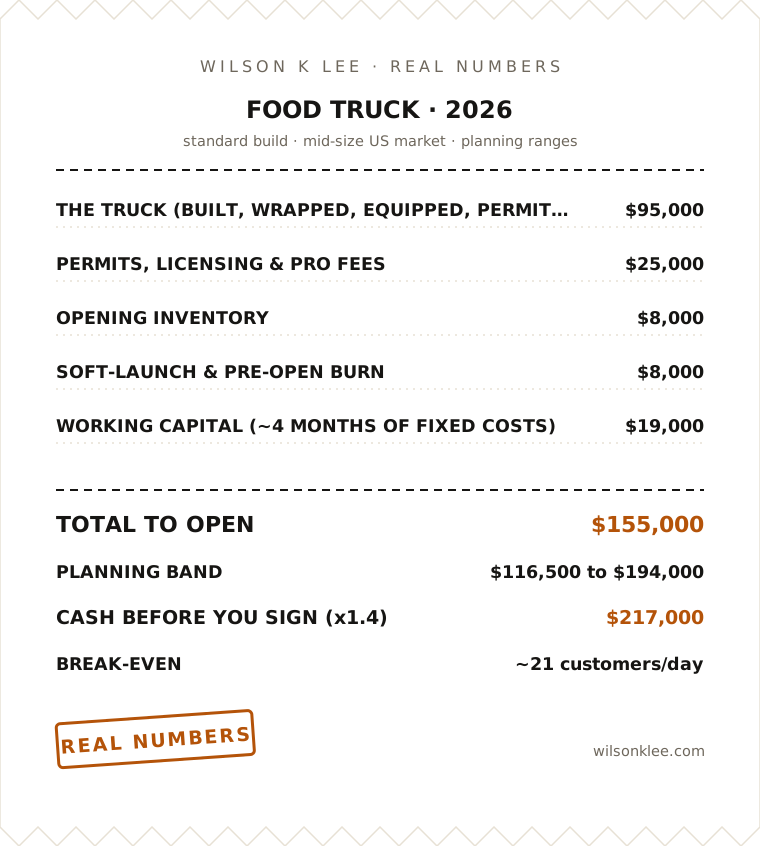
Starting a standard food truck in 2026 costs $155,000 all-in (planning band: $116,500 to $194,000), and you need $217,000 in accessible cash before you commit to anything. At an average ticket of $14, you break even at roughly 21 customers a day, or about $8,800 a month in revenue. The truck itself is the budget; everything else is secondary.

Watch the interview
Source: YouTube · the full conversation, free
What does a food truck actually cost to start in 2026?
The number is $155,000.
That is the all-in cost to open a standard food truck: built, wrapped, equipped, permitted, stocked, and with enough working capital to survive the first four months before revenue stabilizes. The realistic planning band is $116,500 on the lean end to $194,000 if things run over, and they usually run over.
Here is every line item, no rounding, no hand-waving.
| Line item | Cost |
|---|---|
| The truck (built, wrapped, equipped, permitted) | $95,000 |
| Permits, licensing & pro fees | $25,000 |
| Opening inventory | $8,000 |
| Soft-launch & pre-open burn | $8,000 |
| Working capital (~4 months of fixed costs) | $19,000 |
| Total | $155,000 |
The truck is the whole budget. A wrapped, permitted, equipped truck is where the money goes, not rent. That is the food truck’s version of what a restaurant pays in build-out and first/last/security deposit. The difference is you are writing one large check upfront for the vehicle instead of spreading costs across a lease. New custom builds run $75,000 to $200,000. A quality used truck runs $30,000 to $70,000. If you go used and repurpose it, you free up real money to spend on product and marketing, which is where food trucks actually win or lose.
The $25,000 for permits, licensing, and professional fees is not a rounding error. Commissary fees, parking permits, health department licensing, and the professional fees to set up your business entity properly add up fast. First-timers almost always undercount this category because they budget for the permit application cost and forget the commissary contract, the parking agreement, and the accountant. Those are real, recurring costs that start before you serve your first customer.
Working capital of $19,000 covers roughly four months of fixed costs at a monthly burn of $4,700 when you have zero sales. That burn includes commissary, insurance, fuel, and your base labor. Four months is not a generous cushion. It is the minimum to give you enough runway to find your locations, refine your menu, and build an audience before the math turns against you.
What is the x1.4 rule, and why does it matter?
The number you need in accessible cash before you sign anything is $217,000.
That is $155,000 multiplied by 1.4. The reason for the multiplier is straightforward. Equipment breaks. Permit timelines slip. Your soft launch takes three weekends instead of one. The truck you found needs a repair you did not see coming. None of these are edge cases. They are standard operating conditions for a first-time food truck operator.
The x1.4 rule is not a buffer for carelessness. It is the difference between a setback costing you a week and a setback shutting you down. If you have $155,000 and the truck needs a $15,000 repair in month two, you are already making desperate decisions. If you have $217,000, you fix the truck, you adapt, and you keep moving.
Do not start unless you have the $217,000 figure covered, either in cash, a confirmed loan, or a combination with a co-signer who is fully committed.
How does the money model work? Break-even, burn, and the 25/25/25 target
Your monthly burn at zero sales is $4,700. That covers the fixed costs you owe whether you sell anything or not.
At an average ticket of $14, you need 21 customers a day to break even. That works out to roughly $8,800 a month in revenue. If you are running five days a week, you need 21 paying customers every single shift. That is not a crowd. That is a consistent, findable audience who knows where you are and shows up.
The prime-cost target is 25/25/25. That means food cost at 25% of revenue, labor at 25%, and overhead at 25%. That leaves 25% for profit before owner pay. Hit all three and you have a viable business. Miss one and you are subsidizing your own operation.
The food truck model has the lowest fixed costs of any food business format. You are not locked into a lease. You do not owe rent on a dining room. But the trade-off is that you chase location and events instead of location coming to you. That mobility is the asset. It is also the job. Rotating between financial districts at lunch, breweries on Friday evenings, and community events on weekends is not passive. The truck requires an operator who is actively finding the next spot.
What traps kill food truck operators before they find their footing?
There are three documented traps that take out first-timers consistently.
The first is treating the truck budget as the total budget. The truck costs $95,000. Operators write that check and feel like they are done with the big spending. Then permits, commissary, and the soft-launch burn arrive and there is no cash left. The line items after the truck are not optional. They are part of the cost of opening.
The second trap is forgetting that commissary, permits, and parking are recurring costs, not one-time fees. You pay a commissary every month to prep and store your food legally. You pay for parking agreements or event fees every time you set up. These costs do not stop when you start selling. They run in parallel with your revenue from day one. Operators who do not model these as monthly fixed expenses are always surprised by why the numbers do not work.
The third trap is building a truck around a commodity. If you sell plain burgers, stop. You can get that at a restaurant, a drive-through, or the food truck three spots over at the same event. A food truck needs a reason to chase. That means one signature item that is visual, shareable, and impossible to get at a regular restaurant. The trucks that build followings and fill parking lots have one item that people drive across the city for. Build the menu around that item first, four to seven items total, and make sure every other item reinforces the same identity.
Is a food truck the right format for you?
A food truck is the right choice if you want the lowest fixed-cost entry point into food service, you are willing to be the operator chasing locations and events, and you have a concept with a genuine signature item that gives people a reason to find you.
A food truck is the wrong choice if you are planning to hire one person to run it while you stay hands-off, at least in the first year. The margins at $8,800 a month in revenue do not support a full manager salary plus owner profit while the business is still finding its feet. The operator and the owner need to be the same person early on.
A food truck is also wrong if you are trying to escape the complexity of a restaurant by going mobile. A food truck has the same food safety requirements, the same labor laws, and many of the same permit obligations as a brick-and-mortar. What it removes is the lease and the dining room. What it adds is the daily logistics of location, transport, and commissary.
If you already operate a restaurant and are considering a truck as a second revenue stream, your position is genuinely stronger. You already have supplier relationships, a commissary may already be in place, and your brand has existing awareness. The truck becomes an extension of a proven concept rather than a proof-of-concept from scratch.
How do you find and fund the truck itself?
The US food truck industry was at $2.8 billion in 2025 and growing at close to 7% annually, which means the used truck market is active. Facebook Marketplace is a real source for quality used trucks. Auction houses are a less obvious source that first-timers miss. Both can put you in a quality used truck in the $30,000 to $70,000 range, which frees up capital for the items that actually drive revenue: product quality, branding, and marketing.
For funding, the line items above are concrete enough to bring to an SBA lender or a community development financial institution. The working capital figure, the permit costs, and the truck purchase are all documentable. A business plan built around 21 customers a day at $14 average ticket is a real conversation, not a pitch deck fantasy.
Build your social audience before you spend the first dollar on the truck. Document the build, the recipe testing, the permit process. By the time you open, the people watching that content are your day-one customers. An empty parking lot on opening day is a cash flow crisis. A lineup on opening day because 1,000 people followed your build is a business.
The whole thing, on one receipt
Tool — free · not sponsored, I built it
Want your exact numbers for a food truck? The free calculator runs your cost to open, the ×1.4 cash reserve, and your break-even in about 30 seconds. Prefer paper? The Startup Budget Worksheet is the printable version.
Run your numbers →Questions owners actually ask
Do you recommend starting a food truck as a passive investor, hiring someone to run it for you?
Not in year one. The break-even is roughly 21 customers a day at a $14 average ticket, which is about $8,800 a month in revenue. At that level, the margins do not support a manager's salary plus investor profit while the business is still finding its locations and building its audience. The operator and the owner need to be the same person early on. Once the truck has consistent revenue, a proven route, and repeatable systems, bringing in a manager becomes a real option. Starting there is how you run out of money before you find your footing.
What is the best way to find an affordable food truck?
Two sources work well: Facebook Marketplace and auction houses. Facebook Marketplace has active listings for quality used trucks. Auction houses are the less obvious option that most first-timers miss entirely. A quality used truck runs $30,000 to $70,000, compared to $75,000 to $200,000 for a new custom build. Going used and putting the savings into product quality and branding is the smarter allocation. Just budget for a mechanical inspection before you buy. A used truck with a hidden repair need can wipe out the savings instantly.
I am debating opening a chilaquiles and coffee truck. Any thoughts?
The concept has real potential because it solves a specific problem: a destination breakfast or brunch item that you cannot get at a drive-through. The key question is whether your chilaquiles are the one signature item that people would drive across the city for. If the answer is yes, build the whole menu around that dish and keep everything else to four to six supporting items. Coffee pairs naturally as the add-on that lifts average ticket above $14. The trap to avoid is being generic. A chilaquiles and coffee truck with a signature preparation and a strong visual presentation has a story. A generic Mexican breakfast truck does not.
I already have a restaurant. Does that help if I add a food truck?
Yes, significantly. You already have supplier relationships, which reduces opening inventory costs and gives you negotiating power. Your commissary situation may already be resolved. Your brand has existing recognition, so the truck is an extension of something people already trust rather than an unknown concept asking for attention. The truck becomes a second revenue stream and a mobile marketing tool for the restaurant. The operational complexity of running two formats simultaneously is real, but your starting position is much stronger than someone launching from scratch.
What was the hardest part of starting a food truck for most operators?
Location is the consistent answer. You cannot park anywhere and expect it to work. Finding spots with enough foot traffic, figuring out which events are worth the fee, and learning which time windows perform takes trial and error. The data tells you what works, but collecting that data costs time and money. The operators who survive that phase are the ones who built an audience before they opened, so they had people following them to each location instead of relying entirely on foot traffic they had no control over.
I want to start a shawarma or kebab truck but do not know where to begin. How do I get started?
Start with the concept first, not the grill. Shawarma and kebab have genuine demand and strong visual appeal, which checks two important boxes. Your first job is to identify who your customer is: the office lunch crowd, the late-night event crowd, or the weekend market crowd. Each of those requires a different location strategy and a different menu format. Then figure out your commissary situation, because a grill-based operation has specific ventilation and fuel requirements that affect which commissary facilities will accept you. Once you know your customer and your commissary, you can spec the right truck or trailer setup around the actual cooking requirements.
Where do food truck operators buy their ingredients?
The same wholesale suppliers that restaurants use: Sysco, US Foods, and regional food service distributors. Once you have your business license and commissary agreement in place, you can open a wholesale account. Local restaurant supply markets are also worth visiting for specialty or fresh items. Your commissary kitchen may also have supplier relationships you can tap into early on, before your volume justifies a direct wholesale account of your own.
Is the food truck industry actually growing, or is it oversaturated?
The US food truck industry hit $2.8 billion in 2025 with over 48,000 trucks on the road, growing at close to 7% annually. The market is growing, not contracting. Oversaturation is a local question, not an industry-wide one. In any given city, certain food categories are crowded and others have real gaps. The operators who struggle are the ones selling commodity items with no differentiation. The ones building audiences around a signature item that people seek out are finding the market receptive.
The Weekly Receipt
One brand story, one number, one answered question. 2 minutes, Tuesdays.
Free. Unsubscribe anytime, one click, no games.
You're in, friend. See you Tuesday.
Keep going: food truck guides
9 Steps to a Profitable Food Truck Business in 2026
A nine-step framework for launching a profitable food truck in 2026: audience, viral menu, location, costs, an
Food Truck vs Pop-Up Tent: What to Know Before You Buy
Start with a tent or jump straight to a truck? What to test first, the equipment traps to avoid, and what oper
Food Truck vs Restaurant: Which Should You Open in 2026?
A food truck costs $155,000 to start in 2026. A restaurant costs $969,000. The real difference is the life you
How to Run a Profitable Food Truck: A Sushi Chef's Lessons
A sushi chef runs a thriving food truck on a small menu, premium ingredients sourced daily, and deep community
How to Start a Food Truck Business: A Step-by-Step Starter Guide
What it takes to start a food truck: picking a concept, choosing pitches, designing the menu, startup costs, p