Coffee shop · Guide Updated July 2026
How to Open a Coffee Shop in 2026: The Modern 8-Step Playbook
The traditional rules for opening a coffee shop no longer work. Before you sign a lease or write a business plan, build 1,000 real followers who are invested in your journey, then use AI tools and foot-traffic data to make every major decision. This 8-step playbook is the exact sequence I would follow if I were opening a cafe from scratch in 2026.
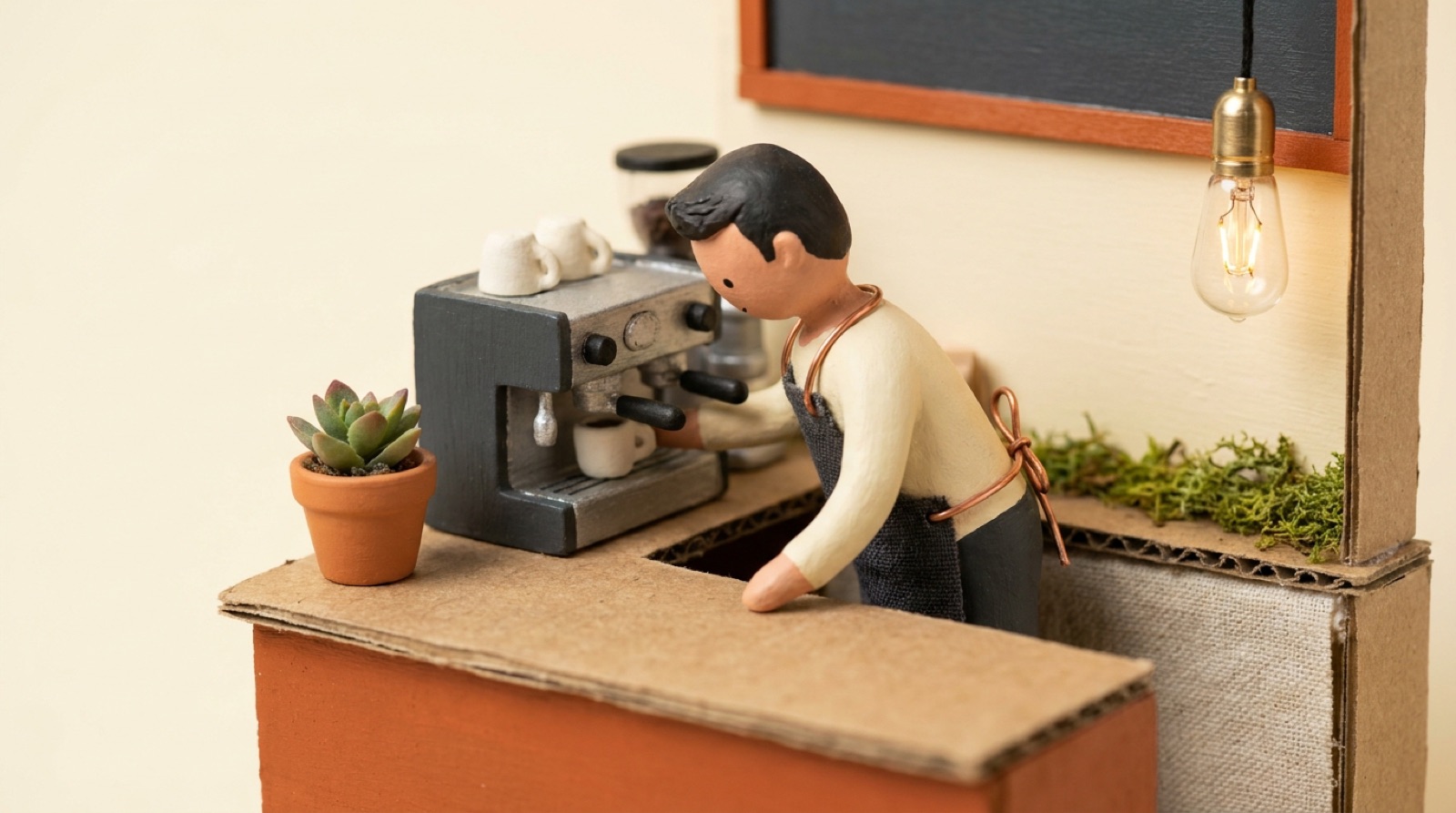
Stop writing a 50-page business plan. Stop hunting for the perfect corner before you have a single customer. The traditional rules of opening a coffee shop do not work anymore, and following them in 2026 is choosing to play the game on hard mode.
This is the exact eight-step sequence I would follow if I were starting a cafe today. Not with blind luck. With an audience, real data, and AI tools that work like a well-resourced partner.
Step 1: Build Your Audience Before You Build the Cafe
Content creation is the most important shift in this entire playbook. The biggest misconception people have is that they don’t know what to post. The answer is simple: post your journey.
Share your obsession with specialty coffee. Show the beans you’re tasting, the roasts you’re testing, the aroma you’re chasing. Educate your audience on why you chose those beans. Show the mistakes you’re making along the way. Nobody has it all figured out, and that honesty is exactly what makes people root for you.
Brands like Daylow Coffee and Little Pisces built real trust by letting people in early, documenting the process, and sharing openly with their communities. Transparency is the content.
My challenge to you is concrete: build an audience of 1,000 followers before you spend a single dollar on rent. These are people who feel like they’re building alongside you. That pre-built community is what fills your shop on opening day.
To make this practical, use ChatGPT to generate your first 30 days of pre-launch content. Prompt it to build a behind-the-scenes content calendar for a cafe in your niche and city. Use the output as a reference, not a script. Your real conversations, whether with your business partner, your logo designer, or your supplier, are the actual content. Make it personal. Make it yours.
Step 2: Treat AI Like a GPS, Not a Gimmick
Imagine two people driving cross-country. One uses a paper map. One uses a GPS. The GPS user arrives faster. That’s the difference AI makes for you right now.
AI does not replace your skills or your taste. It helps you make smarter decisions faster so you can spend your time on the things you actually care about. Ask AI for a comprehensive step-by-step guide to starting a cafe in 2026, and you get practical advice, current trends, and beginner-friendly action steps in minutes. That is the kind of output that used to cost you a consultant.
The tools available are advancing fast. The specific platforms popular today may look different by the time you’re deep into your build. Focus on the behavior: use AI as a thinking partner at every stage of this process.
Step 3: Define Your Vision and Vibe
Every consultant will tell you to start with financial projections. I say start with vision and vibe, and be painfully specific about it.
In 2026, people are not buying coffee. They are buying a sense of belonging. Your job is to know exactly what kind of belonging your cafe creates before you spend a dollar on buildout.
Tools like Nano Banana Pro let you generate a full visual mood board from a simple prompt. For example: “Make a vision board for a cafe specializing in premium matcha and desserts, targeting ages 14 to 34, in the heart of Vancouver.” Out comes a mood board with images, a color palette, and packaging ideas, without hiring a brand designer or spending hours in Photoshop.
This visual document becomes your road map. Every decision you make later, from your interior to your menu to your packaging, gets measured against it.
Step 4: Choose Your Location With Data, Not Gut Feel
Only at step four do we talk about location. And when we do, we do not guess.
Choosing a cafe location without data in 2026 is gambling blind. The right question is not “Is there foot traffic near this corner?” The right question is “Is my specific audience here during the hours that matter?”
AI-powered tools like Placer.ai now give you foot traffic analysis for any area of interest. You can pull a report on a nearby Starbucks, see how many visitors came in December, and get a comparative breakdown against neighboring competitors. Big chains have had access to this kind of data for years. Now you have it too.
Use that data to pressure-test any location before you sign anything.
Step 5: Run a Pop-Up Before You Commit to a Permanent Space
Before you lock into a long-term lease, go lean. A pop-up lets you derisk your investment while testing the most important thing: your customer experience.
You launch your pop-up to the pre-built audience you created in step one. The content that comes out of the pop-up gets shared. The cash starts to flow. And you get real feedback on your product before you’re locked into a five-year lease.
Cow Dog, a cafe in Vancouver, started exactly this way. They ran pop-ups inside another food and beverage space, built buzz, grew their following, and eventually opened their first brick-and-mortar location. They made more than a million dollars in their first year. The founder Joe credited the love and support from his pop-up customers as a core reason the move to a permanent space felt possible.
Use a project management tool like Notion to organize everything for your pop-up. Equipment lists, supply checklists, coffee and ingredient sourcing, marketing tasks. You can use AI inside Notion to generate recommendations, or simply use it as an organized digital notepad. Either way, keep everything in one place.
Step 6: Get Brutally Clear on Your Logistics and Financials
This is not the exciting part. It is the part that kills most cafes.
Cafes don’t fail because of bad coffee. They fail because of cash flow surprises. Before you sign any lease, you need to be clear on the cost of every drink, your labor cost per hour, prep time per menu item, supplier flexibility, and your total cash run rate.
As of 2026, opening a coffee shop in the US costs around $457,000 on average, with a planning range of $343,000 to $571,500. Before you sign a lease, you should have roughly $640,000 in accessible cash. That is the x1.4 rule: your total capital needs to cover construction cost overruns, slow opening months, and the unexpected expenses that will absolutely show up. Your break-even point lands at roughly 84 customers per day at an $8 average ticket.
For your profit and loss projection, use Claude AI. Paste in a prompt asking it to build you a P&L model for a coffee shop. Claude will code a working application in under five minutes that lets you adjust revenue inputs, expense categories, and operating assumptions. No broken spreadsheet formulas. No guesswork on the math. A real tool you can actually use to forecast your numbers with confidence.
Step 7: Design a Space Worth Sharing
When you’re building out your physical space, every decision you make should answer one question: will someone want to photograph this?
In 2026, your cafe interior is your most powerful marketing asset. Natural lighting from large windows, a signature wall or corner where customers naturally stop to take photos, a visual identity that matches the mood board you built in step three. These are not nice-to-haves. They are part of your marketing budget.
If you’re redesigning an existing space, you do not need to spend tens of thousands of dollars on an architect for early-stage renderings. Tools like Nano Banana Pro let you snap a photo of the raw space, describe your vision in plain language (“minimalistic Scandinavian vibe, natural wood furniture, bright white walls, some greenery”), and generate an instant redesign render. Use that to sharpen your vision before you bring in a contractor.
Design for the experience. Design for the share.
Step 8: The Grand Opening That Is Not Too Grand
If you followed steps one through seven, opening day is not terrifying. It is inevitable.
You are not opening your doors to strangers. You are opening them to a community that already loves you, has watched you build, and has been waiting for this moment. I ran this playbook seven times when we scaled our dessert chain, 720 Sweets, from one location to seven. Every single grand opening had lineups out the door and wrapped around the corner, not because of luck, but because we took our community along for the entire journey.
That is the only kind of grand opening worth having.
The Bottom Line
Build your audience before you build your cafe. Use AI to make faster, smarter decisions at every step. Let data choose your location. Start lean with a pop-up, then commit to a permanent space once the market has already told you yes. The operators who win in 2026 are not the ones with the biggest budgets. They are the ones who show up honestly, build in public, and earn their community before they ever turn on the espresso machine.
Watch the full video
Source — YouTube · the full breakdown, free
Tool — free · not sponsored, I built it
Want your exact numbers for a coffee shop? The free calculator runs your cost to open, the ×1.4 cash reserve, and your break-even in about 30 seconds. Prefer paper? The Startup Budget Worksheet is the printable version.
Run your numbers →Questions owners actually ask
Does this 8-step playbook work for opening a restaurant, not just a coffee shop?
The core principles apply directly to any food and beverage concept. Building an audience before you sign a lease, using AI tools for planning and design, testing with a pop-up before committing to a permanent space, and designing a shareable interior are all format-agnostic. The specific financial numbers in this guide are calibrated for coffee shops, so you will need to rebuild the P&L inputs for a full-service restaurant, where build-out costs and labor structures are different.
Why build 1,000 followers before spending money on rent?
Those 1,000 followers are your pre-qualified customer base. They have watched you build, they trust you, and they are primed to show up on day one. Every grand opening I ran at 720 Sweets had lines out the door because we built community before we built the space. Opening to strangers means you are starting from zero when the rent clock is already running.
How much money do I realistically need to open a coffee shop in 2026?
The average build-out cost in the US is around $457,000, with a planning range of $343,000 to $571,500 as of 2026. Before you sign a lease, you should have roughly $640,000 in accessible cash. That extra buffer, about 1.4 times your build cost, covers overruns, slow opening months, and the cash flow surprises that kill most cafes.
How many customers do I need per day to break even?
At an $8 average ticket, you need roughly 84 customers per day to break even. Use that number as your baseline when you are forecasting revenue and evaluating whether a location can realistically deliver that volume based on foot traffic data.
What AI tools are most useful for planning a cafe?
ChatGPT is useful for generating content calendars and step-by-step planning prompts. Claude AI can build a working P&L model for your cafe from a single prompt in under five minutes. Nano Banana Pro can generate vision boards and interior redesign renders from a photo and a text description. Placer.ai provides foot traffic analysis for any location you are evaluating, including comparisons with nearby competitors.
Do I need to do a pop-up before opening a permanent location?
A pop-up is the smartest way to derisk your concept before committing to a multi-year lease. Cow Dog Cafe in Vancouver started as a pop-up inside another food and beverage space, built a following, and then opened a permanent location that made more than a million dollars in its first year. The pop-up lets you test your product, your experience, and your operations while cash is still flowing and your exposure is limited.
The Weekly Receipt
One brand story, one number, one answered question. 2 minutes, Tuesdays.
Free. Unsubscribe anytime, one click, no games.
You're in, friend. See you Tuesday.
Keep going: coffee shop guides
How Much Does It Cost to Open a Coffee Shop in 2026?
The real 2026 cost to open a coffee shop: $457,000 all-in, $640,000 cash before you sign, and the daily break-
8 Steps to Building a Profitable Coffee Shop Business
Wilson K Lee breaks down the 8 essential steps to start and run a profitable coffee shop, from knowing your cu
Why a Market Downturn Is the Best Time to Open a Restaurant or Cafe
Four concrete strategic advantages that make opening a restaurant during an economic downturn smarter than wai
How to Get Cafe Customers Without Discounts: 4 Modern Marketing Strategies
Stop cutting prices to fill seats. These 4 cafe marketing strategies build real customer loyalty and increase
How One Coffee Shop Owner Paid Rent in 24 Hours During COVID-19 Lockdown
Narrative Coffee's Max pivoted to half-gallon lattes during COVID-19 lockdown and covered rent and salary in t
How a Former Disney Manager Built a Multi-Location Coffee Shop From Scratch
Andrea went from Disney World hospitality to sleeping under her espresso machine to running two Rhode Island c
How Grounds & Hounds Built a $1.2M Online Coffee Business with a Mission-Driven Brand
Wilson K Lee breaks down how Grounds & Hounds went from $100K to $1.2M in revenue selling coffee online by bui
How to Calculate Food Cost Percentage (and Actually Use It to Make More Money)
Learn how to calculate food cost percentage, the difference between ideal and actual food cost, and how to use