Ice cream shop · Guide Updated July 2026
How to Write an Ice Cream Shop Business Plan
A solid ice cream shop business plan covers eight sections: concept, target market, team, location, sample menu, design and branding, SWOT analysis, marketing, and financials. Every section exists for one reason: to show investors, partners, and yourself exactly how the business will make money and pay everyone back. Skip any section and you leave money, talent, or your own clarity on the table.
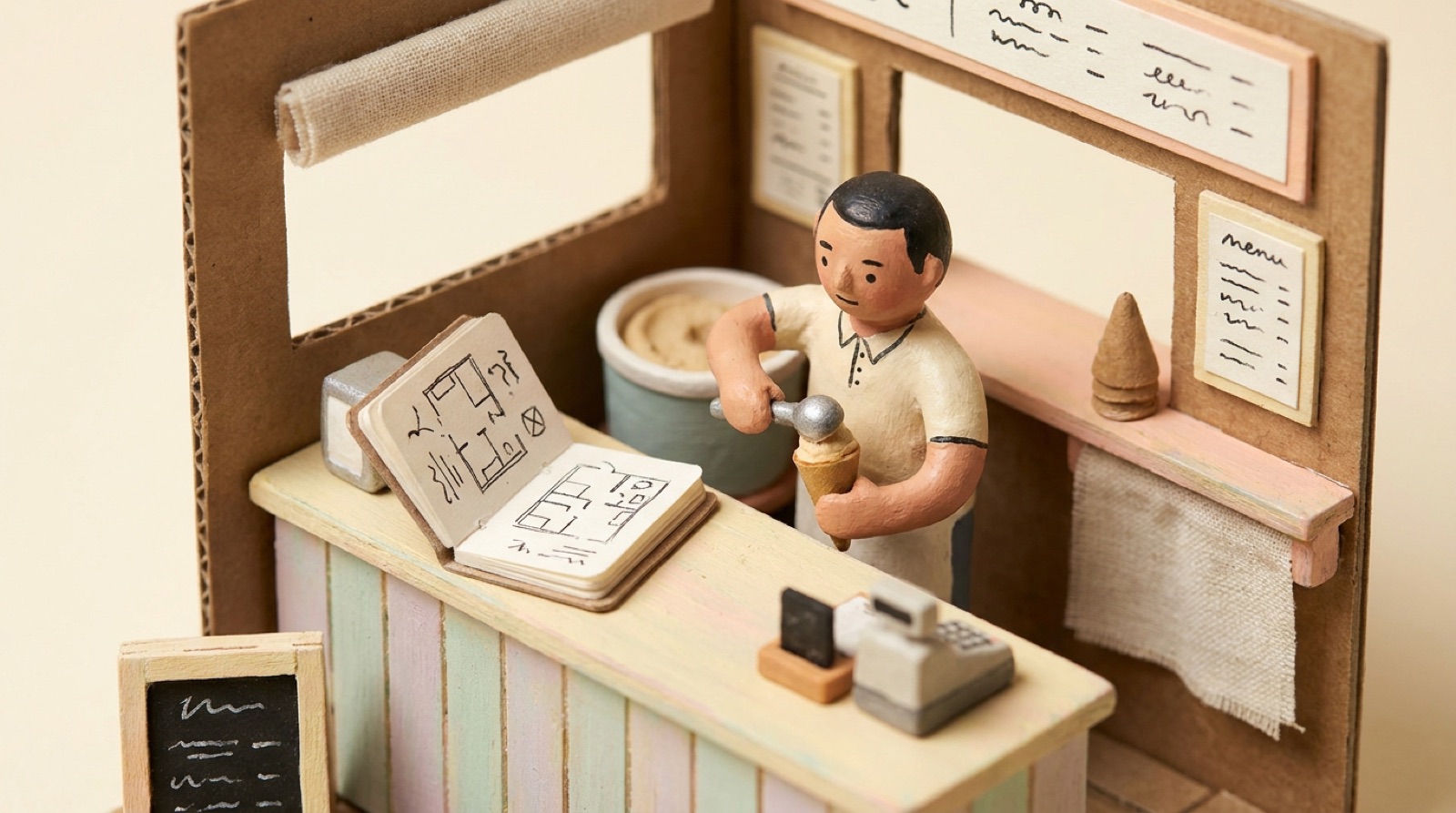
Opening an ice cream shop without a business plan is like driving to a mountain you’ve never seen with no map and no gas gauge. You might get close, but you will waste time, money, and momentum you cannot afford to waste. Write the plan first. Here is exactly what goes in it.
Why Does an Ice Cream Shop Need a Business Plan?
Three reasons, and all three are practical.
First, you need it to raise money. Anyone giving you capital, whether that is a friend, a bank, or a grant committee, needs to see how and when they get it back. The more detailed your plan, the more confidence you give them, and the higher your chances of getting funded.
Second, you need it to attract the right partners and team members. A great idea stuck in your head is invisible to everyone else. The moment you write it down, talented people can decide whether they believe in it. That is how you build a team instead of just hiring bodies.
Third, it is your map. When you are simultaneously handling your buildout, city permits, product development, marketing, and hiring, it is easy to lose sight of your actual path to profit. Your business plan cuts through the noise and brings you back to what matters.
What Is Your Concept?
The concept is the first thing you nail down, because every decision afterward, including equipment, space, budget, staffing, and marketing, flows from it.
Are you building a dine-in experience, a grab-and-go counter, or a mobile food truck? Are you serving gelato, soft-serve, frozen yogurt, or sorbet? These are not small details. They define your entire operation.
Here is the frame that makes concept planning concrete: whatever you are building is a solution to someone else’s problem. At 720 Sweets, we built a soft-serve dine-in experience specifically for young Asian millennials. They were stuck on campus, looking for a place to hang out, feel a sense of community, and take photos worth posting. Smoke coming out of ice cream was the answer to that problem. Because we knew the problem we were solving, we knew exactly what flavors to serve, such as milk tea, green tea, and taiyaki, and exactly what kind of environment to create.
Your concept is not just your product. It is the reason your product exists for a specific group of people.
Who Is Your Target Market?
Once you have your concept, you identify the exact person whose problem you are solving. Not a broad demographic. One person.
At 720 Sweets, that person was Michelle. She was 19 years old, studying at UBC, working part-time at H&M, wearing Aritzia and Lululemon, and spending her time on Instagram and TikTok. She valued status, friendship, and new experiences.
When you profile your target customer that precisely, your marketing writes itself. You know where she spends her time, so you know where to reach her. You know what she values, so you know what to say. Your investors will either confirm the profile matches their assumptions or be genuinely impressed by the depth of your thinking. Both outcomes help you.
You will not get this profile perfectly right from day one. That is fine. It is your best-educated starting point, and it gives you a benchmark to pivot from as you learn more.
Who Is on Your Team and Why Does It Matter?
Investors bet on people as much as they bet on ideas. Your business plan must include the backgrounds of your core team, and those backgrounds need to show what each person actually brings to the table.
There are three things worth highlighting for each team member.
Skill set. Can they manage social media, run operations, develop recipes, or handle fundraising?
Resources. Do they have capital, time, or deep industry knowledge?
Connections. Do they know bankers, suppliers, or other operators who can give you an inside edge?
Do not list someone simply because they are your spouse or best friend. That is not a business credential.
At 720 Sweets, I was deliberate about this. My first partner, Tim, was a supplier for our ingredients, which meant we got the best pricing from day one. My partner Brian was the operations lead, the person who ran the day-to-day and genuinely loved doing it. A third partner came in because he could fund the business. I handled marketing and stayed close to our customers. Four people, four distinct contributions. That is a team worth writing about.
If you are early-stage and your team lacks formal experience, lead with transferable skills and genuine commitment. Heart, time, and passion are real assets. Write about them honestly.
How Do You Choose the Right Location?
Location matters, but not in the way most people think. It is not automatically about the highest foot traffic. It is about where your target customer already spends time.
There are two types of locations. Destination locations require people to travel specifically to you. They have more friction but cost significantly less in rent. High-density, high-foot-traffic locations, typically downtown cores, convert walk-by traffic into customers and charge premium rent accordingly.
For 720 Sweets, a downtown flagship would have been a mistake. Our customers were young university students who were not hanging out downtown. Our winning location was a destination spot about ten minutes from the nearest university, right outside a bus stop. Our target market could reach it easily. Rent was manageable. It fit our budget and our customer.
Never fall in love with a location because it feels prestigious. Evaluate it from your customer’s perspective, then pressure-test it against your budget.
What Goes on Your Sample Menu?
Your sample menu is what turns your vision into something tangible. It also signals to investors that you understand unit economics. Three things need to be clear for every item on it.
Purpose. Why is this item on the menu? What problem does it solve? At our first location, we created a full soft-serve experience, complete with smoke effects and toppings, priced at seven dollars, specifically designed to be photographed and shared. At our mall location, the purpose was completely different: a two-dollar cone for shoppers who wanted a quick treat while buying groceries. Same brand, two menus built around two different purposes.
Complementary items. Ice cream alone is a low average ticket. You need items like waffles, drinks, and add-ons that raise what each customer spends. Every dollar added to the average ticket dramatically affects whether your shop covers rent and labor.
Cost of goods sold. Know your margins on every item before you finalize the menu. Some items are traffic drivers. Some are your profit engine. You need to know which is which. Survey potential customers in your target area before you lock in anything. Surveys are how you validate product ideas before spending money on equipment.
Why Do Designs and Branding Belong in the Business Plan?
Your renders, logos, packaging, and interior design concepts are not vanity. They are proof that your concept is real and that it will resonate with the people you are targeting.
At 720 Sweets, our custom wall murals were a direct response to what our target customer wanted: a backdrop worth photographing and sharing with friends. The packaging reinforced the same brand identity. When you put these visuals in your business plan, your investors and partners can see the concept rather than just read about it. That closes the gap between idea and belief.
What Is a SWOT Analysis and Do You Actually Need One?
Yes, you need one. A SWOT analysis covers your Strengths, Weaknesses, Opportunities, and Threats. It is not a formality. It is a discipline that forces you to be honest about your position before you spend a dollar.
At 720 Sweets, my strength was being young and connected to the influencers and media that reached my exact demographic. Someone in their fifties running a competing dessert shop could not replicate that quickly.
My weakness was distribution. I could not match the cost-of-goods pricing of established chains with multiple locations buying in bulk. Knowing that weakness meant I stopped competing on price and competed on experience instead.
An opportunity we identified was a grocery chain looking to partner with a dessert brand. A threat we identified was that smoke coming out of ice cream was a gimmick with a limited shelf life. Acknowledging that threat meant we built strategies to keep customers coming back even after the novelty wore off.
Your SWOT shows investors you are not naive. It shows them you have already thought about what could go wrong and what you plan to do about it.
What Marketing Strategies Should You Include?
By the time you reach the marketing section, you already know your customer, your location, and your concept. Marketing becomes straightforward: where does your customer spend their attention, and how do you reach them there?
At 720 Sweets, we knew our audience had a short attention span and a strong social identity. That meant brand collaborations were critical. We partnered with Vitasoy and Nespresso because those brands were already in our customers’ world. Every new product launch also included a media outreach push to generate buzz before the doors opened.
Your marketing plan does not need to be elaborate. It needs to be specific to your customer and honest about how you will execute it. Whether that means local events, influencer partnerships, Facebook ads, or stunts, name the tactics and explain why they fit your customer.
What Financial Numbers Must You Include?
This is the section most first-time operators underestimate, and it is the section that costs them the most.
Your financials must account for labor costs, equipment costs, rent, cost of goods sold, and, in 2026, third-party delivery commissions. At 720 Sweets, we wasted more than thirty thousand dollars because we bought the wrong machine and had to dismantle our counter to remove it. That kind of mistake eats into your cash reserves, shortens your runway, and can kill a shop before it ever finds its footing.
As a current planning range, opening an ice cream or dessert shop in the US costs roughly $404,500, with a range of $303,500 to $505,500 as of 2026. Before you sign a lease, you should have approximately $566,500 in accessible cash, using a 1.4x cushion on your estimated opening costs. At a $9 average ticket, you need around 68 customers per day to break even.
The more accurate and detailed your financial projections are, the more confidence your investors have that their money is being used wisely, and the more likely you are to actually get the funding.
The Bottom Line
A business plan is not paperwork. It is your first real test of whether you have thought your concept through. Cover all eight sections: concept, target market, team, location, menu, design, SWOT, marketing, and financials. Be specific enough that a stranger can read it and see exactly how the business makes money. The operator who knows their numbers, knows their customer, and knows their team before the first nail goes in the wall is the one who actually makes it to profitable.
Watch the full video
Source — YouTube · the full breakdown, free
Tool — free · not sponsored, I built it
Want your exact numbers for a ice cream shop? The free calculator runs your cost to open, the ×1.4 cash reserve, and your break-even in about 30 seconds. Prefer paper? The Startup Budget Worksheet is the printable version.
Run your numbers →Questions owners actually ask
Is there a business plan template I can download for an ice cream shop?
The core structure of a solid ice cream shop business plan covers eight sections: concept, target market, team, location, sample menu, designs and branding, SWOT analysis, marketing, and financials. Use those eight headings as your template and fill each one in using the framework in this guide. The financial section is the most critical, so start there with your real cost estimates before you finalize anything else.
Is it a good idea to combine a coffee shop or breakfast restaurant with an ice cream shop?
The key question is whether the combination serves one clear target customer. At 720 Sweets, every menu item was chosen because it solved a specific problem for a specific person. If your coffee or breakfast offer and your ice cream offer share the same target customer and reinforce the same brand experience, the combination can work. If they serve different customers with different needs, you risk building a shop with no clear identity, which makes marketing and operations significantly harder.
I want to open an ice cream shop that also serves milkshakes, snow cones, and eventually boba tea and burgers. Where do I start?
Start with your concept section and get ruthless about it. Every item on your menu should solve the same problem for the same target customer. Adding categories, from ice cream to boba to burgers, raises your equipment costs, your complexity, and your training burden from day one. Launch with a focused menu that serves your core customer well, validate it, and expand once you have the cash flow and operational capacity to do it right.
Ice cream shop or pizza parlor? How do I decide which business to open?
The answer comes from your target market, not the food category. Whichever concept you can build as a genuine solution to a specific group of people's problem is the right one for you. The business plan process forces this clarity: write a concept statement and a customer profile for both options and see which one you can describe with more specificity and conviction. That specificity is usually a sign you have real knowledge and passion to back it up.
How do you get early team members to join before you are paying them?
You bring people in based on what they get out of it beyond a salary, whether that is equity, a supplier relationship, an operational role they genuinely want to run, or belief in the vision. At 720 Sweets, each founding partner had a concrete reason to be on the team: one controlled ingredient supply, one wanted to run operations, one provided capital. When you write your team section, be clear about what each person brings and what they receive in return. That honest exchange is what makes early-stage partnerships hold together.
How much does it cost to open an ice cream shop?
As of 2026, opening an ice cream or dessert shop in the US costs roughly $404,500, with a realistic range of $303,500 to $505,500 depending on your market and concept. Before signing a lease, you should have about $566,500 in accessible cash to cover buildout overruns and early operating costs. One real-world example of why that buffer matters: at 720 Sweets, buying the wrong machine and dismantling the counter to remove it cost more than $30,000 alone.
Can I copy your shop's mural ideas for my own ice cream shop?
The murals at 720 Sweets were not decorative choices made at random. They were a direct response to what the target customer, young Asian millennials who wanted Instagram-worthy photos, needed from the space. Before you copy any design element, trace it back to your own customer profile and ask whether it solves the same problem for your customer. Design that is grounded in your specific concept and audience will always outperform design borrowed from someone else's.
The Weekly Receipt
One brand story, one number, one answered question. 2 minutes, Tuesdays.
Free. Unsubscribe anytime, one click, no games.
You're in, friend. See you Tuesday.
Keep going: ice cream shop guides
How Much Does It Cost to Open an Ice Cream Shop? (2026)
Opening an ice cream shop costs $404,500 in 2026 ($303,500-$505,500 range). Wilson K Lee, who built 720 Sweets
How a Cookie Brand Sells 20,000 Cookies a Month: Key Lessons for Food Business Owners
Wilson K Lee breaks down how Bang Cookies went from a farmers market to 20,000 cookies a month. Real lessons f
How to Add $50,000 Extra Revenue to Your Ice Cream Shop
Six concrete steps to diversify your ice cream shop income by building and selling online workshops, adding up
How Two First-Time F&B Operators Built an Ice Cream Chain and Got Acquired in Five Years
Wilson K Lee and his partner Brian built 720 Sweets from one Vancouver ice cream shop to an international fran
How to Open an Ice Cream Shop: A Three-Step Framework for New Operators
Wilson K Lee breaks down the exact three-step framework he used to grow 720 Sweets from one shop to an interna
How Much Does It Cost to Open an Ice Cream Shop?
A full breakdown of ice cream shop startup costs, from renovations and equipment to runway cash, based on real
Is a $12 Pint of Ice Cream Worth the Money? What F&B Operators Need to Know
Wilson K Lee breaks down why premium ice cream pints cost $12 or more, what drives ingredient costs, and what
2 Biggest Lessons From Building and Selling an Ice Cream Business
Wilson K Lee built 720 Sweets from one shop to seven locations, then sold it. Here are the two lessons every F