Coffee shop · Guide Updated July 2026
5 Psychological Marketing Tricks Starbucks Uses (And How Small F&B Owners Can Steal Them)
Starbucks grows a $110 billion brand not by accident but by applying five specific psychology principles: the decoy effect, the cheerleader effect, the cashless effect, charm pricing, and the endowment effect. Every one of these tactics is free or near-free to implement, and each one is available to a single-location food business right now. You do not need a massive marketing budget to use what the biggest coffee chain in the world uses.
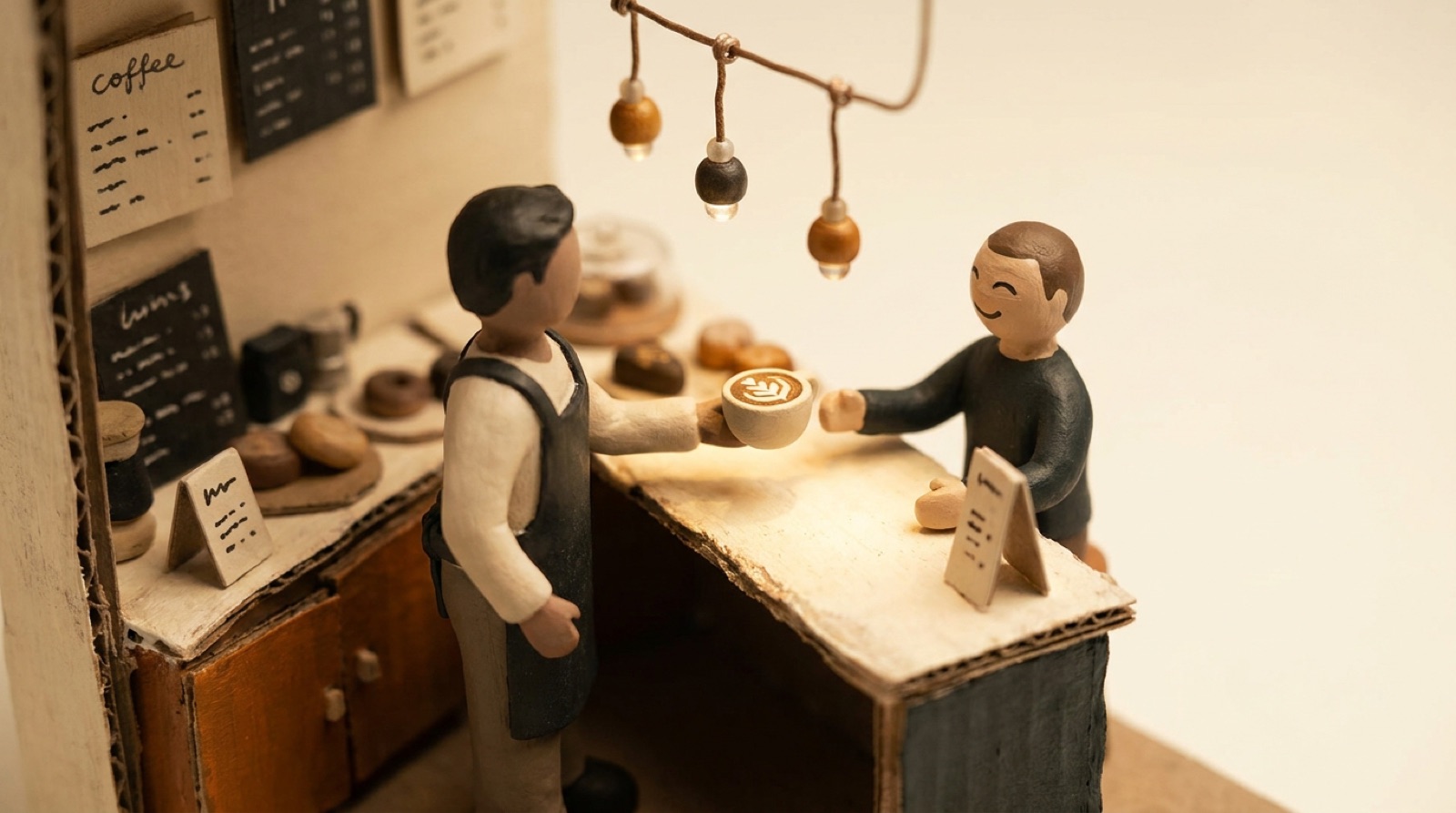
Starbucks is a $110 billion coffee chain. It generates millions of social media engagements every year and keeps customers coming back without needing to discount. The reason is not luck or a massive ad spend. It is psychology, applied consistently, across every touchpoint of the customer experience.
Top-tier restaurant groups spend millions on human psychologists and consultants to figure this stuff out. You do not have to. Here are the five tactics Starbucks uses, broken down so you can apply them in your shop this week.
What Is the Decoy Effect, and How Does Starbucks Use It?
Starbucks offers three drink sizes: tall, grande, and venti. That is not an accident.
When you give a customer two options, they compare them directly. Price versus size, simple math, easy decision. When you add a third option, the comparison becomes much harder. Instead of calculating value, the brain shifts to feeling. It looks for the option that seems like the best deal relative to the others, not the option that matches what the customer actually needs.
In practice, spending one extra dollar to get double the coffee feels like an obvious win. That feeling pushes customers toward the middle or larger size almost every time. It is why the Starbucks barista always asks if you want a grande. It is also why McDonald’s uses the same structure for drinks and nuggets, and why Netflix and Apple use it for subscription tiers.
The opportunity for your shop is straightforward. If you currently offer two sizes, add a third. Make the third option priced slightly higher. Your customers will gravitate to the middle option because it feels like the smart choice. You did not push them there. Psychology did.
How Does the Cheerleader Effect Apply to Food and Drink Menus?
Ask yourself this: what looks more appealing, a lonely cup of coffee, or that same cup of coffee photographed beside a muffin? A burger on its own, or a burger with fries and a drink?
If you picked the combo, you just experienced the cheerleader effect, also called the group attractiveness effect. Individual items look more attractive when presented in groups. The eye stops focusing on the characteristics of the single item and starts responding to the feeling of the whole scene.
Starbucks builds most of its visual marketing around this principle. Items appear together, not in isolation.
Here is how you apply it. If you sell beverages, photograph them in groups of three rather than one at a time. If you sell meals, show the full spread: the main dish, the side, the drink. This lifts the perceived value of every item in the frame without changing the item itself. You are not lying about what you sell. You are presenting it in the context that makes it look its best.
Why Doesn’t Starbucks Put a Dollar Sign on Its Prices?
Look at a Starbucks menu board. You will see numbers. You will not see a dollar sign next to them.
This is the cashless effect. Research shows that when there is no physical reminder of money, people are more willing to spend. One study found that simply removing the dollar sign from a menu increased sales by more than 8%. Eight percent in additional revenue, from a typography change.
The cashless effect is also why Starbucks pushes hard for you to use their app. Paying through an app, earning stars, redeeming rewards: none of it feels like spending real money. The friction of handing over cash is gone. Spending goes up.
The action for your business is simple. Pull the dollar sign off your menu. Keep the numbers. Watch whether average spend changes over the following month. It costs nothing and the research says it works.
What Is Charm Pricing, and Why Does Starbucks End Prices in 5 Instead of 9?
You have heard of charm pricing: prices that end in 9 or 99. The brain reads $2.99 as two dollars, not three. That snap judgment happens before any conscious thought kicks in.
McDonald’s leans into the classic version, ending prices in 9 and 99 cents. Starbucks does something different. Their prices end in 5: $4.95, $5.45, $6.65. That is a deliberate choice tied to brand positioning.
Prices ending in 99 are associated with low-cost, discount brands. Prices ending in 5 signal higher quality. Starbucks is selling a premium product and a premium experience. Ending in 99 would undercut that positioning even if the customer never consciously noticed it.
Look at your own menu. If your prices end in 99, consider shifting them to 95. You keep the psychological benefit of not hitting a round number, and you move away from the discount-brand signal. It is a small change with a real impact on how customers perceive your quality.
How Does the Endowment Effect Keep Starbucks Customers Coming Back?
Here is a simple truth: people value things they own more than things they do not. A phone worth $500 on the open market feels worth $1,000 to the person who owns it. That is the endowment effect.
Starbucks exploits this in two ways that are both replicable for any small shop.
First, they write your name on the cup. That cup now belongs to you before you have even taken a sip. Psychologically, you value it more. You are more satisfied with it. And when a barista misspells your name or adds a funny drawing, there is a good chance you photograph it and post it. The hashtag #StarbucksNameFails has generated thousands of shares of free advertising for Starbucks. Whether that misspelling is accidental or a trained tactic is an open question, but the result is the same either way: customers do the marketing for free.
Second, Starbucks lets you customize your drink any way you want. When you build your own order, that drink becomes your drink. Your secret menu item. You bring friends to show them your spot. You come back because you feel like a regular, not a random customer. That sense of ownership and belonging is what turns a one-time buyer into someone who shows up every week.
For your shop, write the customer’s name on the order. Put a little personality into it. Let customers modify their order. Create the feeling that this is their place. That is not a trick. That is hospitality done right, and it is exactly what keeps a small shop full of regulars.
The Bottom Line
These five tactics cost you almost nothing to implement. Remove the dollar sign. Add a third pricing tier. Show your products in groups. End your prices in 5. Write your customer’s name down and let them make the order their own. Starbucks built a $110 billion business using psychology that is available to every food operator, regardless of size. The operators who pay attention to how customers feel inside their shop, not just what they serve, are the ones who build something that lasts. As I always say: people forget what you sell, but they never forget how your place made them feel.
Watch the full video
Source — YouTube · the full breakdown, free
Tool — free · not sponsored, I built it
Want your exact numbers for a coffee shop? The free calculator runs your cost to open, the ×1.4 cash reserve, and your break-even in about 30 seconds. Prefer paper? The Startup Budget Worksheet is the printable version.
Run your numbers →Questions owners actually ask
Do whole-number prices like $7 signal even more quality and exclusivity than prices ending in 5?
Prices ending in 5 signal a premium brand, which is why Starbucks uses them instead of 99-cent endings. Whole-number pricing takes that a step further and is common in high-end or luxury food and beverage settings where the message is that the experience is above any conversation about cents. It can work for an upscale concept. The key is that your price format needs to match the rest of your brand signals, your space, your plating, your service. If everything else says premium, a whole-number price reinforces that.
Won't removing the dollar sign from the menu look like we're being secretive about pricing?
The dollar sign removal is about reducing the psychological sting of spending, not hiding prices. The numbers are still visible and clear. Starbucks does this openly on its menu boards worldwide and customers have no confusion about what things cost. Transparency is about whether the price is findable and honest, not about whether a currency symbol appears next to it. Keep your prices readable and fair, and your customers will have no issue.
I understand why businesses love gift cards, but why do customers buy them when they often end up spending more than the card's value?
The endowment effect explains a big part of this. Once a customer has a gift card, the balance feels like found money rather than their own cash. That feeling reduces the pain of spending it, which is the same cashless effect Starbucks uses with its app. The gift card also creates a sense of belonging to the brand. From a pure math standpoint you are right that customers often spend more than the card's value to clear the balance, which is exactly why businesses push them. But for the buyer, the experience of giving a gift card feels easier and more personal than handing over cash, and that emotional value is real even if the financial math favors the business.
If 99-cent pricing signals cheap, why does Apple use it for apps and songs?
Apple uses 99-cent pricing in its App Store and iTunes marketplace, which is a mass-market, high-volume, low-price environment. In that context the 99-cent signal works because the product literally is low-cost and accessible. Apple's hardware, the iPhone and Mac lineup, does not use 99-cent endings the same way. The principle is about matching price format to brand positioning. A $999 laptop is positioned very differently from a 99-cent app, even if both come from the same company.
Should cafes and bakeries selling cakes or donuts also use the three-size decoy approach?
The decoy effect works for any product where you can create size or quantity tiers. For cakes and donuts, that could mean a single piece, a half-dozen, and a full dozen, or a small slice, a regular slice, and a large slice with a side. The middle option becomes the most attractive because it feels like the best relative value. Photography also matters here: showing those three options together triggers the cheerleader effect at the same time, making the whole display more appealing than a single product shot would.
Do these tactics still work in a slower or developing economy where customers are very price-sensitive?
The psychology behind these tactics is human, not economic. The decoy effect, the cashless effect, and the endowment effect operate on how brains process decisions regardless of income level. In a price-sensitive market the tactics become even more important because the margin for error on perceived value is smaller. Removing the dollar sign, creating a sense of ownership through names and customization, and presenting items in appealing groups all increase perceived value without requiring you to lower prices. The cheerleader effect in particular costs nothing: it is about how you photograph and display what you already sell.
The Weekly Receipt
One brand story, one number, one answered question. 2 minutes, Tuesdays.
Free. Unsubscribe anytime, one click, no games.
You're in, friend. See you Tuesday.
Keep going: coffee shop guides
How Much Does It Cost to Open a Coffee Shop in 2026?
The real 2026 cost to open a coffee shop: $457,000 all-in, $640,000 cash before you sign, and the daily break-
8 Steps to Building a Profitable Coffee Shop Business
Wilson K Lee breaks down the 8 essential steps to start and run a profitable coffee shop, from knowing your cu
Why a Market Downturn Is the Best Time to Open a Restaurant or Cafe
Four concrete strategic advantages that make opening a restaurant during an economic downturn smarter than wai
How to Get Cafe Customers Without Discounts: 4 Modern Marketing Strategies
Stop cutting prices to fill seats. These 4 cafe marketing strategies build real customer loyalty and increase
How One Coffee Shop Owner Paid Rent in 24 Hours During COVID-19 Lockdown
Narrative Coffee's Max pivoted to half-gallon lattes during COVID-19 lockdown and covered rent and salary in t
How a Former Disney Manager Built a Multi-Location Coffee Shop From Scratch
Andrea went from Disney World hospitality to sleeping under her espresso machine to running two Rhode Island c
How to Calculate Food Cost Percentage (and Actually Use It to Make More Money)
Learn how to calculate food cost percentage, the difference between ideal and actual food cost, and how to use
How to Open a Cafe in 2026: An 8-Step Playbook to Avoid the 80% Failure Rate
Wilson K Lee's modern 8-step playbook for opening a profitable cafe in 2026, using audience-building, AI tools