Coffee shop · Guide Updated September 2026
Why Busy Coffee & Boba Shops Still Go Broke: The Real Unit Economics
A busy shop and a profitable shop are two different things. If you don't know your prime cost, your AOV, and your burn rate, a full line can be hiding a business that's bleeding cash. Coffee and boba are volume games with thin tickets, so a crowd that looks great on Instagram can still lose to rent and labor. Check your three numbers before you touch marketing.
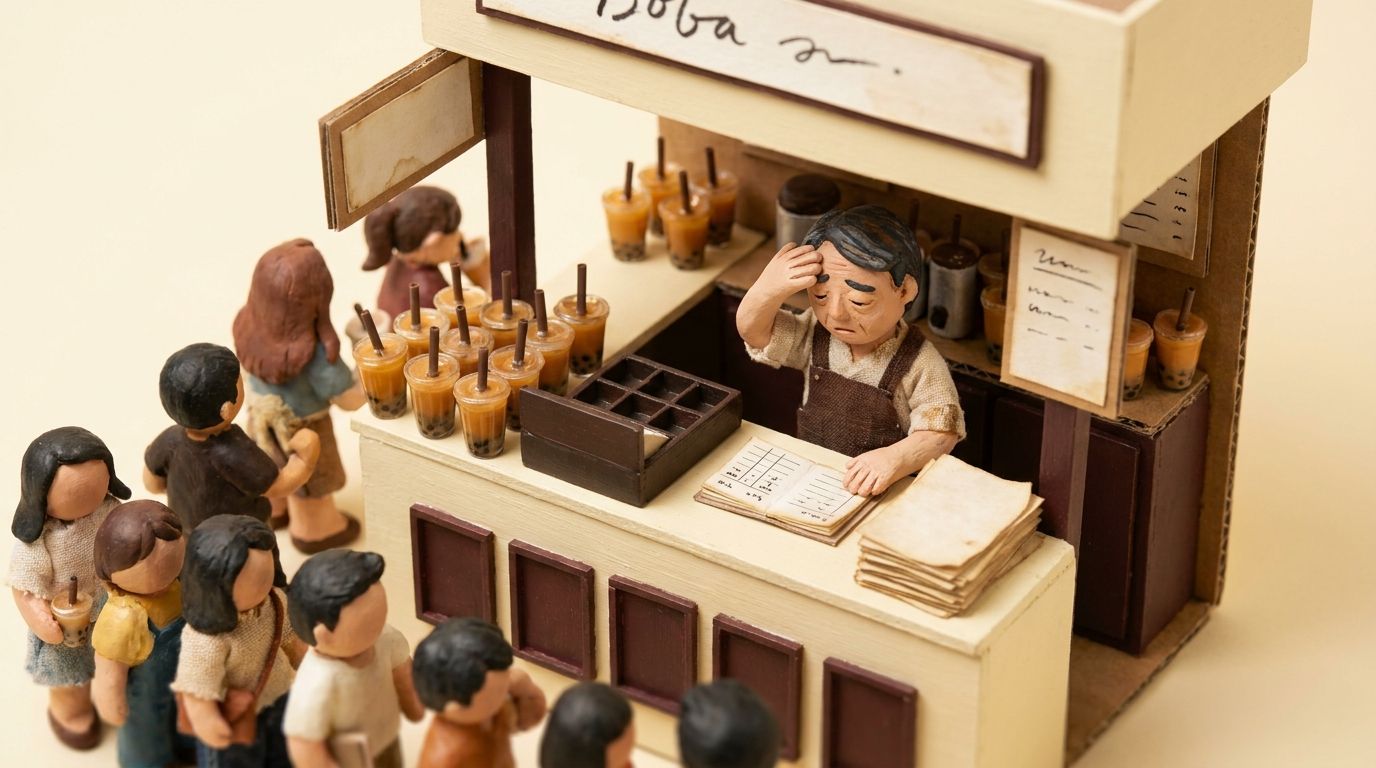
Busy is a vibe. Profitable is a number.
I lived this one myself. At 720 Sweets, I’d watch ice cream and bubble tea fly out the window on a Saturday, line out the door, staff sweating, register ringing nonstop. Felt amazing. Then I’d check the bank account that same week and see a thousand dollars, two thousand dollars, sometimes negative. I was making money on paper and going broke in real life.
That gap is the whole story behind this question. A busy shop tells you people showed up. It tells you nothing about whether you kept any of their money after rent, wages, and cost of goods took their cut. Restaurant and cafe margins run 3 to 5 percent in a good year. That means for every hundred dollars that rings through your till, three to five dollars is actually yours. A crowded room can still leave you with almost nothing, because the crowd was never the problem you needed to solve.
Know your three numbers, or you’re flying blind
There are three numbers every operator has to know cold. If you can’t say all three out loud right now, you’re flying blind, no matter how long the line is.
First is AOV, average order value, meaning how much the typical customer spends per visit. Second is prime cost, a simple 25/25/25 rule of thumb: 25 percent of revenue to cost of goods (the coffee, milk, boba pearls, cups), 25 percent to labor, 25 percent to rent and overhead. Third is burn rate, what you’re paying out of pocket every month even if you sold zero drinks that day, rent, insurance, loan payments, the stuff that doesn’t stop.
When an operator tells me sales look great, I don’t ask about traffic. I ask for one of these three numbers. Nine times out of ten they can’t give it to me. That’s the actual problem, not the marketing, not the location, not the weather. You cannot manage what you don’t measure, and revenue is not the same thing as profitability.
Coffee and boba are volume games, not ticket games
Here’s the part that trips up a lot of busy shops. Coffee and boba are low-ticket businesses. You’re selling an $7 to $8 item, not a $35 dinner. That means the whole business model depends on volume, real volume, not just a rush hour that looks packed on camera.
A coffee shop opening in 2026 needs roughly $457,000 to get the doors open and needs to sell around 84 drinks a day at an $8 ticket just to break even. A boba shop needs about $374,000 to open and needs around 87 drinks a day at a $7 ticket to break even. Those aren’t scary numbers, they’re just the math of a low-ticket business. But they explain why a shop can look busy and still miss break-even. If your rush hour gives you 84 drinks but your slow hours only add another 20, you’re short. A line at 8am doesn’t cover a dead 2pm.
This is also why location isn’t a nice-to-have for this category, it’s the whole game. With a low-ticket item, you need heavy foot traffic just to hit the volume that pays for rent and labor. A great product in a quiet location will look busy on your best day and still lose money on your average day.
Prime cost is where the money actually disappears
Go back to that 25/25/25 rule. If your cost of goods is running at 32 percent instead of 25, that’s 7 points of every sale gone before you even get to labor and rent. Multiply that across a busy day and you understand why a full house doesn’t translate to a full bank account.
Most shops that are busy and broke have prime cost creeping past 75 percent combined without anyone catching it, because nobody’s tracking the three numbers separately. Milk waste, syrup over-pour, boba pearls tossed at close, an extra body scheduled on a shift that didn’t need it. None of it looks dramatic day to day. All of it adds up to the gap between a full register and an empty account.
The menu is probably part of it too
The fewer things you sell, the better you can sell them. A long menu means more ingredients, more waste, slower service during your rush, and a kitchen or bar that can’t hit the throughput a busy shop actually needs. In-N-Out runs four items and outsells a McDonald’s roughly two to one per store. That’s not an accident, that’s what happens when you engineer a small menu hard instead of adding options to chase everyone.
Before you spend another dollar on marketing to bring in more traffic, look at what’s actually on your menu and whether every drink is pulling its weight. A tight menu with a smart bundle, say a drink plus a snack, can push AOV up without you needing a single new customer walking through the door. That’s often a faster fix than more foot traffic you can’t yet serve profitably.
Check the trend before you panic
One more thing. If you’re busy but the money’s still not there, look at your repeat customer rate week over week, not the total traffic number. A shop can be busy with new faces every week while regulars quietly stop coming back, and total volume can hide that for months. The P&L lags 30 to 60 days behind reality. Repeat rate moves first. A busy shop with a falling repeat rate isn’t a marketing problem, it’s a signal that something about the product or experience isn’t earning the second visit, and no amount of foot traffic fixes that on its own.
Tool — free · not sponsored, I built it
Want your exact numbers for a coffee shop? The free calculator runs your cost to open, the ×1.4 cash reserve, and your break-even in about 30 seconds. Prefer paper? The Startup Budget Worksheet is the printable version.
Run your numbers →Questions owners actually ask
My coffee shop has a line every morning, why am I still not profitable?
A morning rush doesn't cover a full day of rent and labor on its own. Coffee and boba are low-ticket, volume-driven businesses, so you need enough traffic across the whole day, not just the rush, to clear break-even. Check your prime cost too. If cost of goods and labor are running above the 25/25/25 rule of thumb, a busy line can still lose money.
What are the three numbers I need to know to figure out why I'm not profitable?
AOV (average order value), prime cost (the 25% COGS, 25% labor, 25% rent rule of thumb), and burn rate (what you pay out monthly at zero sales). If you can't say all three right now, that's the first problem to fix, before touching marketing or menu.
Is it a marketing problem if my shop looks busy but isn't making money?
Usually not. Check your repeat customer rate week over week first. If it's flat or rising, the issue is likely cost structure, not customer count. If it's falling, more marketing won't fix it, the product or experience needs attention.
Should I cut my menu if I'm busy but not profitable?
Yes, look there before you spend on ads. A smaller menu means less waste, faster service during your rush, and easier cross-utilization of ingredients. A tight menu with a good bundle can also raise your average order value without needing a single new customer.
The Weekly Receipt
One brand story, one number, one answered question. 2 minutes, Tuesdays.
Free. Unsubscribe anytime, one click, no games.
You're in, friend. See you Tuesday.
Keep going: coffee shop guides
How Much Does It Cost to Open a Coffee Shop in 2026?
The real 2026 cost to open a coffee shop: $457,000 all-in, $640,000 cash before you sign, and the daily break-
8 Steps to Building a Profitable Coffee Shop Business
Wilson K Lee breaks down the 8 essential steps to start and run a profitable coffee shop, from knowing your cu
Why a Market Downturn Is the Best Time to Open a Restaurant or Cafe
Four concrete strategic advantages that make opening a restaurant during an economic downturn smarter than wai
How to Get Cafe Customers Without Discounts: 4 Modern Marketing Strategies
Stop cutting prices to fill seats. These 4 cafe marketing strategies build real customer loyalty and increase
How One Coffee Shop Owner Paid Rent in 24 Hours During COVID-19 Lockdown
Narrative Coffee's Max pivoted to half-gallon lattes during COVID-19 lockdown and covered rent and salary in t
How a Former Disney Manager Built a Multi-Location Coffee Shop From Scratch
Andrea went from Disney World hospitality to sleeping under her espresso machine to running two Rhode Island c
How Grounds & Hounds Built a $1.2M Online Coffee Business with a Mission-Driven Brand
Wilson K Lee breaks down how Grounds & Hounds went from $100K to $1.2M in revenue selling coffee online by bui
How to Calculate Food Cost Percentage (and Actually Use It to Make More Money)
Learn how to calculate food cost percentage, the difference between ideal and actual food cost, and how to use