Cloud kitchen · Guide Updated August 2026
Cloud Kitchens Explained: What They Are, Pros & Cons
Cloud kitchens, also called ghost kitchens or virtual kitchens, are restaurants with no physical storefront. You operate out of a shared commercial kitchen and deliver exclusively through third-party apps like Uber Eats or Grubhub. Startup costs are substantially lower than a traditional brick-and-mortar restaurant, making cloud kitchens the fastest legal path from recipe to paying customers.
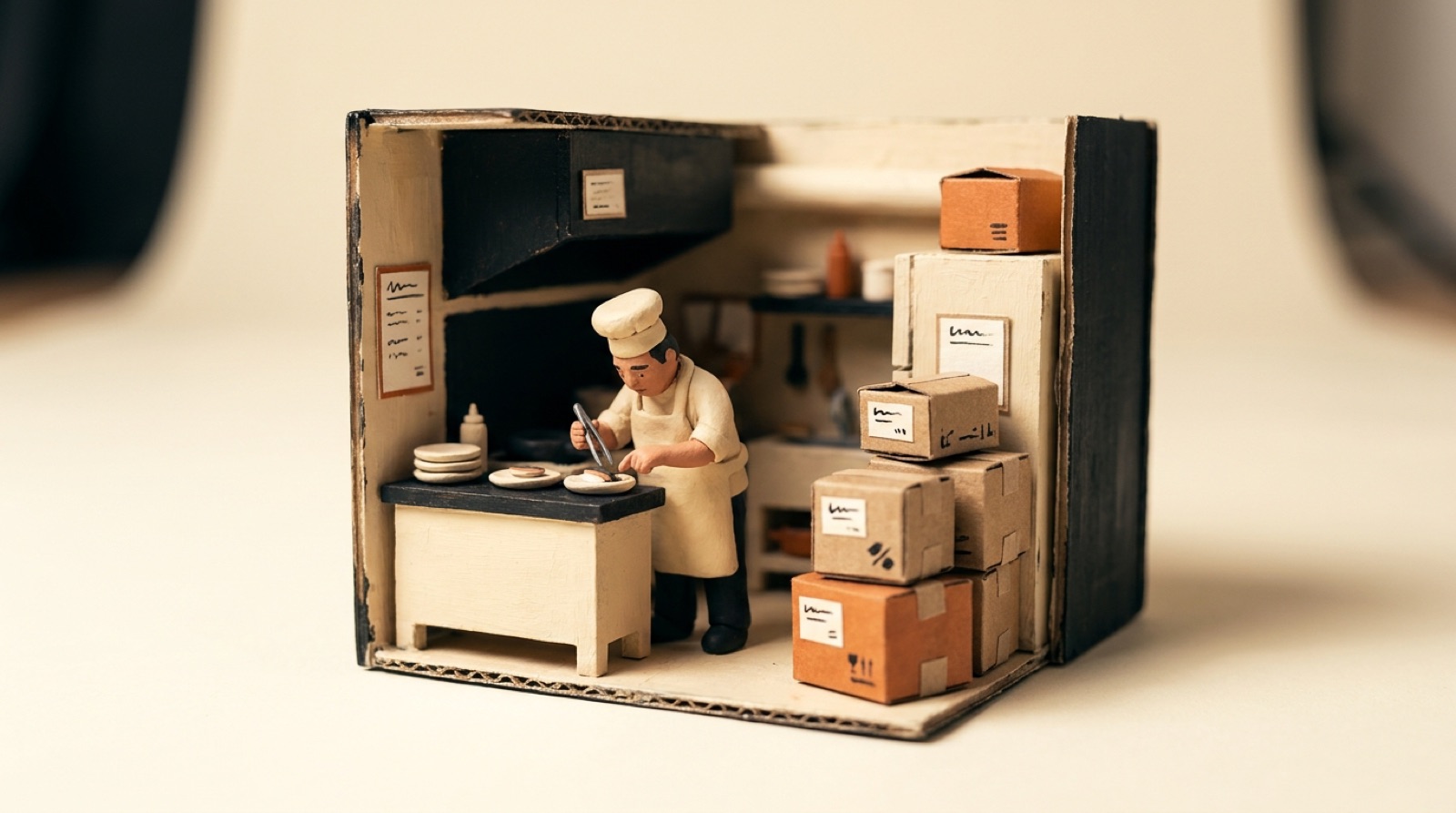
A cloud kitchen is a restaurant with no physical storefront. You rent space inside a commercial, centralized kitchen, produce your food, and distribute it entirely through third-party delivery apps like Uber Eats, Grubhub, or Postmates. Customers never visit you. They order through an app, and a driver brings it to them.
That single structural difference, no storefront, changes almost every cost and risk calculation in your business.
Why Is This Model Growing So Fast?
The food delivery industry was already on track to surpass $70 billion, and the capital pouring into the space confirms it is not a fad. The former CEO of Uber raised more than $400 million into his own cloud kitchen company. When operators and investors at that level are moving in the same direction, the underlying demand is real.
The reason the model works comes down to focus. A cloud kitchen strips out everything that is not food production and delivery. No dining room. No host stand. No walk-in traffic. Your only job is to produce good food consistently and get it out the door.
What Are the Real Pros of Running a Cloud Kitchen?
Lower startup cost. You do not buy your own equipment. You do not sign a five- or ten-year lease and then spend months renovating. You do not wait out the licensing and regulatory process before earning your first dollar. As of 2026, opening a cloud kitchen runs around $208,000, with a planning range of $156,000 to $260,000. That is still real money, but it is a fraction of what a full-scale brick-and-mortar restaurant costs.
Faster launch. You sign a lease for one to two years inside an existing facility, and you are ready to operate. The infrastructure, the equipment, the health certifications for the space, those are already handled.
No front-of-house headaches. You do not hire servers, hosts, or bussers. You do not train customer-facing staff or worry about how a rainy Tuesday is going to kill your floor count. In fact, bad weather drives delivery orders up, not down.
Location flexibility. You are not paying a premium for foot traffic you do not need. A cloud kitchen can sit in an industrial area or a shared facility nowhere near a high-street address, and it does not matter, because your customers find you on an app, not by walking by.
What Are the Real Cons You Need to Know Before You Start?
The apps own your customer. This is the biggest structural problem with the model. The delivery platforms hold the customer relationship, the data, and the loyalty. You do not know who ordered from you last Tuesday. You cannot reach them directly. You cannot build that emotional, community connection that keeps customers coming back for years. In a food business, loyal repeat customers are everything, and this model makes them harder to develop.
You are dependent on one distribution channel. If Uber Eats decides to raise its commission rate, feature a competitor over you, or change its algorithm, your revenue moves with it. You have no bargaining power when the platform is your only sales channel. That is a serious business risk, not a minor inconvenience.
No physical visibility. You cannot catch a walk-by customer. You cannot put up a sign. Your entire marketing effort lives inside the app ecosystem. For some operators that is fine. For others, especially those building a brand with long-term ambitions, it is a genuine limitation.
My strong recommendation: use this model for a defined period, one to two years. Build your customer base, prove your concept, and refine your recipe. Then move into your own brick-and-mortar. At that point you are negotiating with delivery apps from a position of strength. You can tell them you have a restaurant down the street and you do not need them. That is real bargaining power.
What Are the Three Types of Cloud Kitchen?
Type 1: Exclusive delivery-app kitchens. Platforms like Uber Eats and Deliveroo have built their own kitchen facilities. If you operate inside one, you can only use their app. The upside is premium placement, because they want you to succeed so their customers get a better experience. The downside is you miss every customer who orders through Grubhub, Postmates, SkipTheDishes, or any competing platform.
Type 2: Non-exclusive shared kitchens. Operators like Cloud Kitchens and Kitchen United run large commercial facilities where you can partner with any delivery app you choose. You get more market reach. You give up the exclusive preferential treatment from any single platform. This is the more flexible path, and if you are willing to invest in advertising within the apps, you can offset the loss of preferential placement.
Type 3: Mobile cloud kitchens. Think large food trucks that rent out kitchen space closer to residential neighborhoods. The proximity shortens delivery times, which is a genuine advantage. The trade-offs are limited space, a less controlled environment, and a narrower customer reach. The cost is lower, but so is the scale.
There is also a fourth model worth knowing about: pick-up-only ordering, where customers order online and come to collect. Starbucks tested this in New York. I am skeptical it works at scale for most operators, because the whole appeal of ordering online is that someone else brings it to you.
Who Is the Cloud Kitchen Model Actually For?
This model is built for the operator who has a genuinely good recipe and the drive to bring it to market, but does not yet have the capital or experience to run a full-scale restaurant. If you want to share your food with the world and the barrier of equipment costs, long leases, and licensing is what is stopping you, a cloud kitchen removes that barrier.
It is also a smart proving ground. You can test a concept, build a following, and learn your unit economics before committing to a storefront. If the numbers work inside a cloud kitchen, you have real data to take to a landlord or a lender.
As of 2026, your break-even inside a cloud kitchen structure is roughly 20 customers per day at a $22 average ticket. That is an achievable target for a focused operator who takes product quality and app presence seriously.
How Do You Get Customers When Nobody Can See Your Shop?
Your discovery happens entirely inside the delivery apps. That means your menu photos, your item descriptions, your ratings, and your response time are your storefront. Treat them accordingly. Early on, your reviews are your reputation. Every order is a chance to build one or destroy one.
The operators who grow fast in this model are obsessive about product consistency and packaging. A bad delivery experience, food that arrives cold or poorly packed, generates a bad review that follows you inside the algorithm. A great experience generates a repeat order, and repeat orders are the closest thing to loyal customers this model allows.
What If You Want to Open Your Own Cloud Kitchen Facility for Others?
If you want to be the landlord rather than the tenant, you are essentially building a commercial kitchen facility and leasing space to food operators. The considerations flip entirely. You need to think about how many kitchen pods or stations you can fit, shared equipment and maintenance, health department certification for the facility itself, and how you will attract and vet the operators who lease from you. It is a real estate and operations business layered on top of food service infrastructure, and it deserves its own full analysis before you commit capital to it.
The Bottom Line
A cloud kitchen is a legitimate, lower-cost path into the food business, not a shortcut around the hard work of building a brand. Use it to prove your concept, not as your permanent address. The model hands you speed and lower overhead; it takes away your customer relationship and your negotiating power. Go in with both eyes open, set a one-to-two-year runway, and build toward owning your own space when the numbers justify it. The operators who win with this model are the ones who treat it as a launchpad, not a destination.
What Are Cloud Kitchens, In Plain Terms?
Cloud kitchens are restaurants that exist only inside delivery apps. There is no dining room, no sign out front, and no host greeting walk-in guests. You rent a station inside a shared commercial kitchen facility, cook your menu there, and every order arrives through a driver from Uber Eats, Grubhub, Postmates, or a similar platform.
The name changes depending on who you ask. Some people call it a ghost kitchen. Others say virtual kitchen or dark kitchen. All three describe the exact same setup: a kitchen built purely for production and delivery, with zero investment in the customer-facing parts of a normal restaurant.
That single change, dropping the dining room, is what makes the model so cheap and fast to launch compared to a traditional restaurant. It is also what creates its biggest weakness. You never build a direct relationship with the people eating your food, because the app sits between you and them the entire time. Understand that trade-off before you sign a lease inside one of these facilities.
Watch the full video
Source — YouTube · the full breakdown, free
Tool — free · not sponsored, I built it
Want your exact numbers for a cloud kitchen? The free calculator runs your cost to open, the ×1.4 cash reserve, and your break-even in about 30 seconds. Prefer paper? The Startup Budget Worksheet is the printable version.
Run your numbers →Questions owners actually ask
How do I find a cloud kitchen location, and how do I know if there's space for me?
You are looking for shared commercial kitchen facilities, not traditional restaurant spaces. Companies like Cloud Kitchens and Kitchen United operate large facilities designed specifically for delivery-only operators, and you can search for them by city. Delivery app platforms like Uber Eats and Deliveroo also run their own exclusive kitchen facilities. You sign a lease inside one of these existing operations, typically for one to two years, rather than finding and building your own raw space.
Can I use my home kitchen to start a cloud kitchen?
No. Cloud kitchens operate out of certified commercial kitchen facilities. Health departments require commercial certification for any food sold to the public, and the delivery apps require the same. The cloud kitchen model lowers your costs by letting you rent space inside an existing commercial facility rather than building one yourself, but a home kitchen does not meet that standard.
How much does it cost to rent a kitchen station inside a cloud kitchen facility?
Rental rates vary by market, and the source material does not quote a specific per-station figure. As a broader planning benchmark, opening inside a cloud kitchen structure costs around $208,000 as of 2026, with a range of $156,000 to $260,000. You should contact facilities directly in your city for current station pricing, as local market rates differ significantly.
How much do the delivery apps charge operators?
The transcript does not quote a specific commission percentage for platforms like Uber Eats or Grubhub. What it does make clear is that the apps control the pricing and can raise rates without your input, which is why depending entirely on one platform is a serious risk. Research current commission structures directly with each platform before you build your financial model.
Would a cloud kitchen work for a dessert or baking business?
Yes. The model is well suited to any food concept that can be produced in a commercial kitchen and delivered without major quality loss. If you have a proven dessert or baking product and need a licensed commercial space to scale production and reach new customers through delivery apps, a cloud kitchen is a practical fit. The key questions are whether your product travels well and whether the delivery app customer base in your area overlaps with your target customer.
How do you get your first customers when no one can physically see your kitchen?
Your entire customer discovery happens inside the delivery apps. Your menu photos, item descriptions, ratings, and response time function as your storefront. Early reviews carry heavy weight in app algorithms, so every order is a reputation-building opportunity. Consistent product quality and careful packaging are the two factors most within your control when you are starting from zero visibility.
Is a cloud kitchen a good long-term business model, or should I plan to move on?
Wilson's direct recommendation is to use the cloud kitchen as a launchpad for one to two years, not as a permanent business structure. In that window, you prove your concept, build a customer base, and generate the financial data you need. After that, moving into your own brick-and-mortar gives you a real customer relationship, physical visibility, and meaningful bargaining power with the delivery platforms you were previously dependent on.
What is a cloud kitchen exactly?
A cloud kitchen is a restaurant with no physical storefront. You rent space inside a shared commercial kitchen, cook your food there, and send it out entirely through delivery apps like Uber Eats, Grubhub, or Postmates. Customers never see your kitchen, they only interact with your listing inside the app.
Are cloud kitchens and ghost kitchens the same thing?
Yes. Cloud kitchen, ghost kitchen, and virtual kitchen all describe the same model, a delivery-only restaurant that operates without a dining room or storefront. Whichever name you use, the structure is identical: no walk-in customers, no front-of-house staff, and revenue built entirely through third-party delivery platforms.
The Weekly Receipt
One brand story, one number, one answered question. 2 minutes, Tuesdays.
Free. Unsubscribe anytime, one click, no games.
You're in, friend. See you Tuesday.
Keep going: cloud kitchen guides
Cloud Kitchen Cost in 2026: The Full Breakdown
See the real 2026 cloud kitchen cost, $208,000 line-by-line, the cash you need before signing, and break-even
How a Tech Sales Guy Built a Profitable Automated Cloud Kitchen With Zero Food Experience
A tech sales professional built an automated mozzarella stick ghost kitchen business in NYC, hitting $3,800/mo
4 Benefits of Running Multiple Brands in One Cloud Kitchen
Running multiple brands from one cloud kitchen cuts costs, widens your audience, and lets you test new concept
Why Chicken Wings Are the Best Food Item for a Ghost Kitchen
Chicken wings offer proven demand, 60 to 70% margins, and major brand validation. Here's why they're the top f
6 Cloud Kitchen Business Models Every F&B Operator Should Know
A plain-English breakdown of the six cloud kitchen business models, from independent single-brand to hub-and-s
Cloud Kitchen Business Plan Report: 10 Must-Have Parts
How to write a cloud kitchen business plan report covering all 10 components investors expect, from concept to
7 Cloud Kitchen Marketing Channels You Must Master to Drive Sales
Wilson K Lee breaks down the 7 essential marketing channels every ghost kitchen operator must own, from Instag
5 Cloud Kitchen Mistakes That Will Bankrupt Your Business
Wilson K Lee breaks down the 5 most common cloud kitchen mistakes that kill ghost kitchen businesses, and exac